
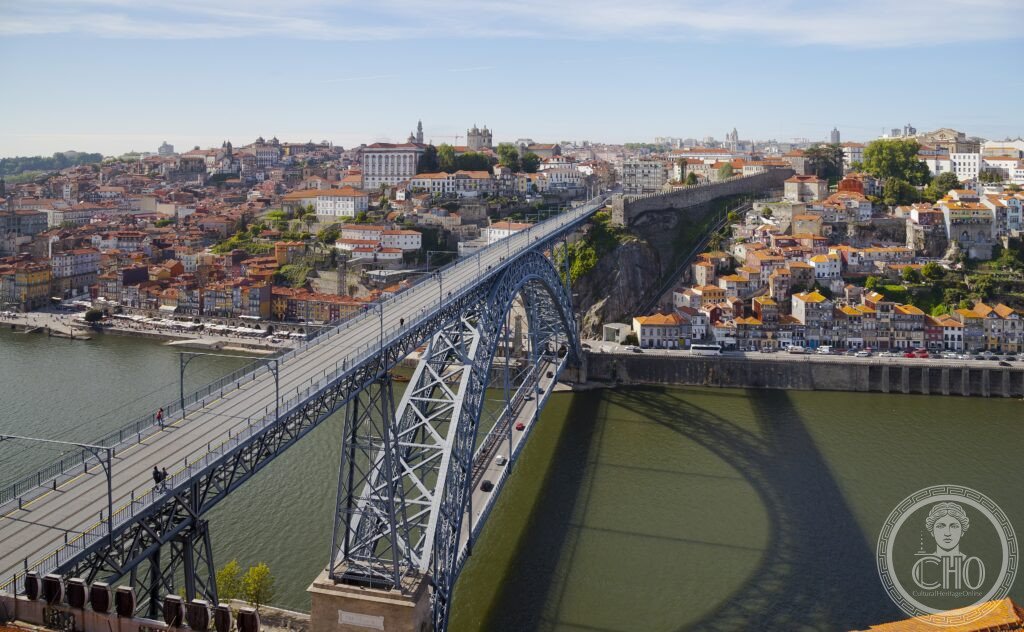
The city that named a country and a wine. Porto (Portus Cale, the “harbour on the Cale River” from which “Portugal” derives) grew on the granite hills above the Douro River estuary into the second largest city of Portugal and one of the most visually dramatic historic cityscapes in Europe, with its medieval riverside quarter (Ribeira), its extraordinary azulejo-tiled church façades, and the Luís I Bridge framing the view across the Douro to the Port wine lodges of Vila Nova de Gaia in a composition that has no parallel in European urban scenery.
At a glance
Porto (population approximately 240,000; metropolitan area 1.7 million) is the capital of the Norte Region of Portugal, on the north bank of the Douro River at a point approximately 5 km from its Atlantic mouth, at an altitude that varies from sea level in the Ribeira to approximately 90 metres at the highest points of the historic centre. Porto is the oldest continuously inhabited large city in the Iberian Peninsula, with Paleolithic, Iron Age, and Roman settlement layers. UNESCO inscribed the Historic Centre of Porto, Luís I Bridge and Monastery of Serra do Pilar in 1996. The city gave its name to the whole country of Portugal (“terra Portucalense” — the land of Porto and Cale) and to Port wine (Vinho do Porto), the fortified wine produced in the Douro Valley and aged in Vila Nova de Gaia.
Key facts
- Luís I Bridge (Ponte Dom Luís I, 1886): Porto’s defining monument and one of the great iron bridges of the 19th century. Designed by Théophile Seyrig (the Belgian engineer who had previously worked with Gustave Eiffel on the Maria Pia Railway Bridge, still visible 3 km upstream, and on the Eiffel Tower itself) and built between 1881 and 1886. The bridge spans 172 metres between its piers, with an upper deck at 45 metres above the Douro and a lower deck at 9 metres. The upper deck was originally for carriages and is now used by the metro (Line D, the elevated urban railway that crosses the bridge providing the most scenic urban metro ride in Europe) and pedestrians. The lower deck carries road traffic and pedestrians. The bridge connects the Ribeira (Porto lower town) directly to Vila Nova de Gaia (the wine lodge district).
- Sé do Porto (Cathedral, 12th century): the oldest and most austere monument in Porto and the city’s spiritual heart. Begun in the late 12th century (the main nave and twin towers are Romanesque, approximately 1110–1200; the choir is Gothic, 14th century; the cloister is covered in 18th-century azulejo tile panels by the master tile painter António Vital Rifarto depicting the Life of the Virgin and scenes from Ovid’s Metamorphoses). The Sé is built on the highest point of the granite hill above the Ribeira (the cathedral terrace is the best panoramic viewpoint in the city). The Baroque chapel of the Holy Sacrament inside the cathedral is renowned for its solid silver altar (covered in painted wood during the Napoleonic Wars to prevent looting).
- Igreja de São Francisco (Church of Saint Francis, 14th–18th century): the most opulent Baroque interior in Portugal and one of the greatest examples of Portuguese Baroque woodwork in the world. The original Gothic church (begun 1383) was entirely redecorated between 1718 and 1754 with approximately 400 kg of gilded carved wood (talha dourada) covering every surface of the nave. Columns, pilasters, ceiling, altars, choir stalls. In a continuous profusion of vine scrolls, cherubs, and acanthus leaves so dense that the stone beneath is entirely invisible. The decoration was executed in the style of the National Portuguese Baroque (Joanino Baroque) by the carpenters and gilders of the school of Porto. Adjacent to the church is the Palácio da Bolsa (Stock Exchange Palace, 1842–1910) with the extraordinary Moorish Revival Arab Hall (the most elaborate Moorish Revival interior in the Iberian Peninsula, with its horseshoe arches and plasterwork copied from the Alhambra).
- Livraria Lello (1906): consistently voted one of the most beautiful bookshops in the world and one of the most visited buildings in Porto (entrance ticket now required due to tourist volumes). Built in 1906 by the architect Xavier Esteves in a style that blends Neo-Gothic and Art Nouveau, with a double staircase in deep red carved wood spiralling up to the balcony level, a stained glass skylight with the motto “Decus in Labore” (“Dignity in work”), and richly decorated wooden shelves that predated its fame as a bookshop by a century. Joanne K. Rowling taught English in Porto from 1991 to 1993 and is said to have visited Lello frequently, finding in its atmosphere some of the inspiration for the Hogwarts library. The bookshop sells principally Portuguese-language literature and maintains an active literary events programme.
- Azulejos of Porto: the distinctive Portuguese ceramic tile tradition reaches its most extraordinary expression in Porto, where entire church and palace façades are clad in blue-and-white (or polychrome) ceramic tile panels. The tradition of architectural azulejo (from the Arabic az-zulayj, “polished stone”) in Portugal dates to the 15th century (initially imported from Seville, then Spain), was nationalised and developed in the 17th–18th centuries, and reached its apogee in the 20th century. The most striking Porto examples: the São Bento Railway Station (azulejo panels by Jorge Colaço, 1930, depicting scenes of Portuguese history in blue-and-white, covering the entire concourse in approximately 20,000 tiles — one of the great public art works of the 20th century), the façade of the Carmo Church (entirely clad in a vast azulejo panel of 1912), and the façade of the Chapel of the Souls (Capelas das Almas, 1929, the largest azulejo panel in Porto with approximately 15,947 tiles).
- Heritage: UNESCO World Heritage Site, Historic Centre of Porto, Luís I Bridge and Monastery of Serra do Pilar, inscribed 1996.
- GPS: 41.1579° N, 8.6291° W.
History
The Latin name Portus Cale (harbour of the Cale, a Celtic tribe) refers to the Roman town on the hill where the Sé now stands. The Visigoths and then the Moors controlled the site until the Christian reconquest (the city changed hands between Muslim and Christian forces multiple times between the 8th and 11th centuries). The County of Portugal was created by Alfonso VI of León in 1096 as a fief for his son-in-law Henry of Burgundy, named after Portus Cale. The city was the base from which Henry’s son (Afonso Henriques, the first King of Portugal, 1139–1185) launched the creation of the independent Kingdom of Portugal. Porto was thus the cradle city of Portugal.
The city’s importance grew with the Portuguese Age of Exploration (15th–16th century): Porto supplied ships and provisions for Henry the Navigator’s expeditions along the African coast (the city’s butchers donated all the meat from their slaughtered cattle to the fleet, keeping only the offal — hence Porto people are called “tripeiros”, “tripe eaters”, with the dish tripas à moda do Porto as the city’s emblematic recipe). The Port wine trade with England (guaranteed by the Methuen Treaty of 1703) made the merchants of the English Factory in Porto wealthy enough to build the English Factory House (1785 — still a private members’ club for British wine merchants on the Rua do Infante Dom Henrique) and finance much of the 18th-century Baroque building that defines the historic centre today.
What you see
The historic centre is most easily navigated on foot, though the hills are steep. Standard circuit from the Sé hill: Sé Cathedral and terrace (panoramic view). Torre dos Clérigos (Baroque tower by Nicolau Nasoni, 1763, the tallest tower in Portugal at 75.6 m, 225 steps to the top for a 360° panorama). Livraria Lello (entrance ticket required, queue at opening). Igreja de São Francisco and the Palácio da Bolsa/Arab Hall (guided tour required for the Arab Hall, depart every 30 min). Ribeira waterfront (the medieval quayside, Cais da Ribeira, with its outdoor restaurants and the Douro view toward the bridges). Cross the Luís I Bridge (lower deck) to Vila Nova de Gaia. Tour of a Port wine lodge (Taylor’s, Graham’s, and Ramos Pinto are open for tours and tastings; all three offer views over the Douro toward Porto from their terraces; Taylor’s has the best panoramic terrace).
São Bento Railway Station (the azulejo concourse — arrive before 9am or after 6pm to see the tiles without crowds, and to catch the local Alfa Pendular trains to Lisbon departing from the adjacent Campanhã station) is 10 minutes walk from the Sé. The Serralves Contemporary Art Museum (Álvaro Siza Vieira, 1999 — the finest building by Portugal’s Nobel Prize-winning architect, in the western residential district, 4 km from the historic centre) and its pink Art Deco Villa Serralves (1930s) and park are the most important contemporary art destination in Portugal outside Lisbon.
Practical information
- Admission: Sé Cathedral free (cloister approximately €3). Torre dos Clérigos approximately €8. Livraria Lello €5 (deductible from book purchases). Igreja de São Francisco approximately €5. Palácio da Bolsa approximately €10. Port wine lodge tours approximately €15–25 (including tasting). Serralves Museum approximately €12. Most Port wine lodge tours highly recommended to book in advance (Taylor’s and Graham’s fill up). The Porto Card (24h/48h/72h; approximately €13/20/25) covers public transport and many museum entrances.
- Getting there: Francisco Sá Carneiro Airport (OPO). Direct flights from London (2h, Ryanair/easyJet/TAP), Amsterdam (2.5h, KLM/easyJet), Paris (2h, TAP/easyJet/Transavia), Frankfurt (2.5h, TAP/Ryanair), Madrid (1.5h, Iberia/Vueling). No regular long-haul direct flights (change at Lisbon). The airport is 11 km north of the city centre. Metro Line E (violet) connects the airport to the Aliados/Trindade hub in 30 min (€2.00). Taxi approximately €20–25 (20–30 min). By train from Lisbon Alfa Pendular (2h 45 min, from Campanhã station, approximately €25 in advance — the scenic route along the Douro estuary is standard but the faster IC route via the interior saves 20 min).
- The Douro Valley: the Port wine production region (the demarcated Douro wine region, the oldest demarcated wine region in the world, established 1756 by the Marquis of Pombal) extends 100 km inland along the Douro River from Porto. The Douro Valley (UNESCO WHS 2001) is one of the most spectacular cultivated landscapes in the world, with terraced vineyards carved into granite schist cliffs 500–700 m above the river. The standard wine tourism circuit from Porto: train from Campanhã to Pinhão station (3h, €10, along the Douro riverbank — the most scenic train journey in Portugal) → Quinta do Crasto or Quinta do Vale Meão wine tour → return boat down the Douro (5h, April–October, approximately €80 from Pinhão to Porto). Or drive the N222 road (voted “most scenic road in the world” by Top Gear magazine) along the south bank of the Douro.
Getting there
Francisco Sá Carneiro Airport (OPO): 11 km from centre. Metro E line (30 min). Flights from London (2h), Amsterdam (2.5h), Paris (2h). Train from Lisbon (2h 45min). GPS: 41.1579, -8.6291.
Nearby
- Braga. 55 km north of Porto (45 min by train or bus). The “Rome of Portugal”. The seat of the oldest diocese in the Iberian Peninsula (the archbishopric of Braga was established in 410 AD and has been continuously occupied since; the archbishops of Braga at various times claimed authority over the entire Iberian Peninsula). The Bom Jesus do Monte sanctuary (3 km east of Braga — a Baroque pilgrimage church at the top of a 116-metre hill, reached by a dramatic Baroque staircase of 577 steps with zigzag flights and fountain-chapels representing the Stations of the Cross; UNESCO WHS 2019). The historic centre of Braga itself has Portugal’s finest Baroque architecture after Porto.
- Guimarães. 55 km north-east of Porto (50 min by train). The birthplace of Portugal. Afonso Henriques, the first King of Portugal, was born in the castle of Guimarães (the Castelo de Guimarães, 10th century, UNESCO WHS 2001 jointly with the historic centre) and proclaimed the independence of the County of Portugal here in 1128. The historic centre (UNESCO WHS 2001) is the best-preserved medieval urban fabric in Portugal north of Porto, with the Paço dos Duques de Bragança (15th century, the palace of the Dukes of Bragança, now a national museum) and the Romanesque church of Nossa Senhora da Oliveira. The city’s motto is “Aqui nasceu Portugal” (“Portugal was born here”).
- Viana do Castelo. 75 km north of Porto (1.5h by train). The most elegant small historic city in the Minho region. The Praça da República (16th century, with its Manueline fountain and arcaded loggia) is considered one of the most beautiful squares in Portugal. The Basilica of Santa Luzia (Neo-Byzantine, 1904–1935, by the architect Miguel Ventura Terra, on a hill overlooking the city and the Lima estuary, reached by funicular railway) gives the widest panoramic view in northern Portugal. The traditional Minho folk costume (the black-and-red embroidered dress and gold filigree jewellery of the Viana do Castelo women, worn at the Romaria de Nossa Senhora da Agonia festival in August) is the most elaborate traditional folk dress in Portugal.
Sources
- Wikipedia, Porto. Dom Luís I Bridge. Igreja de São Francisco, Porto. Livraria Lello, accessed June 2026.
- UNESCO, Historic Centre of Porto, Luís I Bridge and Monastery of Serra do Pilar, WHS reference 755, inscribed 1996.
- José Mattoso (ed.), História de Portugal, vol. 3 (A Monarquia Feudal), Estampa, 1993.
- Sarah Bradford, The Story of Port: The Englishman’s Wine, Christie’s Wine Publications, 1983.
Find it on the map
See this place and what’s around it →
📷 Become a Cultural Heritage Online photographer
Share your photos of places: they stay published under your name as the author. The more they're seen, the more you get noticed — and soon a contest will reward the most appreciated photos.
Log in or sign up free to add a photo