
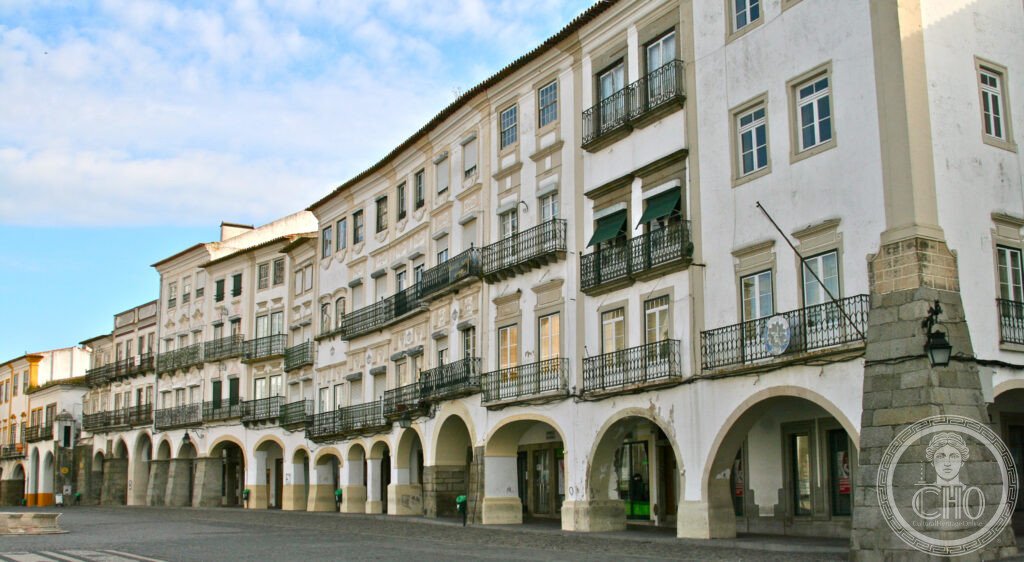
The most completely preserved historic city in Portugal south of the Tagus. Évora (Roman Liberalitas Iulia, “Generosity of Julius”, a municipium from the 1st century AD) is enclosed within 14th-century walls and contains more than two millennia of architectural layers within a single compact hilltop city: a Corinthian Roman temple of the 1st century AD, a Romanesque-Gothic cathedral, a Renaissance royal palace, and an 18th-century aqueduct whose arcade pierces directly through the 16th-century houses of the old town.
At a glance
Évora (population approximately 57,000) is the capital of the Alentejo region (the great wheat-plain of central-southern Portugal) and Portugal’s most important historic city after Lisbon, Porto, and Coimbra. The historic centre is enclosed within nearly complete 14th-century walls (the Fernandine walls, built by King Fernando I between 1373 and 1375) approximately 3.5 km in circumference, with most of the city’s monuments concentrated within a 500-metre radius of the cathedral. UNESCO inscribed the Historic Centre of Évora in 1986. The city was the seat of the University of Évora (founded 1559 by the Jesuits — closed by the Marquis of Pombal when he expelled the Jesuits from Portugal in 1759, refounded 1979) and served as the second capital of Portugal under the Avis dynasty (15th century).
Key facts
- Roman Temple of Évora (1st–2nd century AD): the finest surviving Roman temple in the Iberian Peninsula, built in the 1st or 2nd century AD on the highest point of the Roman town (the acropolis, where the medieval cathedral and the adjacent Évora Museum now stand). 14 Corinthian columns of the peristyle survive (at 9 metres tall, in white Estremoz marble with elaborate capitals), making this one of the best-preserved Roman temple structures north of the Sahara. The temple was long misidentified as a temple of Diana (the “Temple of Diana” is still its popular name, though the actual deity worshipped is uncertain) and was used as a slaughterhouse in the medieval period (which accidentally preserved the columns from demolition for building material by making them too dirty to be desirable). The temple is freely visible at all times from the adjacent square.
- Évora Cathedral (Sé de Évora, begun 1186): the largest medieval cathedral in Portugal and the most architecturally significant Romanesque-Gothic building south of the Tagus. Begun in 1186 under the orders of King Sancho I and largely completed by 1250 in a Transitional Romanesque-Gothic style (the two massive towers flanking the west façade are Romanesque, while the vaulting and choir are Gothic). The cloister (14th century, Gothic, with a panoramic terrace over the Roman temple and the Alentejo plain) and the choir (18th century Baroque, with gilded carved wood) are the most distinctive interior spaces. The cathedral treasury contains the most important medieval ivory statue in Portugal. The “Our Lady of the New Seed” (Nossa Senhora do Ó, 14th century French, depicting a pregnant Virgin Mary with the Christ child visible inside her stomach — one of the rarest iconographic types in Christian art).
- Chapel of Bones (Igreja de São Francisco and the Capelas dos Ossos, 1511): the most disturbing and most visited monument in Évora. The Church of São Francisco (begun 1501, Manueline-Gothic, with the royal coat-of-arms and the armillary sphere of King Manuel I on the façade) contains a side chapel built by Franciscan monks in the 16th century using the bones and skulls of approximately 5,000 people exhumed from the overcrowded local cemeteries. The walls and pillars of the chapel are entirely lined with skulls and femurs (arranged in geometric patterns similar to the Sedlec Ossuary in Czech Republic). The inscription over the entrance reads: “Nós ossos que aqui estamos, pelos vossos esperamos” (“We bones that are here, await yours”). The chapel was built as a meditation on mortality in the Franciscan tradition and was a place of prayer, not a morbid tourist attraction. It functions as both today.
- Silver Aqueduct of the Silver Water (Aqueduto da Prata, 1531–1537): one of the finest surviving Roman-revival aqueducts in Europe and the only major Renaissance aqueduct in Portugal. Built by Francisco de Arruda between 1531 and 1537 to bring water from the Prata (Silver) spring 18 km north of Évora to the medieval city (which had relied on cisterns and wells since the Roman aqueduct fell out of use). The aqueduct enters the city on the northern side through its Moorish-style arcade (the arcades on the northern approach are in a distinctively Islamic horseshoe-arch style, reflecting the Mudéjar influence on Portuguese architecture) and then makes its most remarkable passage through the streets of the old city. The houses built directly up against and over the aqueduct arches in the Rua do Cano (“Street of the Pipe”) create one of the most extraordinary streetscapes in Europe, with residents living inside the aqueduct structure.
- Alentejo food and wine: Évora is the gastronomic capital of the Alentejo. The most distinctive and arguably the finest regional cuisine in Portugal. The essential dishes: açorda alentejana (a thick soup of bread, garlic, olive oil, and coriander, topped with a poached egg — the fundamental peasant dish of the Alentejo). Migas (fried bread with olive oil and garlic, often served with pork). Sopa de cação (dogfish soup with vinegar and bread). The roast suckling pig from Portalegre. Queijo de azeitão (sheep’s cheese). And the Alentejo wines (the Alentejo DOC, centred on the towns of Reguengos de Monsaraz, Borba, Redondo, and Vidigueira, producing some of Portugal’s most internationally recognised red wines from the Aragonez/Tinta Roriz, Trincadeira, and Alicante Bouschet grape varieties).
- Heritage: UNESCO World Heritage Site, Historic Centre of Évora, inscribed 1986.
- GPS: 38.5667° N, 7.9000° W.
History
The hill that Évora occupies was settled by the Celti (a Celtic tribe) before Roman conquest. Julius Caesar may have visited (the town’s Roman name, Liberalitas Iulia, was attributed to Caesar’s generosity in granting it municipal status). The Visigoths controlled the city (409–711) and it became the seat of a bishopric from the 5th century. The Moorish occupation (711–1165) left the characteristic horseshoe-arch detail visible in the Silver Aqueduct. The Christian reconquest of Évora by Gerald the Fearless (Giraldo Sem Pavor, from whom the main square takes its name) in 1165 ended four and a half centuries of Islamic rule and established the city as a key fortress of the nascent Kingdom of Portugal.
Évora reached its greatest importance under the Avis dynasty (1385–1580), when it served as a second royal capital and the Castelo do Évora (no longer standing) was used as a royal residence. King Manuel I (1495–1521, whose reign saw the peak of Portuguese maritime expansion and the distinctive “Manueline” architectural style named after him) chose Évora as his principal residence for much of his reign. Vasco da Gama was in Évora when he received his commission for the first voyage to India (1497) and returned to the city between voyages. The expulsion of the Jesuits by the Marquis of Pombal (1759) closed the university and reduced the city’s importance, effectively freezing its development and preserving its historic fabric.
What you see
The historic centre is extremely compact and entirely walkable from the Cathedral terrace: Cathedral and cloister terrace (panorama over the Roman Temple and the Alentejo plain). Roman Temple (free view from the adjacent square). Évora Museum (in the former Bishop’s palace adjacent to the Cathedral, with Roman mosaics, medieval sculpture, and Flemish paintings including the Flemish polyptych “Life of the Virgin” commissioned by Bishop Afonso de Portugal, c.1500, one of the finest 15th-century Flemish paintings in Portugal). Praça do Giraldo (main square with the arcaded façade and the marble fountain). Igreja de São Francisco and the Chapel of Bones (allow 45 min). Rua do Cano and the Silver Aqueduct (walk north along the aqueduct street through the houses built against its arches).
The Alentejo megaliths: the area around Évora contains the most important Neolithic megalith complex in western Europe (rivalling or surpassing the Carnac complex in Brittany). The Cromeleque dos Almendres (a stone circle of approximately 95 menhirs, the largest megalithic complex in the Iberian Peninsula, 15 km west of Évora — accessible only by car or taxi; best at sunset when the standing stones cast long shadows across the pastureland) and the Anta Grande do Zambujeiro (a large dolmen burial chamber, the largest dolmen in Europe, 15 km south-west of Évora).
Practical information
- Admission: Roman Temple free (visible at all times). Cathedral approximately €4 (cloister extra €2). Chapel of Bones approximately €5. Évora Museum approximately €4. Most streets and the Praça do Giraldo free. The city walls are freely walkable. Aqueduct walk in Rua do Cano is free. The Cromeleque dos Almendres (megaliths, 15 km west) is a signposted rural site with free access. Car or taxi required (approximately €25 return from Évora).
- Getting there: Évora has no airport. Arrivals are typically via Lisbon. Direct train from Lisbon Oriente (2h, Comboios de Portugal Intercidades, approximately €14, departures every 2h). Bus from Lisbon Sete Rios (1h 45 min, Rede Expressos, approximately €12, more frequent). The Évora train and bus station is 800 m south-east of the historic centre (15 min walk uphill or taxi). By car from Lisbon (1h 20 min on the A6 motorway). By car from Porto (3h). Évora is ideally positioned as a base for Alentejo exploration. Monsaraz (walled medieval village, 50 km east), Marvão (mountain castle village, 90 km north-east), and Beja (Roman city of Pax Iulia, 75 km south) are all within day-trip range.
- Monsaraz: 50 km east of Évora (50 min by car) on the Spanish border above the Alqueva Reservoir (the largest artificial lake in western Europe). The completely intact hilltop walled village of Monsaraz (population approximately 800, inside the medieval walls) looks across the reservoir to Spain and contains a Manueline church, a castle tower converted to a bullfighting arena, and the smallest village in the world with an active contemporary art museum (Museu de Arte Sacra de Monsaraz, with medieval religious art and a 14th-century fresco of a judge being tried simultaneously by the just and the corrupt).
Getting there
No airport. Train from Lisbon (2h). Bus from Lisbon (1h 45min). Quiet Alentejo city best explored on foot. GPS: 38.5667, -7.9000.
Nearby
- Estremoz. 45 km north of Évora (40 min by car). The marble capital of Portugal and one of the most photogenic market towns in the Alentejo. The entire historic centre (the upper town, within a 13th-century castle and Italianate clock tower, the Torre das Três Coroas) is built in the distinctive white Estremoz marble from which Roman temples, Portuguese cathedrals, and the azulejo tiles of Porto were all made. The weekly Saturday market (the Feira de Estremoz, one of the largest and most authentic regional markets in Portugal, selling Alentejo pottery, cheese, chouriço, and the distinctive clay figurines of the Estremoz school) is the best rural market experience in Portugal.
- Elvas. 70 km east of Évora on the Spanish border (1h by car). The most formidable fortified city in Portugal and one of the best-preserved Vauban-era military fortification systems in the world. The fortifications of Elvas (UNESCO WHS 2012 as “Garrison Border Town of Elvas and its Fortifications”) include a complete system of star-shaped bastions (1643–1653, designed in the style of Vauban before Vauban) and the Amoreira Aqueduct (the second largest aqueduct in Portugal after the Lisbon Águas Livres, 7.5 km long, with 843 arches on 4 levels, built 1529–1622).
- Lisbon. 130 km west of Évora (1h 20min by car, 2h by train). The capital of Portugal, on the Tagus estuary. While Lisbon is often visited first, the reverse circuit (Lisbon → Évora → Porto → Sintra) makes historical sense for understanding the Portuguese national narrative. The Belém district of Lisbon (Torre de Belém, UNESCO WHS 1983, the Manuelline watchtower from which Portuguese explorers departed; the Mosteiro dos Jerónimos, UNESCO WHS 1983, the greatest Manueline church, burial place of Vasco da Gama) is Lisbon’s most important heritage cluster.
Sources
- Wikipedia, Évora. Roman temple of Évora. Évora Cathedral. Chapel of Bones (Évora), accessed June 2026.
- UNESCO, Historic Centre of Évora, WHS reference 361, inscribed 1986.
- José Mattoso (ed.), A Monarquia Feudal 1096–1480, Estampa, 1993.
- Jorge Rodrigues, Évora: da época romana ao século XXI, Câmara Municipal de Évora, 2012.
Find it on the map
See this place and what’s around it →
📷 Become a Cultural Heritage Online photographer
Share your photos of places: they stay published under your name as the author. The more they're seen, the more you get noticed — and soon a contest will reward the most appreciated photos.
Log in or sign up free to add a photo