

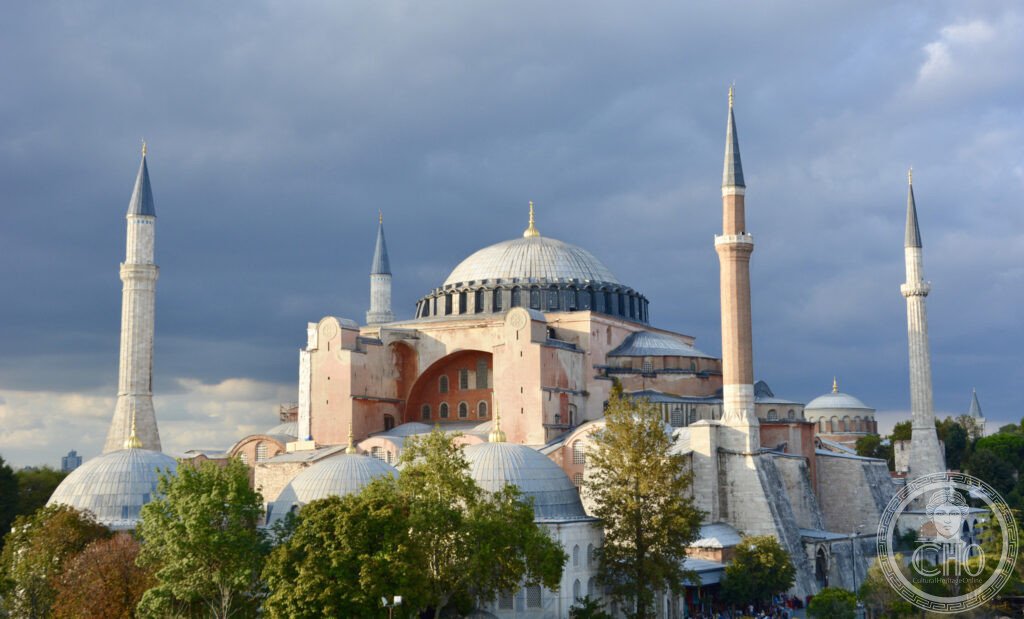
The only city in the world that straddles two continents and the only city that has been capital of the Roman Empire, the Byzantine Empire, and the Ottoman Empire. Istanbul, at the meeting point of Europe and Asia above the Bosphorus Strait, contains in a single district the Hagia Sophia (the most important building of the Byzantine world), the Topkapi Palace (the administrative centre of the Ottoman Empire for four centuries), and the Blue Mosque (the only mosque in Istanbul with six minarets).
At a glance
The Historic Areas of Istanbul (UNESCO WHS 1985; 4 zones: the Archaeological Park (Sultanahmet); the Süleymaniye district; the Zeyrek district; the land walls zone; total area approximately 2,395 ha; population of Istanbul approximately 15 million (the most populous city in Europe by population within city limits; the most important commercial city in the Middle East)) was founded as Byzantium (the Greek colony; c.657 BCE; the most strategically located city in the ancient world — the only crossing point between Europe and Asia in the region; the city that controls the Bosphorus controls the trade between the Black Sea and the Mediterranean) by the Megarian Greek colonists. The city was refounded as Constantinople (Κωνσταντινούπολη; “City of Constantine”) in 330 CE by the Roman Emperor Constantine I (the founder of the Byzantine Empire; the first Christian Roman emperor; the most consequential emperor in the history of the Roman state). Constantinople was the capital of the Eastern Roman (Byzantine) Empire from 330 to 1453 CE (1,123 years — the longest continuous capital of a single empire in world history). The Ottoman conquest (29 May 1453; Sultan Mehmed II (“the Conqueror”; Fatih Sultan Mehmed; the most important military event in the history of the medieval Mediterranean; the fall of the Byzantine Empire; the beginning of the Ottoman capital at Constantinople (renamed Istanbul in popular use, though “Constantinople” remained the official name in Ottoman state documents until 1930)); the Turkish Republic (from 1923; Atatürk’s reforms (1923–1938; the most dramatic modernisation programme in the history of the Middle East; the Latin alphabet; secular law; the haric (fez ban); the conversion of the Hagia Sophia to a museum (1934)))).
Key facts
- The Hagia Sophia: the most important building in the history of Byzantine civilisation. The construction history: the first church on the site was dedicated in 360 CE and burned in 404 CE; the second church was rebuilt in 415 CE and burned in 532 CE during the Nika Revolt — the most violent urban revolt in Byzantine history. The current building was designed by Anthemios of Tralles and Isidore of Miletus, the most important architects of the Byzantine world: Anthemios was a mathematician as much as an architect, and the design of the dome reflects mathematical principles not seen again in architecture until the Renaissance. It was completed in 537 CE in five years and ten months — the most rapid construction of a major domed structure before the modern era. The structural principle: the dome (31.87 m diameter) is supported not on a drum, as in the Pantheon, but on four triangular pendentives (spherical triangles) that transfer the weight of the dome to four massive piers. The technique of the pendentive is the single most important structural innovation in the history of world architecture, because it allowed large domes to be placed over square rooms for the first time: every domed church and mosque built since — including St. Peter’s, the Blue Mosque, the Süleymaniye, and every Baroque church in Italy — derives its structural logic from the Hagia Sophia. The interior: the nave is 73.5 m long × 69.7 m wide, the largest interior space in the ancient or medieval world for approximately 1,000 years. The mosaics are the most important surviving Byzantine mosaics. The Deesis mosaic (c.1261) is the finest Byzantine mosaic of the late period, Christ enthroned between the Virgin and St. John the Baptist, in the upper gallery: the most important single Byzantine artwork visible in Istanbul. The Empress Zoe mosaic is the mosaic panel with Christ flanked by the Empress Zoe and her husband Constantine IX, the most politically revealing Byzantine mosaic — the face of the male figure was replaced twice, when Zoe changed husbands, and Christ’s face was repainted when the mosaic was restored. Then the Ottoman conversions: at the conversion to a mosque in 1453 the mosaics were plastered over, not destroyed, and the four minarets were added (the original two were built by Mehmed II and Bayezid II, the other two by Selim II and Murat III in the 16th century). In the Atatürk museum period (1934–2020) the plaster was removed from the mosaics and the building was used as a neutral cultural monument accessible to all. The Erdoğan re-conversion came in 2020, when the mosaics were covered with curtains during Islamic prayer times — the most controversial building-use decision in Turkey in the 21st century.
- Topkapi Palace: the administrative centre of the most powerful empire of the 15th–17th centuries. Topkapi Sarayı was begun in 1459 by Mehmed II and expanded by successive sultans: it was the administrative and residential centre of the Ottoman government for approximately 400 years (1459–1856, when the court moved to Dolmabahçe Palace). The layout is a series of four successive courtyards. The First Court is the Janissary court, open to the public throughout the Ottoman period and the most public part of the palace. In the Second Court the Imperial Council (the Divan) met, and there are the Kitchens, with the most important collection of Chinese porcelain outside China. The Third Court is the most private of the semi-public courts, with the Throne Room and the Pavilion of the Holy Mantle, which holds the most sacred Islamic relics in the palace: the mantle, footprint, and tooth of the Prophet Muhammad, and the sword of the Prophet — the most important collection of Islamic relics in the world outside Mecca. The Fourth Court holds the private gardens of the sultan, the pavilions and kiosks, and the most beautiful views of the Golden Horn, the Bosphorus, and the Sea of Marmara. The Harem is the most visited section of the palace, the private apartments of the sultan, his wives, concubines, and children: approximately 400 rooms, of which only a fraction are open to the public. The most architecturally interesting single space in the Harem is the Chamber of Murad III (1578), designed by the great Ottoman architect Sinan (Mimar Sinan; 1490–1588), the greatest Ottoman architect, the builder of the Süleymaniye Mosque and the Selimiye Mosque in Edirne — the Ottoman equivalent of Michelangelo. The Treasury is the most visited single room in the palace, and holds the four most important objects. The Topkapi Dagger is the most famous Ottoman decorative object, with three large emeralds in the hilt, made as a gift for the Persian Shah Nadir which was never delivered because he was assassinated before it arrived. The Spoonmaker’s Diamond (Kaşıkçı Elması) is 86 carats, the fifth-largest diamond in the world, found in a rubbish heap in the 17th century and sold for three spoons — hence the name, and the most valuable object in the treasury.
- The Blue Mosque and the Basilica Cistern: the Ottoman skyline and the Roman underground. The Blue Mosque (Sultan Ahmed Mosque; Sultanahmet Camii) was built 1609–1616 under Sultan Ahmed I and is the most famous Ottoman mosque in Istanbul. “Blue Mosque” is a popular name derived from the approximately 20,000 Iznik tiles that cover the interior walls and dome in shades of blue: the finest tiles in the Ottoman tradition, made in Iznik (ancient Nicaea) using the most refined ceramic technique in the Ottoman world, with the famous floral designs on a white ground. The 6 minarets were the most controversial feature of the mosque when built — only the mosque at Mecca had 6 minarets, and Ahmed I resolved the scandal by paying for a 7th minaret at Mecca. The Basilica Cistern (Yerebatan Sarnıcı; “Sunken Cistern”) was built in 532 CE under Justinian I and is the most important surviving example of Byzantine civil engineering: 9,800 m², the largest surviving ancient cistern in the world, with 336 marble columns in 12 rows of 28. The two Medusa heads are used as bases for two columns at the north-west corner; the heads were taken from an older Roman monument, and one is upside down, one is sideways — the asymmetric placement was deliberate, to neutralise the Medusa’s gaze, since direct eye contact with the gaze would turn the viewer to stone and tilting averts the direct gaze. It is now a major tourist attraction with lights and atmospheric music, and the most dramatic ancient space accessible to visitors in Istanbul.
- Heritage: UNESCO World Heritage Site, Historic Areas of Istanbul, inscribed 1985.
- GPS: 41.0082° N, 28.9784° E.
History
Byzantium (c.657 BCE) was a Greek colony: the strategic position at the only crossing point of the Bosphorus made it the most important trading city on the Black Sea route. Constantinople followed in 330 CE, when Constantine I chose the site for its strategic position and its distance from the Roman political establishment; the new city was the largest construction project of the 4th century. The Byzantine Empire (330–1453 CE) was the most durable political structure in European history: the empire survived 1,123 years — longer than the Western Roman Empire survived from Augustus to the fall (27 BCE–476 CE = 503 years) and longer than any other European empire. In the Fourth Crusade (1204) the Crusaders sacked Constantinople — the most scandalous act of the medieval Crusading movement, Orthodox Christians attacked by fellow Christians; the Latin Empire (1204–1261) occupied the city, and the city never fully recovered economically. The Ottoman conquest came on 29 May 1453: the end of the Byzantine Empire, the beginning of the Ottoman capital, and the transformation of the city’s skyline by the mosques of Mehmed II, Bayezid II, and Suleiman the Magnificent, the Golden Age of Ottoman architecture. Then Atatürk and the Turkish Republic (1923). UNESCO WHS 1985.
What you see
The Sultanahmet district is the most concentrated heritage zone in Istanbul, walkable in a day. The Hagia Sophia is the essential first visit: allow 2h, early morning or late afternoon to avoid the maximum crowds, and do not miss the upper gallery, with the Byzantine mosaics and the best views of the nave. The Topkapi Palace means the main palace buildings + the Harem (separate ticket; separate entry; the most visited section): allow 2h for the palace alone + 1h for the Harem. The Blue Mosque is the only mosque where non-Muslims enter free; modest dress is required, and there is no visit during the 5 daily prayer times (approximately 30 min each). The Basilica Cistern takes 30–45 min, is atmospheric and always cool (useful in summer), and is the best evening visit option, since it is open late in summer. The Hippodrome was the ancient chariot racing circuit of Constantinople and is now a public square, with the three surviving ancient monuments: the Serpent Column (479 BCE; from Delphi; the oldest monument in Istanbul); the Egyptian Obelisk (1500 BCE; brought by Theodosius I from Luxor in 390 CE; the most ancient monument in the city); and the Column of Constantine.
Practical information
- Getting there: Istanbul Airport (IST) is the new airport opened in 2019, the largest airport in Europe, 40 km north-west of the city centre. From it the Metro M11 reaches Gayrettepe in 40 min for approximately TRY 50 (EUR 1.30), and the Havaist airport bus goes to Taksim Square in 1h for approximately TRY 100. For the journey to the Sultanahmet historic district, from Taksim or Gayrettepe take the T1 tram (Kabataş–Bağcılar) directly to the Sultanahmet stop — the single most useful single tram route in Istanbul, which passes the Grand Bazaar (Kapalıçarşı) and the Hippodrome. The Istanbul Kart is the rechargeable transit card, essential for public transport, available from ticket machines at the airport Metro station and all major stops, for approximately TRY 50 deposit + credit: the only practical way to use the tram, bus, Metro, and ferry.
- The Turkish hammam experience: the original spa tradition. The hammam is the Turkish bath, the most important bathing tradition in the Ottoman world: every quarter of Istanbul had its own hammam, and there were approximately 4,000 hammams in Istanbul at the peak of the Ottoman period. Most have closed, and approximately 60 traditional hammams still operate. The ritual: undress in the çamekan (the entrance hall with individual locked cubicles); enter the hararet (the hot room) and lie on the göbektaşı (the heated marble platform at the centre, the central element of every hammam); sweat; have a vigorous scrub by the tellak (the male bath attendant) or natır (female), who removes a remarkable amount of dead skin using a kese (a rough scrubbing mitt); receive a foam massage; cool down in the soğukluk (cool room). The most famous historic hammam in the Sultanahmet area is the Çemberlitaş Hamamı (1584), designed by Mimar Sinan, the same architect as the Süleymaniye Mosque: the finest surviving historic hammam interior in Istanbul.
- The Bosphorus crossing and the Asian side: experiencing both Europe and Asia in one day. The Bosphorus ferry is the most underrated tourist experience in Istanbul: the public ferries (Şehir Hatları) cross the Bosphorus between the European shore (Eminönü or Beşiktaş) and the Asian shore (Üsküdar or Kadıköy) every 30 minutes, for approximately TRY 15 (EUR 0.40), and the 15-min crossing passes between the two continents with a view of the Ottoman fortresses on the Bosphorus shore. The Üsküdar landing is the Asian shore neighbourhood, the most relaxed and least touristic of the major ferry terminals, with the Mihrimah Sultan Mosque (1548; Mimar Sinan) — the most beautiful light effect of any Ottoman mosque in Istanbul, since the windows allow the sunset light to flood the interior on the day of the spring equinox. Kadıköy is the most vibrant Asian neighbourhood, with the fish market, the produce market and the most authentic Istanbul street food scene: midye dolma (stuffed mussels), a street food unique to Istanbul, where the mussel vendor (midyeci) adds lemon juice. The taste is one thing, the etiquette another: eat as many as you like and the vendor counts the shells at the end to determine the price.
Getting there
Istanbul Airport (IST; Metro M11 to Gayrettepe 40min then tram T1 to Sultanahmet). T1 tram is the essential tourist route. Istanbul Kart required. GPS: 41.0082, 28.9784.
Nearby
- Ephesus (UNESCO WHS 2015). 600 km south of Istanbul (1h by flight to İzmir + 1h by car; or overnight bus (9h)). The most completely excavated ancient Greek and Roman city in the world. Ephesus (Efes; the ancient Ionian Greek city; at its peak in the 1st–2nd century CE one of the largest cities in the Roman Empire (population approximately 200,000–500,000; the third or fourth largest city in the Roman world after Rome, Alexandria, and Antioch)). The Library of Celsus (117–120 CE; the most photographed ancient building in Turkey; the two-storey facade of the Roman library; the library held approximately 12,000 scrolls; the most important civic library of the eastern Roman Empire (the third largest in the Roman world after the libraries of Rome and Alexandria)). The Great Theatre (25,000 seats; the theatre where St. Paul (the apostle) was reportedly driven from the city by the silversmiths who made models of the Temple of Artemis (according to Acts 19:23–41 — the most important biblical reference associated with any still-standing ancient monument)).
- Göreme (Cappadocia, UNESCO WHS 1985). 750 km south-east of Istanbul (1h 15min by flight to Kayseri or Nevşehir). The most surreal geological and cultural landscape in Turkey. Cappadocia is the volcanic tuff landscape in central Anatolia: the erosion of the tuff by wind and rain created the “fairy chimneys” (peribacaları), conical rock formations capped by harder basalt, the most distinctive geological formations in Turkey, with approximately 250 fairy chimneys in the Göreme valley. Then the underground cities: Derinkuyu is the deepest underground city, 18 levels and approximately 85 m deep, capable of sheltering approximately 20,000 people, built by early Christians escaping Byzantine religious persecution and later Arab raids. Its ventilation shafts, holes in the ceiling of each room, are the engineering of the underground city, and are perfectly functional millennia later. The cave churches are at the Göreme Open Air Museum (UNESCO WHS 1985), the finest collection of Byzantine cave church frescoes in Turkey: approximately 30 rock-cut churches with fresco decoration dating from the 10th–12th century CE. The hot air balloon flights are the most popular tourist activity in Cappadocia, with approximately 150 balloons in the air at dawn over the fairy chimneys — the most photographed dawn scene in Turkey.
- Bursa and Cumalıkızık (UNESCO WHS 2014). 150 km south of Istanbul (1h 30min by car or ferry to Bursa). The first Ottoman capital and the finest early Ottoman architecture. Bursa was the first capital of the Ottoman Empire (1326–1369) and the most important early Ottoman city. The Green Mosque (Yeşil Cami; 1421) is the finest early Ottoman mosque in Turkey, with the turquoise İznik tile decoration of the interior — the earliest surviving major example of İznik tile production. The deep turquoise-green of the 15th-century İznik tilework is the most refined tile colour in all of Ottoman architectural history: the later blue-and-white Iznik tiles of the Blue Mosque are more famous, but the Bursa green tiles are considered by specialists to be technically superior. The Grand Bazaar of Bursa (the Kapalı Çarşı) is the oldest covered market in the Ottoman world, built on the silk trade: Bursa was the western terminus of the Silk Road from China through Persia, and the silk merchants of Bursa were the wealthiest in the Ottoman Empire.
Sources
- Wikipedia, Hagia Sophia. Topkapi Palace. History of Istanbul. Basilica Cistern, accessed June 2026.
- UNESCO, Historic Areas of Istanbul, WHS reference 356, inscribed 1985.
- John Julius Norwich, Byzantium: The Early Centuries, Knopf, 1989.
Find it on the map
See this place and what’s around it →📷 Become a Cultural Heritage Online photographer
Share your photos of places: they stay published under your name as the author. The more they're seen, the more you get noticed — and soon a contest will reward the most appreciated photos.
Log in or sign up free to add a photo