
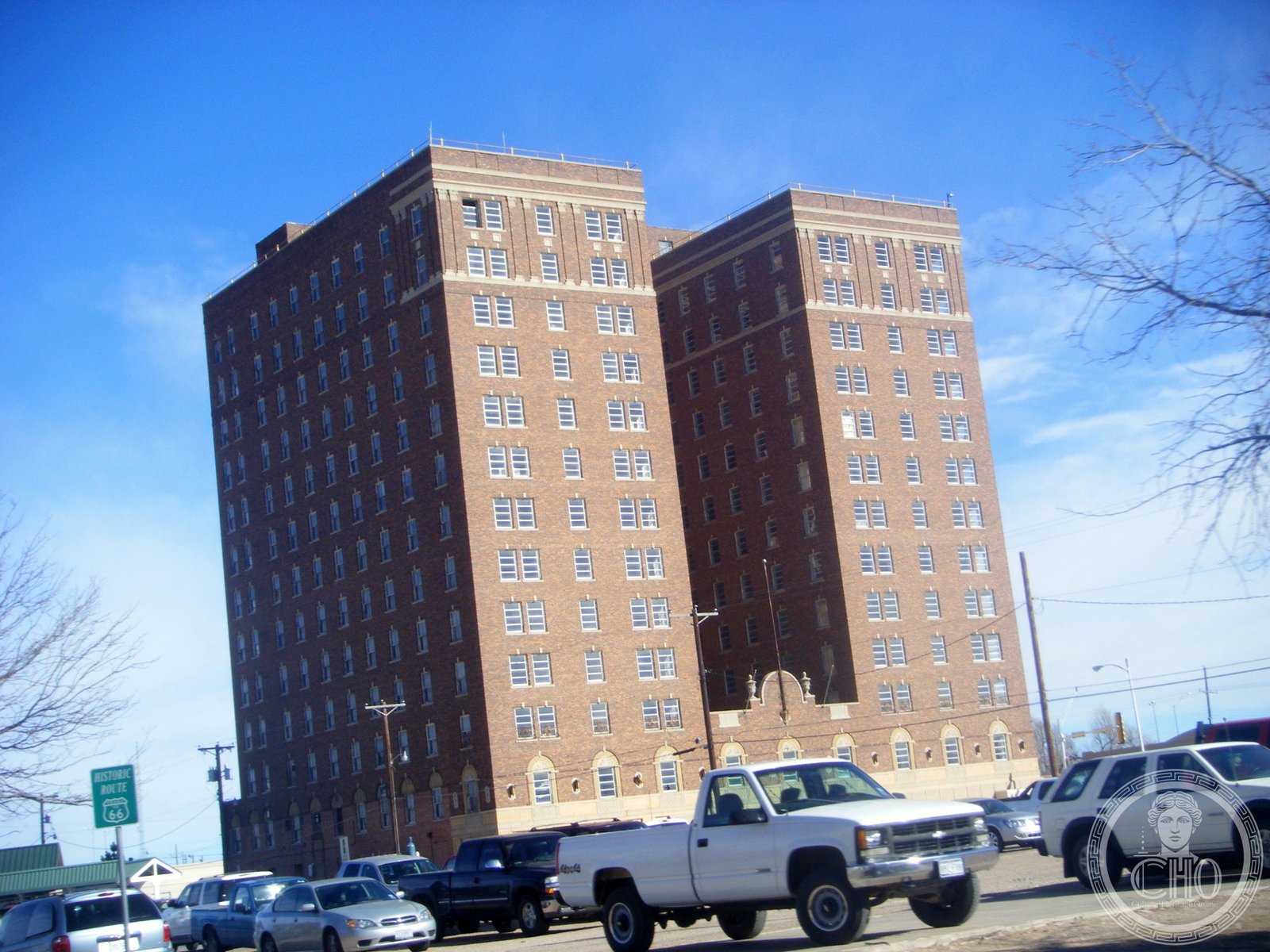
A landmark of 1920s commercial ambition in the Texas Panhandle, the Herring Hotel rose fourteen stories above Amarillo’s Polk Street in 1928 as the region’s most elegant address, its Art Deco façade a declaration of the cattle and oil prosperity reshaping the American West.
At a glance
The Herring Hotel stands at the corner of Polk Street and 6th Avenue in downtown Amarillo, a fourteen-story sentinel in the Zigzag Art Deco idiom that dominated American commercial architecture in the late 1920s. Built in 1928 at the height of the cattle and nascent oil economy that was transforming the Texas Panhandle from open range to commercial metropolis, the hotel was both a business investment and a symbol of civic confidence: Amarillo’s announcement to the world that it was a city capable of sustaining luxury accommodations, a ballroom, and the full apparatus of a cosmopolitan commercial hotel. Named for C.T. Herring, a prominent Amarillo cattleman and businessman whose family helped define the city’s economic character, the building anchored Polk Street as the commercial spine of the Panhandle’s largest city for decades. Though the hotel closed in the latter twentieth century, the building’s NRHP listing and ongoing preservation efforts have kept it as a defining element of Amarillo’s downtown skyline.
Key facts
- Opened: 1928
- Address: 519 S Polk Street, Amarillo, Texas 79101
- Style: Art Deco (Zigzag Moderne), terra-cotta ornament
- Height: 14 stories
- Named for: C.T. Herring, Amarillo cattleman and civic patron
- NRHP: Listed on the National Register of Historic Places
- Current status: Vacant; subject to preservation and redevelopment efforts
History
Amarillo’s growth in the 1910s and 1920s was rapid and speculative, driven first by the XIT Ranch era’s cattlemen and then by the discovery of oil and natural gas in the Panhandle fields to the east and west of the city. By the mid-1920s, Amarillo was the regional hub for an agricultural and energy economy that generated the capital to build civic infrastructure on a scale that astonished visitors unfamiliar with the West’s transformation from frontier to commercial civilization. The Herring Hotel was commissioned by C.T. Herring as both a personal investment and a demonstration that Amarillo could offer the standards of comfort and elegance available in larger American cities.
When it opened in 1928 the hotel immediately became Amarillo’s social center: the ballroom hosted debutante balls, political gatherings, and the banquets of the cattlemen’s associations that governed the region’s economic life. The dining room served the ranching families and oil executives who came to Amarillo for business and needed accommodation appropriate to their expectations. The building’s Art Deco exterior — terra-cotta panels with geometric reliefs, stylized ornamental banding at the upper stories, and the clean vertical thrust of a 1920s commercial skyscraper — expressed in architectural terms the same ambition that drove Amarillo’s economic expansion.
The hotel operated continuously through the mid-twentieth century before the general decline of downtown hotel districts that affected most American cities as suburban motel corridors captured automobile travelers. The Herring closed as a hotel, passing through various ownership configurations before preservation advocates secured its NRHP listing, which provided both recognition and legal protections for a building that remains structurally sound despite years of disuse. Redevelopment proposals have circulated periodically; the building’s scale, location, and Art Deco character make it a candidate for adaptive reuse as residential, hospitality, or mixed-use space.
What you see
The Polk Street facade rises fourteen stories in a clear statement of 1928 commercial ambition, its terra-cotta cladding organized into a tripartite composition — base, shaft, and cap — that was standard for the American commercial skyscraper tradition but executed here with Art Deco ornamental vocabulary rather than classical precedent. Stylized geometric reliefs punctuate the shaft at regular intervals; at the upper floors, zigzag banding and stepped cornices give the building its characteristic Deco silhouette against the wide Panhandle sky. The ground-floor commercial storefronts have been altered over the years, but the upper stories retain much of their original terra-cotta character, including decorative panels at the setback levels that break the vertical thrust with horizontal accents.
The building’s scale relative to its surroundings — Amarillo’s downtown commercial district, though not a dense urban canyon, is broad enough to make a fourteen-story structure genuinely imposing — gives the Herring Hotel a civic presence that few other buildings in the Panhandle can claim. From a distance along Polk Street the tower reads as the natural terminus of the commercial axis, the kind of anchoring landmark that generations of American downtowns used to define their centers. Up close, the terra-cotta detailing rewards inspection: individual panels show the high craft of the 1920s architectural ceramics industry at the height of its influence on American commercial architecture.
Practical information
- Access: Exterior viewable from Polk Street at any time; interior not open to public at present
- Best views: The Polk Street facade is best photographed from the opposite sidewalk; early morning and late afternoon light give the terra-cotta its richest color
- Context: Several other 1920s commercial buildings survive in the surrounding blocks; allow 20-30 minutes to walk the Polk Street historic commercial district
- Preservation note: Check with the Texas Historical Commission or local preservation organizations for current status of redevelopment proposals
Getting there
Amarillo is located at the intersection of Interstate 40 (east-west, Historic Route 66) and Interstate 27 (south to Lubbock and the oil fields) in the Texas Panhandle, approximately 350 miles northwest of Dallas-Fort Worth and 290 miles east of Albuquerque. By air, Rick Husband Amarillo International Airport (AMA) is approximately 7 miles east of downtown on airport Boulevard, served by American and Southwest Airlines with connections to Dallas, Denver, Las Vegas, and Phoenix. The Herring Hotel at 519 S Polk Street is in the center of downtown Amarillo, reachable by taking the Polk Street exit from I-40. Amtrak’s Sunset Limited route passes through Amarillo (Osage Street Station) three times per week on the New Orleans to Los Angeles run.
Nearby
- Cadillac Ranch (1974) — The iconic public art installation of half-buried Cadillacs along Route 66 west of Amarillo, a visual counterpoint to the 1920s downtown commercial architecture three miles east
- Panhandle-Plains Historical Museum, Canyon TX — The largest history museum in Texas, approximately 15 miles south of Amarillo in Canyon, with extensive collections on ranching, oil, and Panhandle history
- Palo Duro Canyon State Park — Texas’s “Grand Canyon,” approximately 25 miles south of downtown Amarillo, a natural landmark that places the human-scale ambition of the Herring Hotel in geological perspective
- Paramount Theatre (1930), Abilene TX — Art Deco performing arts venue approximately 230 miles southeast on I-40/US-84, illustrating the regional spread of Deco commercial architecture across West Texas
Sources
- National Register of Historic Places nomination, Texas Historical Commission
- Texas Historical Commission, Recorded Texas Historic Landmark records
- Amarillo Globe-News archive, Herring Hotel opening and preservation coverage
- Don Biggers, Our Sacred Monkeys: or 20 Years of the Mule Trade — Panhandle-Plains Historical context
- Historic Amarillo Commission, Polk Street Historic District documentation
Find it on the map
See this place and what’s around it →Record researched and written by Luigi De Marchi for Cultural Heritage Online, 2026.
📷 Become a Cultural Heritage Online photographer
Share your photos of places: they stay published under your name as the author. The more they're seen, the more you get noticed — and soon a contest will reward the most appreciated photos.
Log in or sign up free to add a photoIs this page about you?
This page is read by travellers and heritage enthusiasts who find it on Google. Tell us how you are connected to this place and we will take it from there.