
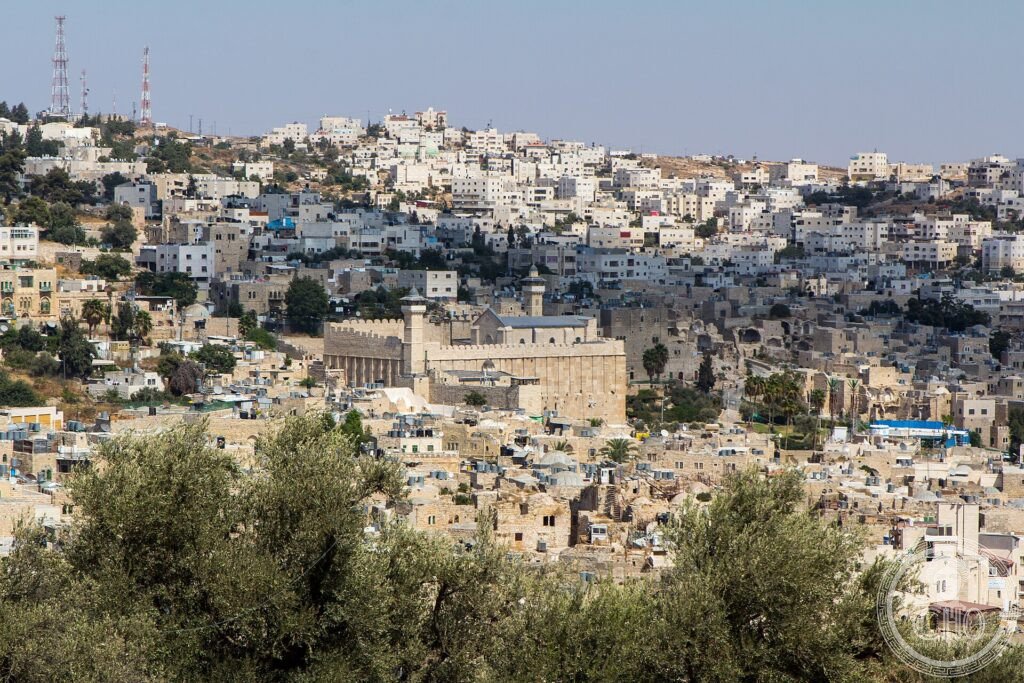
One of the oldest inhabited cities in the world, Hebron — Al-Khalil in Arabic, “the friend” of God — is sacred to Jews, Christians and Muslims as the burial place of Abraham and the patriarchs. Its old town, mainly Mamluk in date, is a maze of stone lanes, covered markets and courtyards around the great enclosure of the Tomb of the Patriarchs.
At a glance
The old town of Hebron (Al-Khalil), in the southern West Bank, is one of the most venerable cities in the Middle East, sacred to Jews, Christians and Muslims as the burial place of Abraham and the patriarchs. Around the massive ancient enclosure that shelters their tombs — the Ibrahimi Mosque / Cave of the Patriarchs — grew a dense old town, built up especially in the Mamluk period, of stone houses, covered markets, courtyards and fountains. Recognised for this heritage, it was inscribed by UNESCO in 2017, immediately on the List of World Heritage in Danger.
Key facts
- UNESCO: World Heritage since 2017 (Hebron/Al-Khalil Old Town), inscribed in danger
- City of the patriarchs: traditional burial place of Abraham
- Sacred to three faiths: Jewish, Christian and Muslim
- The enclosure: the ancient walls of the Tomb/Cave of the Patriarchs
- Mamluk old town: stone houses, markets and courtyards
- Living heritage: a long-inhabited historic centre
History
Hebron is one of the oldest continuously inhabited cities in the region, its importance rooted in the tradition that Abraham bought a cave here to bury his wife Sarah, and that he and the patriarchs were laid to rest in it. Over the great burial enclosure — whose massive stone walls date from the time of Herod — a shrine grew that became the Ibrahimi Mosque, also revered by Jews and Christians.
Around this holy place the old town developed, reaching its characteristic form under the Mamluks and Ottomans, with stone-vaulted streets, covered markets and fine houses. Long a centre of trade and crafts such as glass and pottery, the old town has suffered in the conflict over Hebron; it was inscribed by UNESCO in 2017, at once on the danger list, to help safeguard its heritage.
What you see
The old town is a maze of narrow, stone-vaulted streets and covered souks, with old houses, courtyards, mosques and the traditional workshops of Hebron’s glassblowers and potters. At its heart stands the great enclosure of the Ibrahimi Mosque / Cave of the Patriarchs, its huge ancient stone walls rising above the town.
The weight of history and faith in the old stone streets and the patriarchs’ shrine is the meaning of Hebron.
Practical information
- Old town: the historic centre and the Ibrahimi Mosque enclosure
- Note: a sensitive, divided city; check current travel advice
- Time needed: half a day
- Setting: in the southern West Bank
Getting there
Hebron (Al-Khalil) is in the southern West Bank, Palestine, about 30 km south of Jerusalem and Bethlehem. Access depends on the situation in the region. GPS: 31.525° N, 35.11° E.
Nearby
- Bethlehem — the UNESCO city of the Nativity, to the north
- Jerusalem — the holy city beyond Bethlehem
- Battir — the UNESCO terraced landscape nearby
Sources
- UNESCO World Heritage Centre — “Hebron/Al-Khalil Old Town” (ref. 1565)
- Hebron Rehabilitation Committee — official body
- Encyclopaedia Britannica — Hebron
Find it on the map
See this place and what’s around it →📷 Become a Cultural Heritage Online photographer
Share your photos of places: they stay published under your name as the author. The more they're seen, the more you get noticed — and soon a contest will reward the most appreciated photos.
Log in or sign up free to add a photo