
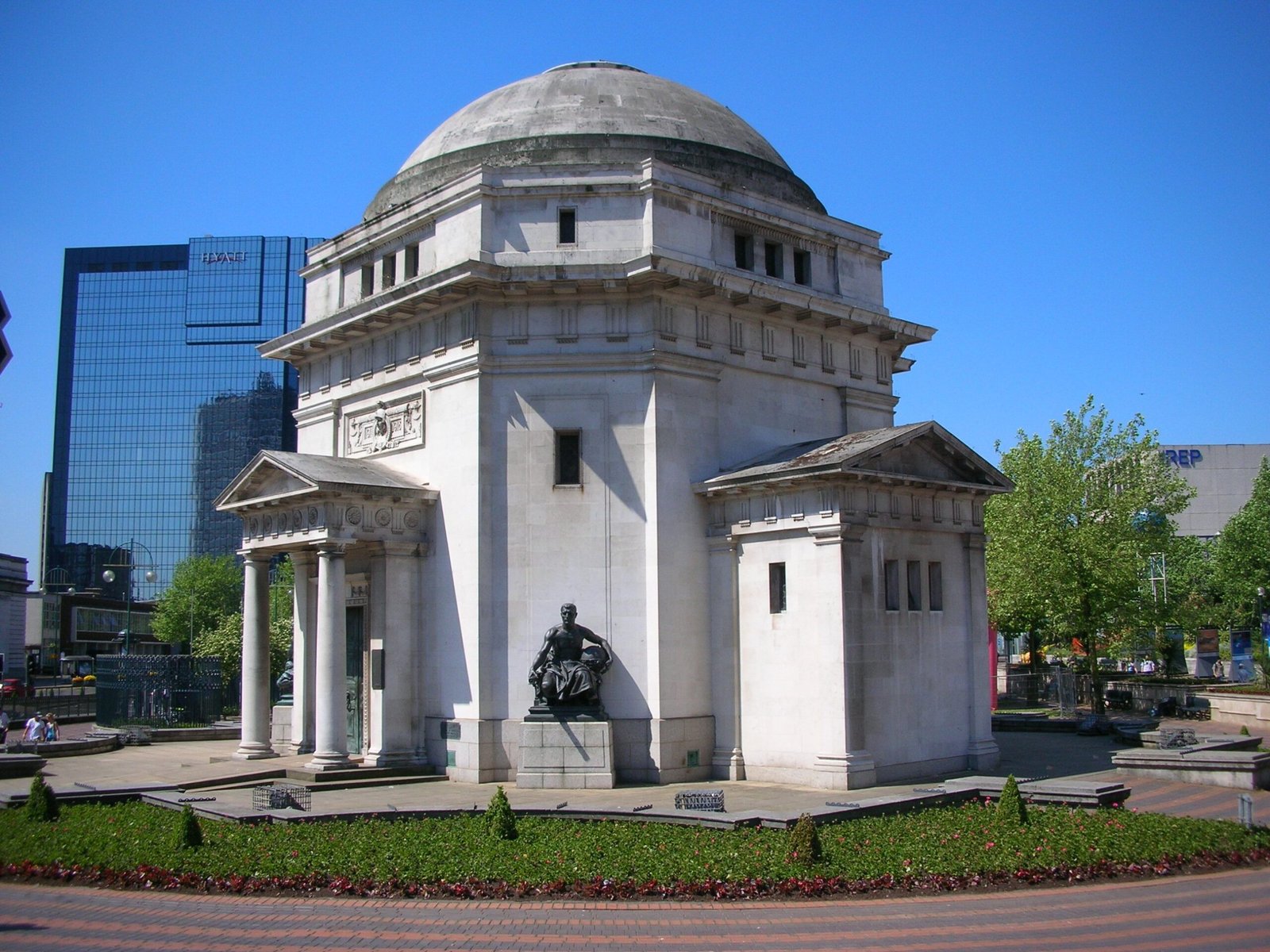
A Portland stone war memorial honouring 12,320 Birmingham citizens killed in World War I, designed by S. N. Cooke and W. N. Twist and opened by Prince Arthur of Connaught in 1925.
At a glance
Centenary Square’s iconic monument stands where a filled-in canal basin once lay. The memorial anchors what was envisioned as Birmingham’s grand civic hub, though that ambitious scheme never fully materialised. Its Grade I listed status—upgraded in 2014—reflects its architectural and historical importance.
History
Construction began in 1922 and concluded in 1925, funded entirely through public donations at a cost of £60,000. The Prince of Wales laid the foundation stone on 12 June 1923; Prince Arthur of Connaught formally opened the hall two years later to an assembled crowd of 30,000.
The memorial was conceived as the first element of an ambitious civic project that would include new council offices, the mayor’s residence, a public library, and a concert hall. World War II’s outbreak halted this vision; only half of one wing of the planned Baskerville House was ever built. In 1989, a First World War Memorial colonnade that had originally stood nearby was relocated to the hall when Centenary Square took its modern form.
What you see
Architects Cooke and Twist fashioned the memorial from Portland stone quarried in Dorset, creating a structure of classical dignity. Its fine tower and west portico dominate the approach.
Four bronze statues by local artist Albert Toft occupy the exterior corners, each representing a branch of the armed forces: Army, Navy, Air Force, and Women’s Services. Inside, three monumental bas-relief plaques carved by William Bloye depict the journey of war—the Call to arms, the Front Line of battle, and the Return of wounded soldiers. A roll of honour, illustrated by Sidney Meteyard, completes the interior commemoration.
Cultural significance
As Birmingham’s principal World War I memorial, the hall embodies the civic mourning of a manufacturing city that sent vast numbers to fight. The inscriptions speak directly: of 150,000 who answered the call to arms, 12,320 fell; 35,000 returned disabled. The words “See to it that they shall not have suffered and died in vain” remain a solemn civic charge.
The St Thomas’ Peace Garden, established in 1995 adjacent to the memorial as a fiftieth-anniversary tribute to peace, extends the site’s meaning beyond World War I to commemorate all who have fallen in armed conflict.
Key facts
- Location: Centenary Square, Birmingham, United Kingdom
- Coordinates: 52.47945, -1.90703056
- Designers: S. N. Cooke and W. N. Twist
- Construction: 1922–1925 by John Barnsley and Son
- Material: Portland stone
- Cost: £60,000 (public donations)
- Opened: 4 July 1925
- Statues: Albert Toft
- Interior reliefs: William Bloye
- Listed status: Grade I (upgraded 27 October 2014)
Practical information & getting there
The Hall of Memory occupies Centenary Square in central Birmingham, within walking distance of the International Convention Centre and Symphony Hall. For current opening hours and visitor information, consult local tourism resources or the venue directly.
Sources & resources
Find it on the map
See this place and what’s around it →📷 Become a Cultural Heritage Online photographer
Share your photos of places: they stay published under your name as the author. The more they're seen, the more you get noticed — and soon a contest will reward the most appreciated photos.
Log in or sign up free to add a photoIs this page about you?
This page is read by travellers and heritage enthusiasts who find it on Google. Tell us how you are connected to this place and we will take it from there.