
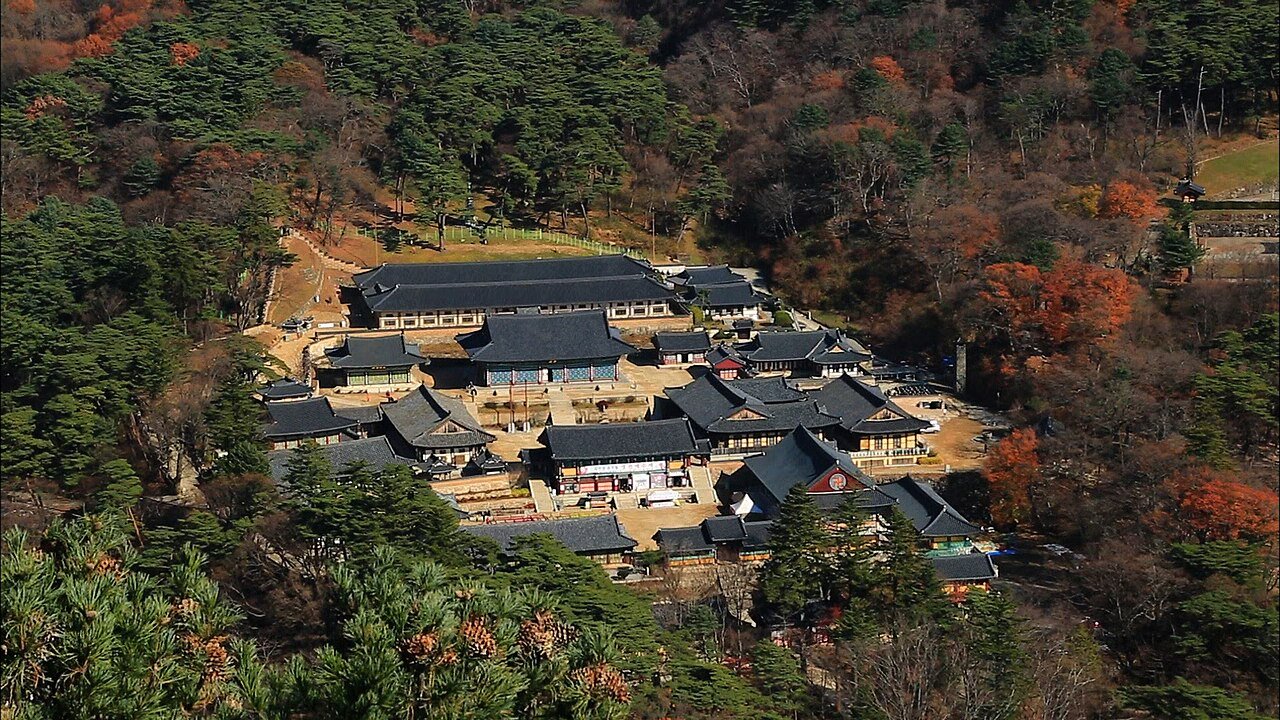
Deep in the Gayasan mountains of southern South Korea, the Buddhist temple of Haeinsa has guarded the Tripitaka Koreana since 1251: 81,258 wooden printing blocks carved with the complete Buddhist canon—52 million individual characters, the most accurate and complete collection of Buddhist scriptures in existence.
At a glance
Founded in 802 AD by two Korean monks returning from Tang Dynasty China, Haeinsa is one of the Three Jewel Temples of Korean Buddhism, representing the Dharma. Its defining treasure, the Tripitaka Koreana—the world’s most complete and authoritative Buddhist scriptural collection—was carved onto 81,258 double-sided wooden blocks between 1237 and 1251 AD. The wooden depositories built in 1488 to house the blocks, the Janggyeong Panjeon, are inscribed as a UNESCO World Heritage Site in recognition of both the collection they contain and the extraordinary passive ventilation engineering that has preserved the blocks in perfect condition for 750 years without modern climate control.
Key facts
- Founded: 802 AD by monks Suneung and Ijeong
- Location: Gayasan mountains, South Gyeongsang Province, approximately 80 km west of Daegu
- Significance: one of the Three Jewel Temples of Korean Buddhism (representing the Dharma)
- Tripitaka Koreana: 81,258 wooden blocks, 1237–1251 AD, approximately 52,330,152 carved characters
- UNESCO WHS: 1995 (Haeinsa Temple Janggyeong Panjeon)
- Depositories constructed: 1488 AD
- Access: open to visitors; entrance fee applies
History
Haeinsa was founded in 802 AD during the Unified Silla period by the monks Suneung and Ijeong after their return from study in Tang Dynasty China. The temple’s name means “temple of reflection on a smooth sea”—a reference to the Buddhist concept of the mind as a still sea that perfectly reflects all phenomena. Over the following centuries Haeinsa grew in importance, suffering several fires and reconstructions while maintaining its position as one of Korea’s principal Buddhist institutions.
The defining event in Haeinsa’s history was the commission and completion of the Tripitaka Koreana between 1237 and 1251 AD. The Goryeo king Gojong ordered the carving of the complete Buddhist canon as a prayer for divine intervention against the Mongol invasions that were devastating the Korean peninsula. The scale of the undertaking is almost impossible to comprehend: approximately 52,330,152 individual characters carved over 16 years, with a consistency of depth and technique so extraordinary that modern scholars conclude the blocks were produced by a highly organised workshop system with strict quality control. Scholars have found almost no scribal errors across the entire 81-million character text—an accuracy unmatched in any comparable scriptural project in human history.
The four wooden depositories that house the Tripitaka—collectively the Janggyeong Panjeon—were constructed in 1488 AD and have functioned without modification ever since. The temple complex as a whole was rebuilt following a major fire in 1817, with most current buildings dating from the early 19th century reconstruction.
What you see
Haeinsa is a large mountainside complex of approximately 70 structures arranged on rising terraces into the Gayasan valley. The main approach leads through a series of gateways and courtyards to the principal worship hall, Daejeokgwangjeon, before arriving at the highest terrace where the four Janggyeong Panjeon depositories stand. The depositories—two long buildings facing each other with two shorter buildings at the ends—appear modest from the outside, but their engineering is extraordinary: the orientation, window sizes, floor composition mixed with salt, charcoal, limestone, and sand, and the careful spacing of ventilation panels create a microclimate that has kept the wooden blocks in perfect condition for 750 years without air conditioning, humidity control, or any modern preservation technology.
Visitors can view the printing blocks through the latticed windows of the depositories but cannot enter. The blocks themselves—each approximately 70 by 24 by 2.8 cm, made from birch wood treated with salt water, dried in shade, and lacquered with poison to resist insects—are stored on open shelves, their edges facing outward, filling the entire interior of both main buildings from floor to ceiling. The visual impression of row upon row of densely carved wooden surfaces extending the full length of the buildings is unlike anything else in the world.
Practical information
- Opening hours: approximately 07:00–18:00 (seasonal variation)
- Entrance fee: applies; check current rates on arrival
- Temple stay: overnight temple-stay programme available for cultural immersion
- Photography: permitted in most areas; check restrictions at depositories
- Best time to visit: autumn for mountain foliage; early morning for quiet worship
Getting there
Haeinsa is approximately 80 km west of Daegu and is served by regular buses from Daegu Seobu bus terminal (approximately 1 hour 20 minutes). From Seoul, the fastest route is high-speed KTX to Daegu then bus to Haeinsa. No rail service reaches the temple directly; the bus terminates at the temple entrance car park. Private vehicle access via the Gayasan National Park road is also straightforward.
Nearby
- Gayasan National Park — the mountain landscape surrounding Haeinsa, with hiking trails to summit peaks above 1,400 metres
- Tongdosa Temple — the largest of the Three Jewel Temples, representing the Buddha, approximately 80 km east near Yangsan
- Songgwangsa Temple — the third of the Three Jewel Temples, representing the Sangha, approximately 150 km southwest in North Jeolla Province
Sources
- Lancaster, L., and Yu, C.S. (eds.), Assimilation of Buddhism in Korea, Asian Humanities Press, 1991
- Korean Cultural Heritage Administration, Haeinsa and the Tripitaka Koreana, official documentation, 1995
- UNESCO World Heritage Centre, “Haeinsa Temple Janggyeong Panjeon,” WHC nomination file, 1995
- Wikipedia, “Haeinsa,” retrieved June 2026
- Wikipedia, “Tripitaka Koreana,” retrieved June 2026
Find it on the map
See this place and what’s around it →📷 Become a Cultural Heritage Online photographer
Share your photos of places: they stay published under your name as the author. The more they're seen, the more you get noticed — and soon a contest will reward the most appreciated photos.
Log in or sign up free to add a photoIs this page about you?
This page is read by travellers and heritage enthusiasts who find it on Google. Tell us how you are connected to this place and we will take it from there.