

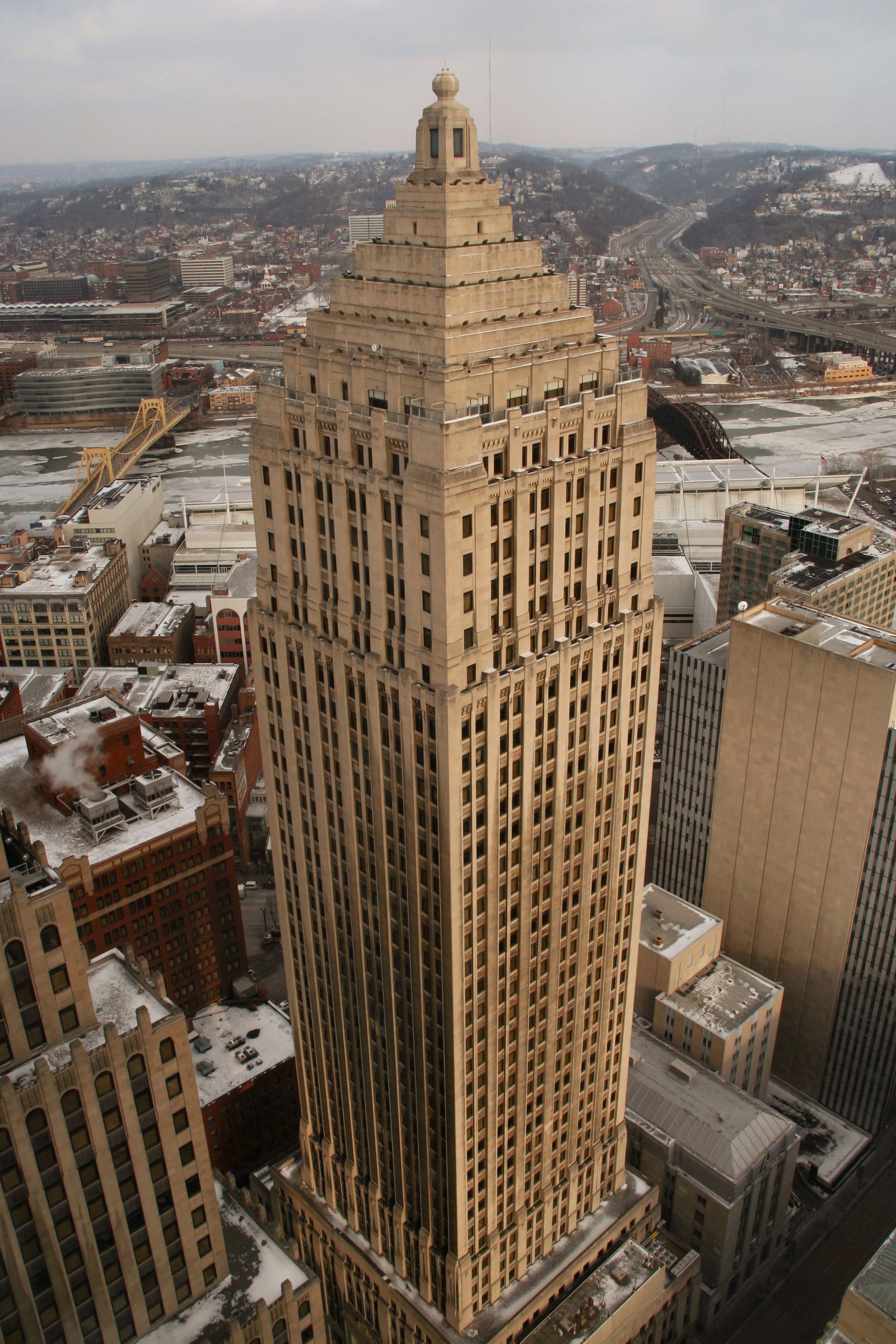

Pittsburgh’s tallest building for nearly four decades, Gulf Tower rises 44 floors from Grant Street with a stepped limestone pyramid that remains one of the city’s defining Art Deco silhouettes.
At a glance
Completed in 1932 for the Gulf Oil Corporation, Gulf Tower stands at 707 Grant Street in the heart of Pittsburgh’s downtown triangle. Trowbridge & Livingston — the New York firm behind the St. Regis Hotel and the B. Altman Building in Manhattan — designed its 44-floor shaft as a composition of limestone setbacks culminating in a stepped pyramid crown with distant echoes of Mesoamerican massing. The building dominated the Pittsburgh skyline for nearly forty years, and its rooftop neon “Gulf” sign in orange became a symbol of the city’s industrial self-confidence. A contributing property in the Pittsburgh Central Downtown Historic District (listed on the National Register in 1985), it remains one of the most cohesive Art Deco towers between New York and Chicago.
Key facts
- Completed: 1932
- Architects: Trowbridge & Livingston
- Height: 44 stories, 582 ft (177 m)
- Style: Art Deco; stepped pyramid crown
- Address: 707 Grant Street, Pittsburgh, PA 15219
- NRHP: Contributing property, Pittsburgh Central Downtown Historic District (1985)
- Signature feature: Stepped limestone pyramid with illuminated Gulf neon sign
History
The Gulf Oil Corporation commissioned Gulf Tower in 1929 at the height of American skyscraper ambition. Trowbridge & Livingston, a New York firm whose portfolio included the St. Regis Hotel (1904), the B. Altman Building (1906), and the New York Stock Exchange annex, delivered a design that channelled the period’s enthusiasm for monumental setback towers. The project proceeded through the Depression years and was completed in 1932, its limestone shaft rising as a statement of corporate permanence amid economic uncertainty.
Gulf Tower held the title of Pittsburgh’s tallest building until 1970, when US Steel Tower surpassed it. For nearly four decades the stepped pyramid and the orange neon “Gulf” sign at its apex defined the city’s skyline seen from across the rivers. The building’s prominence in early photographs and postcards of Pittsburgh makes it one of the most-documented Deco towers in the American interior.
Listed on the National Register of Historic Places in 2008, Gulf Tower today houses commercial office tenants. Its lobby retains the marble and geometric bronze metalwork of the original 1932 fit-out, and the pyramid crown — now lit in modern LED rather than neon — continues to mark the building’s position in the skyline after dark.
What you see
The tower’s limestone facade rises in pronounced setbacks: the lower floors dressed with carved geometric and stylised foliate ornament at the entrance bay, the shaft above kept deliberately spare to accelerate the vertical read. Each setback creates a shadow recession that prevents the massing from feeling monolithic at close range while reinforcing the stepped silhouette visible from miles across the plateau. The pyramid crown — four limestone tiers converging to a flat apex — was inspired by the stepped temples of Mesoamerica, a fashionable reference in American Deco of the late 1920s and early 1930s.
At street level the Grant Street entrance presents a triumphal arch bay framed by fluted pilasters and spandrel panels carved with Deco motifs. Viewed from across Grant Street toward the Allegheny County Courthouse, the full composition reads as a textbook Deco tower: base, shaft, crown, with each zone handled with restraint and the whole resolved by the pyramid top. At dusk the illuminated apex glows against the western sky, the light catching the limestone in a warm amber that links the tower visually to the bridges and rivers below.
Practical information
- Access: Public lobby open weekdays during business hours; exterior visible at all times
- Best view: From Grant Street looking north, or from Point State Park at dusk
- Time needed: 20 minutes exterior; lobby 5–10 minutes
- GPS: 40.4425° N, 79.9953° W
- Nearest transit: Steel Plaza T Station (light rail), 3-minute walk
Getting there
Gulf Tower stands at 707 Grant Street in downtown Pittsburgh, a 3-minute walk from Steel Plaza light-rail station on the T network. Pittsburgh International Airport is approximately 22 miles (35 km) west via Interstate 376. Amtrak’s Capitol Limited stops at Pittsburgh Union Station on Liberty Avenue, about a 10-minute walk from Grant Street.
Nearby
- Koppers Building (1929) — Graham, Anderson, Probst & White’s Art Deco tower with green copper crown, 7th Avenue and Grant Street
- Grant Building (1929) — Henry Hornbostel’s setback tower at 330 Grant Street, famous for its rooftop Morse code beacon
- Allegheny County Courthouse (1888) — H.H. Richardson’s Romanesque Revival masterwork directly across Grant Street
Sources
- National Register of Historic Places, Gulf Tower nomination (2008) — National Park Service, nps.gov
- Pittsburgh History & Landmarks Foundation, landmark documentation — phlf.org
- Kidney, Walter C. Pittsburgh’s Landmark Architecture: The Historic Survey. Pittsburgh History & Landmarks Foundation, 1997
- Trowbridge & Livingston firm, Avery Index to Architectural Periodicals — Columbia University
- Wikidata, Gulf Tower Q5617541 — wikidata.org
Find it on the map
See this place and what’s around it →📷 Become a Cultural Heritage Online photographer
Share your photos of places: they stay published under your name as the author. The more they're seen, the more you get noticed — and soon a contest will reward the most appreciated photos.
Log in or sign up free to add a photoIs this page about you?
This page is read by travellers and heritage enthusiasts who find it on Google. Tell us how you are connected to this place and we will take it from there.