
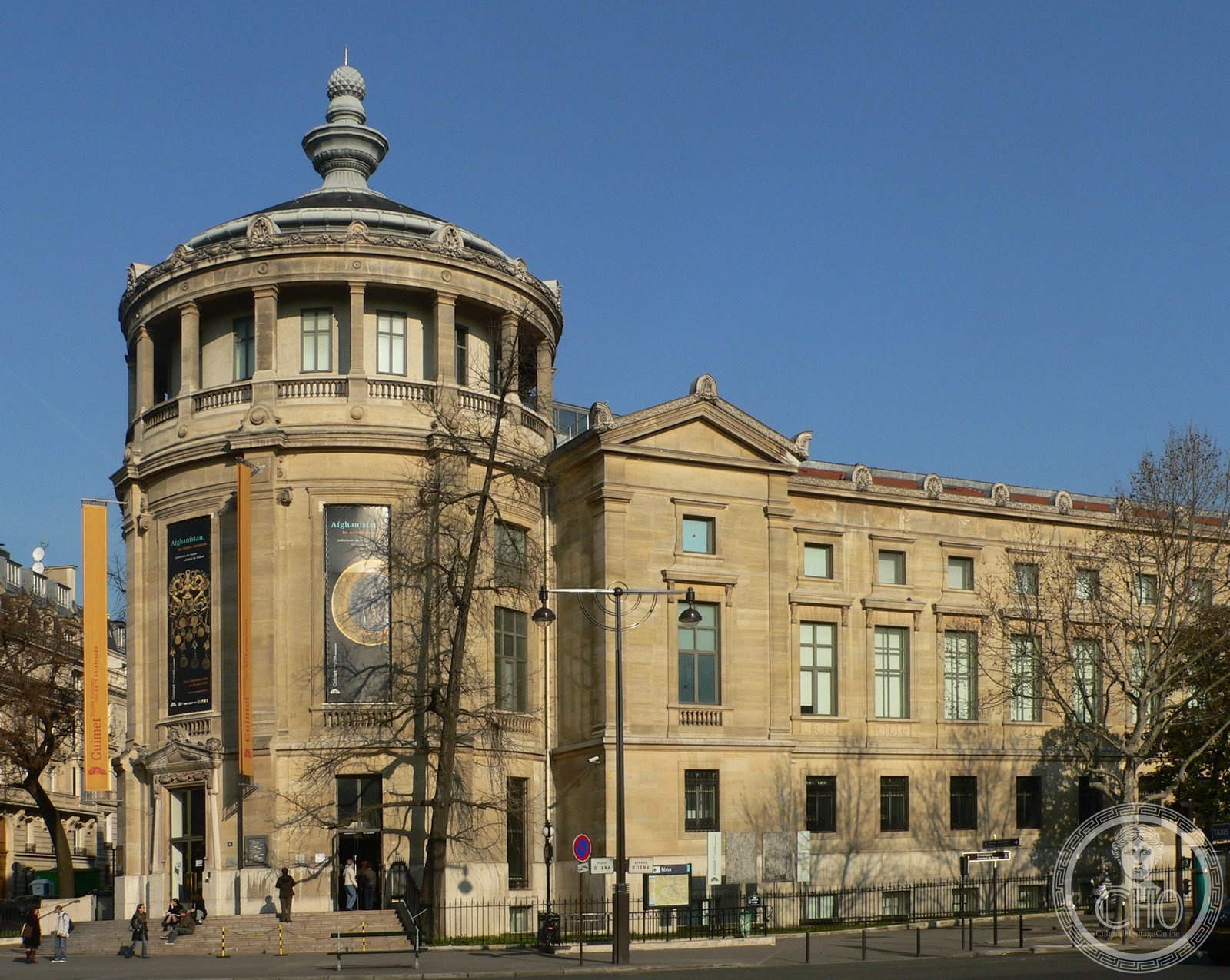
The Musée national des arts asiatiques — Guimet (Guimet Museum) is a national museum in Paris with one of the largest and most comprehensive collections of Asian art outside Asia, comprising over 45,000 objects from Afghanistan, India, Southeast Asia, China, Japan, Korea, Tibet, Nepal, and the Himalayas. Founded in Lyon in 1879 by industrialist and scholar Émile Guimet and transferred to Paris in 1888, it occupies a purpose-built neoclassical building in the 16th arrondissement and represents France’s principal window onto the art, religion, and archaeology of Asia from prehistory to the 19th century.
At a glance
- Type
- National museum of Asian art
- Period
- Founded Lyon 1879; Paris building opened 1889; state museum from 1945
- Style
- Neoclassical (building by Charles Terret)
- Location
- 6 place d’Iéna, 75116 Paris, France
- Founder
- Émile Guimet (1836–1918), industrialist and orientalist
- Collection
- Over 45,000 objects; Cambodia, Thailand, Vietnam, India, Tibet, Nepal, China, Japan, Korea
- Current use
- National museum under the French Ministry of Culture
Overview
The Guimet Museum is a Parisian art museum with one of the largest and most comprehensive collections of Asian art outside of Asia, including items from Cambodia, Thailand, Vietnam, Tibet, India, Nepal, China, Japan, and Korea, among other countries. It was founded by Émile Guimet — a Lyon industrialist who travelled extensively in the Far East in 1876 — initially as a museum of comparative religions in Lyon in 1879, before being transferred to Paris in 1888 and donated to the French state in 1889. After significant renovation in 2001, the museum emerged as the leading institution in Europe for Asian art scholarship and public programming.
History
Émile Guimet travelled to Egypt, Japan, China, and India between 1865 and 1876, amassing a collection of religious objects, iconography, and documentation intended to create a comparative study of world religions. His Lyon museum opened in 1879 with this thematic focus; nine years later the collection was moved to a purpose-built building in Paris designed by Charles Terret, opening in 1889. The French state formally took over the museum in 1945, gradually integrating into it the Asian collections previously housed at the Louvre and the Trocadéro. A major renovation closed the museum from 1996 to 2001; the reopening doubled display space and dramatically improved the presentation of Khmer, Gandharan, and Japanese collections.
What you see
The ground floor and first floor are organised geographically and chronologically, moving from the Gandharan Buddhist sculpture of Afghanistan and Pakistan through the Hindu and Buddhist art of India and Southeast Asia, to the Khmer galleries — one of the finest Angkor-period collections outside Cambodia — and the Himalayan rooms with their Tibetan thangkas and bronze ritual objects. Upper floors display Chinese porcelain, jades, bronzes, and lacquerware spanning three millennia, alongside Japanese screens, armour, ceramics, and prints. The rotunda at the building’s core rises five storeys and is encircled by galleries of Japanese Buddhist sculpture. A separate pavilion — the Hôtel Heidelbach — houses the Bibliothèque de l’INHA Asian art library and rotating Japanese garden displays.
Cultural significance
The Guimet’s Khmer collection, comprising pieces excavated during the French colonial period in Indochina, is the most significant outside the National Museum of Cambodia in Phnom Penh and raises ongoing debates about cultural restitution that reflect wider renegotiations between European museums and their countries of origin. As a scholarly institution, the museum has trained generations of Orientalist art historians and curators and continues to produce reference publications on Asian archaeology and art history. Its 2001 renovation is a benchmark for how to radically improve visitor experience in a 19th-century encyclopaedic museum without compromising collection integrity.
Practical information
Open Wednesday to Monday, 10:00–18:00 (last entry 17:15); closed Tuesdays, 1 January, 1 May, and 25 December. Admission fee applies; free on the first Sunday of each month and for visitors under 26 from EU countries. Audio guides available in French and English. The museum shop specialises in Asian art publications and design objects. A café on the lower level is open during museum hours. Photography is permitted without flash in permanent collections.
Getting there
The nearest Métro stations are Iéna (line 9) and Boissière (line 6), both a two-minute walk from the Place d’Iéna entrance. The museum is also a 15-minute walk from the Eiffel Tower. Bus lines 32 and 63 stop at Place d’Iéna; line 22 stops on avenue du Président Wilson. The Trocadéro area offers pleasant walking routes between the Musée de l’Homme, the Palais de Chaillot, and the Guimet, forming a coherent cultural circuit.
Sources & resources
Find it on the map
See this place and what’s around it →📷 Become a Cultural Heritage Online photographer
Share your photos of places: they stay published under your name as the author. The more they're seen, the more you get noticed — and soon a contest will reward the most appreciated photos.
Log in or sign up free to add a photo