
Great Zimbabwe

Great Zimbabwe ruins dry stone walls tower sub-Saharan Africa UNESCO World Heritage
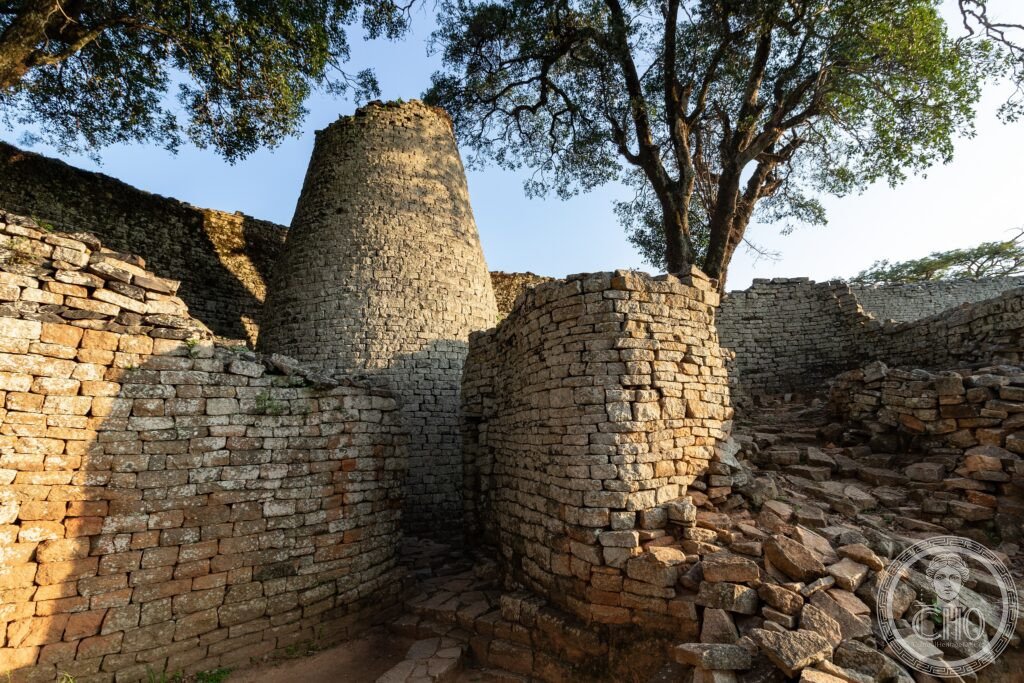
Great Zimbabwe (the Great Enclosure (Imba Huru; “The Great House”) — the largest pre-colonial stone structure in sub-Saharan Africa: the 250-m perimeter wall (5 m thick; 11 m high; constructed entirely without mortar from carefully cut and interlocked granite blocks — the most technically accomplished dry-stone construction in pre-colonial African history); the conical tower (the most debated single structure in Great Zimbabwe: an 11-m-high solid granite-block tower inside the Great Enclosure; no entrance, no internal space, entirely solid — the most architecturally mysterious single structure in any pre-colonial African monument; its function is unknown: it may represent a grain silo in architectural miniature, or a sacred symbol of the king’s power, or a cosmological representation of a termite mound (the most sacred animal structure in many Shona traditional beliefs); the outer wall and the complex patterned coursing of chevron-patterned stone near the top of the wall — the finest decorative masonry in any sub-Saharan dry-stone monument)), Great Zimbabwe National Monument, Masvingo Province, Zimbabwe — UNESCO World Heritage Site 1986. Photo via Wikimedia Commons.
Masvingo Province, Zimbabwe · built 11th–15th century CE (Shona-speaking peoples; Kingdom of Zimbabwe); Great Enclosure (250m perimeter; 5m thick; 11m high; no mortar; most technically accomplished dry-stone construction in pre-colonial Africa); conical tower (11m; solid; function unknown); Zimbabwe Bird soapstone sculptures (8 known; national symbol of Zimbabwe; on the national flag and coat of arms); gave its name to the country; most important pre-colonial monument in sub-Saharan Africa; denied by white-supremacist scholars until independence (1980) · UNESCO World Heritage 1986

Great Zimbabwe

The most important pre-colonial monument in sub-Saharan Africa and the ruins of a medieval city that gave an entire nation its name — Great Zimbabwe, built between the 11th and 15th centuries CE by the Shona-speaking ancestors of modern Zimbabweans, is a granite-walled capital whose very existence was denied by white colonists for a century because it contradicted their belief that Africans could not have built it.

At a glance

Great Zimbabwe (UNESCO WHS 1986; the site covers approximately 7.22 km² — the most extensive pre-colonial ruined city in sub-Saharan Africa; the name (from the Shona dzimba dza mabwe — “houses of stone” — the most architecturally descriptive place name in the Shona language; the name was adopted as the name of the independent nation (Zimbabwe) in 1980 — the only country in the world named after an archaeological site; the most politically consequential single name choice in the history of African independence); the three zones (the Hill Complex (the oldest section; the Acropolis; the royal residence on a granite hill 80 m above the valley; the oldest stone walls at the site (11th century CE)); the Valley Complex (the ruins of the city streets and residential compounds; the most extensive ruined area; the most archaeologically informative zone); the Great Enclosure (the most famous and best-preserved section; described below; built in the late 14th–15th centuries CE by the Shona Kingdom of Zimbabwe at its peak power)); the population at the peak (at its maximum (c. 1350–1420 CE), the Great Zimbabwe settlement housed an estimated 11,000–18,000 people — the largest pre-colonial city in sub-Saharan Africa south of the Zambezi River; the most populated pre-colonial settlement in the interior of southern Africa).

Key facts

  • The Great Enclosure and the dry-stone technique: the finest pre-colonial architecture in Africa — the Great Enclosure (the outer wall: 250 m perimeter; 5 m thick at the base; 11 m high; built from approximately 900,000 blocks of granite (the most precisely counted building blocks of any pre-colonial African structure — the count was made by archaeologist Gertrude Caton-Thompson in the 1929 excavation (the most important single woman archaeologist in the history of African archaeology; her excavation proved conclusively that Great Zimbabwe was built by Bantu-speaking Africans — the most politically significant single archaeological finding of the 20th century in Africa)); the masonry (the most important single technical fact about Great Zimbabwe: the walls are entirely dry-stone — no mortar, no adhesive, no mud; the granite blocks were quarried from the natural exfoliation sheets of the local granite outcrops (the most efficient quarrying method in the African Savanna: the granite exfoliates naturally into flat slabs along the bedding planes; the Shona builders simply exploited the natural joints to extract flat-faced stones that could be stacked without mortar)); the decorative coursing (the chevron pattern frieze near the top of the outer wall — the most ornate decorative programme on any dry-stone wall in southern Africa); the conical tower (described in hero caption; the most debated single structure in pre-colonial African archaeology))
  • The Zimbabwe Birds: the most important portable artworks of pre-colonial Africa — the Zimbabwe Bird sculptures (8 known soapstone bird sculptures (Bunga; a stylised representation somewhere between an eagle and a fish eagle — the most debated species identification in African zooarchaeological art history (is it a fish eagle? a bateleur eagle? a generic raptor?); each sculpture is approximately 40 cm tall; each sits on a stone pedestal (the pedestals were found in the Hill Complex — the most important spatial data for interpreting their function: they flanked the royal approach to the Acropolis residence)); the national symbol (the Zimbabwe Bird appears on the national flag, the coat of arms, and the banknotes of Zimbabwe — the most widely reproduced pre-colonial African artefact in any modern national iconography; the only pre-colonial artefact that is the primary national symbol of a modern African state); the colonial theft (5 of the 8 known birds were taken to South Africa and Europe during the colonial period; most have been returned but the whereabouts of all original birds have been the subject of the most persistent repatriation dispute in southern African museum history))
  • The racial politics of denial: the most politically distorted archaeological narrative in Africa — the colonial denial (the most remarkable episode in the history of archaeology: from the 1890s to the 1970s, white Rhodesian government policy and several prominent archaeologists actively denied that Great Zimbabwe had been built by indigenous Africans; the alternatives proposed: Phoenician traders (the most exotic attribution: the argument was that the Orient Express of the ancient world had somehow reached Zimbabwe); the Queen of Sheba (the Biblical attribution); King Solomon’s mines (the most romantic attribution: H. Rider Haggard set King Solomon’s Mines (1885) at a Zimbabwean prototype); the most dishonest single archaeological conclusion in the history of African archaeology: the government of Ian Smith’s Rhodesia made it illegal for state archaeologists to publicly attribute the ruins to African builders in the 1970s (the most extreme act of state censorship of archaeological evidence in the 20th century); the scientific consensus (Gertrude Caton-Thompson (1929); subsequent excavations by Roger Summers (1958) and Thomas Huffman (1971–1985) conclusively proved Shona origin; the most comprehensively vindicated archaeological finding in 20th-century African prehistory))
  • Heritage: UNESCO World Heritage Site, Great Zimbabwe National Monument, inscribed 1986
  • GPS: -20.2670° N, 30.9340° E

History

The Kingdom of Zimbabwe (the Great Zimbabwe was the capital of the Kingdom of Zimbabwe (approximately 1220–1450 CE; the most powerful pre-colonial kingdom in the interior of southern Africa; the kingdom controlled the gold and ivory trade between the interior of southern Africa and the Swahili Coast ports (Sofala, Kilwa Kisiwani) and thence to India and the Middle East — the most commercially significant pre-colonial trading network in southern Africa; the gold (the most important export: the interior of Zimbabwe sat above the largest gold deposits in southern Africa; the Shona miners extracted placer gold from rivers and reef gold from mines; the gold was traded to Arab and Indian merchants at the Swahili Coast); the decline (the Great Zimbabwe was abandoned in approximately 1420–1450 CE; the cause (the most debated single abandonment in pre-colonial African archaeology: the soil exhaustion theory (the most widely accepted: the intensive settlement of 11,000–18,000 people depleted the local soil and timber resources beyond recovery); the trade route shift theory (the Swahili Coast gold trade shifted to Kilwa in the north, making the southern route less profitable — the most commercial explanation for a political capital’s abandonment); the political succession (after abandonment, the Mutapa kingdom succeeded the Zimbabwe kingdom as the dominant power in the plateau, establishing a new capital at Zvongombe in northern Zimbabwe — the most significant succession capital in the pre-colonial history of the Zimbabwe plateau)); UNESCO WHS 1986.

What you see

The Great Zimbabwe visit (the site museum (the most important single part of the visit for context: the Zimbabwe Birds soapstone sculptures (replicas; the originals are in the site museum and the National Museum of Zimbabwe in Harare); the archaeological exhibition explaining the gold trade and the dry-stone construction technique)); the Great Enclosure walk (the outer enclosure wall; the passage between the inner and outer walls (the most atmospheric walk at the site: the narrow passage is 80 m long and 1.5 m wide — just wide enough for two people to pass; the towering walls on both sides produce the most dramatic enclosed-path experience in any pre-colonial African monument); the conical tower (the interior of the Great Enclosure; the most enigmatic single structure at the site)); the Hill Complex (the oldest and highest part of the site; the Acropolis; accessed via a steep path; the view from the top (the finest panorama of the surrounding Savanna and the valley ruins below — the most expansive historical landscape view in Zimbabwe)); the valley between the Hill Complex and the Great Enclosure (the ruined walls of the ancient city streets; the most extensive ruined urban area at the site).

Practical information

  • Getting there: Harare International Airport (HRE; 300 km north; 3h 30min by road via Masvingo; or Masvingo Airport (MVZ; 30 km from the site; no scheduled commercial flights as of 2026 — the most inaccessibly served UNESCO site in Zimbabwe); by road from Harare (the A4 highway south via Chivhu to Masvingo; the most reliable and most recommended approach; the road is paved but road quality varies); by bus (Harare–Masvingo express buses; 4h; from Harare Mbare musika bus terminal; the most economical approach; a taxi or kombi from Masvingo town centre to the site (30 km; 40min) completes the journey); by self-drive (the most comfortable approach: the site is 30 km south of Masvingo on the B7 road; well signposted from the A4 highway); the accommodation (the Great Zimbabwe Hotel (the most convenient accommodation: 1 km from the site entrance; swimming pool; the finest view of the Hill Complex from the hotel terrace — the most atmospheric hotel terrace view in Zimbabwe))
  • Hwange National Park: the finest elephant habitat in Africa — Hwange (600 km west of Harare; approximately 8h drive via Bulawayo; or fly from Harare to Hwange Airport (WKI)); the park (Hwange National Park: the largest national park in Zimbabwe; 14,620 km²; the finest elephant population in Africa: approximately 45,000–50,000 elephants (the largest single population of African elephants in any national park in southern Africa — the most elephants visible in a single day in any African game reserve; the artificial waterholes (the most important single infrastructure in Hwange: 60+ pumped water points that concentrate the game in the dry season (August–October) to produce the most reliable wildlife concentrations in any southern African park); the lions (approximately 500 lions — the finest lion-watching in Zimbabwe; the Wild Dog Research Trust (the most important African Wild Dog conservation programme in southern Africa: the packs of Hwange are the most studied wild dog population in Zimbabwe))
  • Victoria Falls and Zambia: the most powerful waterfall in Africa — Victoria Falls (100 km west of Hwange; 100 km east of Livingstone, Zambia; a 45-min drive from Hwange; the dual-country falls: on the Zimbabwe-Zambia border; the Devil’s Pool (the most extreme natural swimming pool in the world: a natural rock pool at the edge of the Victoria Falls that fills during high water season (September–December) and in which swimmers can look over the 108-m drop; the most recklessly adventurous heritage attraction in southern Africa; guided only; the most frequently cited life experience at Victoria Falls by independent travellers); described in further detail in its own place card at culturalheritageonline.com/places/victoria-falls-zambia-zimbabwe)

Getting there

Harare Airport (HRE) 300 km (3h 30min drive via Masvingo). Masvingo town 30 km (taxi 40min). Great Zimbabwe Hotel on site (most convenient base). Open daily 8am–5pm. GPS: -20.2670, 30.9340.

Nearby

  • Hwange National Park — 600 km west (8h drive from Harare via Bulawayo); the finest elephant habitat in Africa and the largest concentration of African elephants in any national park — described in Practical section; the essential Zimbabwe circuit: Harare + Great Zimbabwe (1 night) + Bulawayo (the Matobo Hills UNESCO WHS 2003 (the finest rock-art concentration in southern Africa; the Rhodes grave on the summit of View of the World; the 20th-century painter Carel Weight painted the Matobo Hills — the most Scottish-looking landscape in Africa) + 2 nights) + Hwange (2 nights) + Victoria Falls (1 night)
  • Mapungubwe National Park (UNESCO WHS 2003, South Africa) — 800 km south via Beit Bridge; the precursor kingdom to Great Zimbabwe and the finest gold-working site in pre-colonial southern Africa — Mapungubwe (the most important pre-colonial state in the Limpopo River valley (c. 1200–1300 CE; the precursor to the Zimbabwe kingdom; the gold rhino (the most famous pre-colonial gold artefact in southern Africa: a small rhinoceros figure made of beaten gold foil (the most technically accomplished pre-colonial gold-working in any southern African site; found in a royal burial at Mapungubwe Hill; the most valuable single artefact in any South African national museum); UNESCO WHS 2003
  • Gonarezhou National Park and the Limpopo Transfrontier Park — 200 km south-east of Great Zimbabwe; the wildest national park in Zimbabwe and the finest wilderness landscape in the south-east — Gonarezhou (the name means “Place of Elephants” in the Ndau language; the most remote and least-visited national park in Zimbabwe; the Chilojo Cliffs (the most dramatic geological feature in Gonarezhou: 300-m red sandstone cliffs above the Runde River — the finest cliff-face panorama in southern Africa); the Limpopo-Shashe Transfrontier Conservation Area (one of the largest transboundary conservation areas in the world: covering Zimbabwe + Botswana + South Africa; the most politically collaborative wildlife conservation project in southern Africa))

Sources

  • Wikipedia, Great Zimbabwe; Kingdom of Zimbabwe; Zimbabwe Bird, accessed June 2026
  • UNESCO, Great Zimbabwe National Monument, WHS reference 364, inscribed 1986
  • Gertrude Caton-Thompson, The Zimbabwe Culture: Ruins and Reactions, Clarendon Press, 1931

Hero image: Great Zimbabwe ruins, Wikimedia Commons. Editorial text © Cultural Heritage Online, 2026.

📷 Diventa un fotografo di Cultural Heritage Online

Condividi le tue foto dei luoghi: restano pubblicate con la tua firma come autore. Più vengono viste, più ti fai conoscere — e presto un concorso premierà le foto più apprezzate.

Accedi o registrati gratis per aggiungere una foto
📋 Copy & share on social
Scroll to Top