

Ivrea is the only city in the world inscribed on the UNESCO World Heritage List as an industrial city of the twentieth century — the place where Adriano Olivetti attempted to prove that a factory could be a social institution, and that design was an instrument of human dignity.
At a glance
The Archivio Storico Olivetti at Via Jervis 11 in Ivrea preserves the documentary heritage of Olivetti S.p.A. — the typewriter, calculating machine, and computer company whose cultural programme between 1930 and 1980 made it the most artistically ambitious industrial corporation in Europe. The archive holds design drawings, prototypes, photographic records, and corporate documents relating to the products designed by Marcello Nizzoli (Lettera 22, Divisumma 24), Ettore Sottsass (Elea 9003, the first Italian mainframe computer; Valentine typewriter), Mario Bellini (Divisumma 18), and others. Beyond the archive, the city of Ivrea itself constitutes an outdoor museum: more than 70 buildings designed between 1934 and 1960 by modernist architects including Luigi Figini, Gino Pollini, and Ignazio Gardella form the UNESCO-inscribed “20th-century industrial city.”
Key facts
- UNESCO inscription: 2018 (Industrial city of Ivrea)
- Archivio Storico address: Via Guglielmo Jervis 11, 10015 Ivrea (TO)
- GPS: 45.4594, 7.8703
- Collection: Design drawings, prototypes, photographs, corporate records of Olivetti 1908–2000
- Key architects: Luigi Figini, Gino Pollini, Ignazio Gardella, Marco Zanuso
- Reference: Fondazione Adriano Olivetti
History
Camillo Olivetti founded the Olivetti typewriter factory in Ivrea in 1908 in a converted shed — the first Italian typewriter manufacturer. His son Adriano Olivetti, who took over the company in 1938, transformed it into one of the most extraordinary experiments in corporate culture the twentieth century produced. Adriano believed that the factory was a social institution with obligations to the workers and the city: he built workers' housing to the designs of Italy's best architects, established the Olivetti Cultural Centres across Italy (canteen-cum-community-hall hybrids designed by the same architects who built the factories), and recruited a design team — Marcello Nizzoli, Ettore Sottsass, Mario Bellini — whose output defined Italian industrial design for two generations.
The products match the ambition. The Lettera 22 portable typewriter (1950, Nizzoli) won the Compasso d'Oro in 1954 and was selected by Illinois Institute of Technology as one of the hundred best products of industrial design in 1959. The Elea 9003 (1959, Sottsass), the first transistorised mainframe computer built in Italy, was the product that established the aesthetic vocabulary for electronic machinery: cool, precise, coloured in industrial pastels rather than the institutional grey that IBM and Burroughs used. The Valentine portable typewriter (1969, Sottsass and Perry King), with its red plastic casing and foam handle, was designed to be used anywhere — a portable office tool for the generation that was reinventing how people worked.
Adriano Olivetti died suddenly in 1960 on a train between Milan and Lausanne. The company continued to innovate — the Programma 101 of 1965, marketed by Olivetti, is often cited as the world's first commercially available personal computer — but the cultural programme lost its integrating vision. Olivetti's personal computing division was sold to Canon in 1990; the company itself was acquired by Telecom Italia in 1999.
What you see
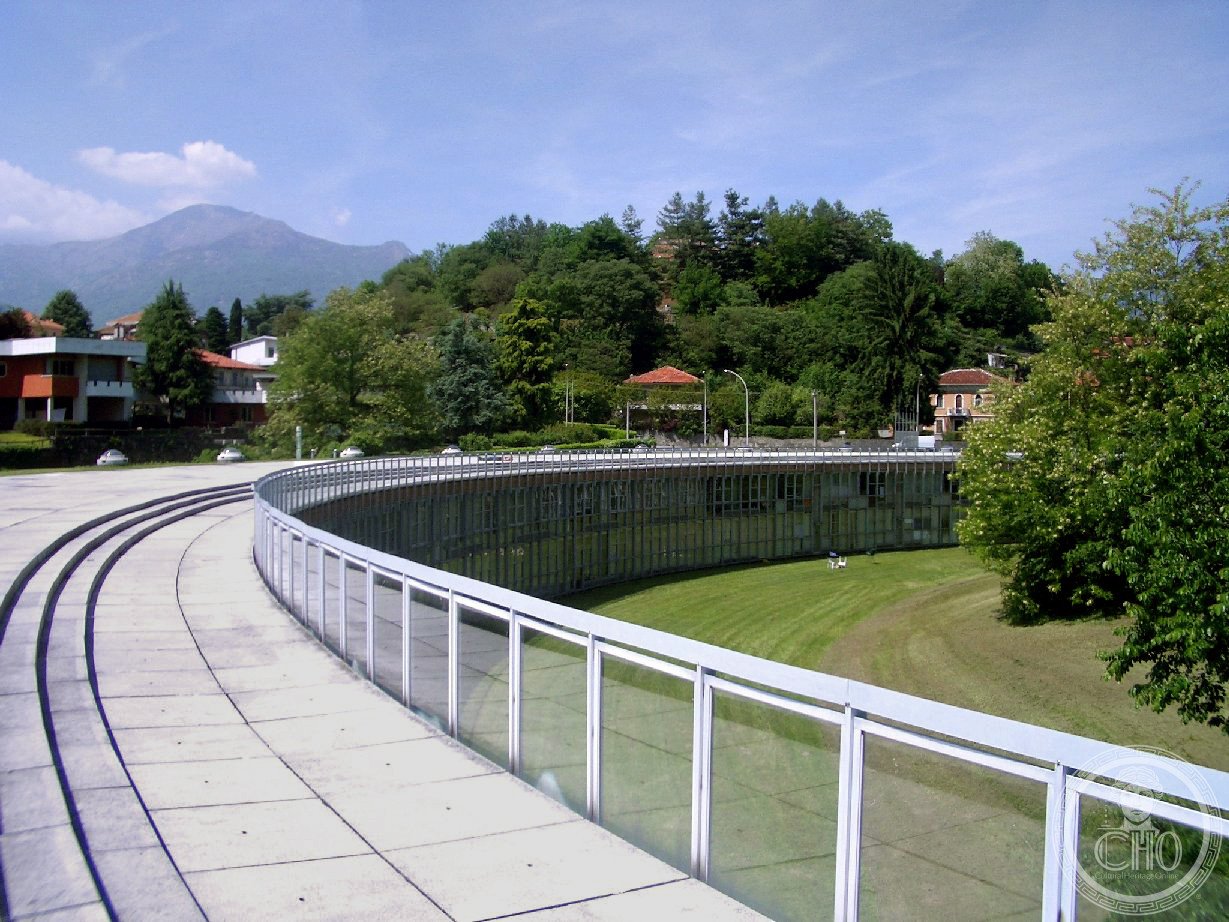
The Olivetti factory complex at Ivrea is unlike any other industrial site in Italy. Figini and Pollini's main factory building (1934–1957) deploys a rigorous modernist grid while allowing natural light into every workshop; the rooftop garden, the canteen building, and the adjacent nursery (1940) treat the industrial campus as a total environment. The Social Services building (Figini and Pollini, 1954) and the research centre (1955) demonstrate the same principle: that industrial architecture does not stop at the factory gate but extends into housing, culture, and welfare.
The city's UNESCO inscription in 2018 recognised not just the buildings but the urban idea behind them: that a single industrial company, with the right cultural and social programme, could transform a provincial Piedmontese town into a model for how industrial modernity might be organised. Walking the Olivetti campus — from the factory to the workers' housing estates, to the Talponia canteen, to the residential neighbourhoods of Bellavista — is the fullest available experience of Adriano Olivetti's total vision.
Practical information
- Archivio Storico Olivetti: Access by appointment; contact Fondazione Adriano Olivetti
- UNESCO city walk: Free, self-guided; map available at Ivrea tourist office
- Olivetti showroom / museum space: Check current programming at canavesano.it
- Time needed: Half day (city walk + main buildings) to full day (archive visit + all sites)
Getting there
Ivrea is 50 km north of Turin on the Turin–Aosta railway (direct trains from Turin Porta Nuova: 55 minutes). From Ivrea station, the Olivetti campus on Via Jervis is 10 minutes on foot across the centre. By car: A5 autostrada Turin–Aosta, exit Ivrea, then 5 minutes to the industrial district. From Milan: 90 minutes via A4 and A5.
Nearby
- Ivrea historic centre — Cathedral, medieval tower, Canavese landscape; adjacent to the industrial city
- Lago di Viverone — 10 km east, pile dwelling site (UNESCO 2011), Bronze Age heritage
- Torino — 50 km south, Museo Egizio, Mole Antonelliana, MAUTO, Pininfarina
- Parco Nazionale Gran Paradiso — 60 km north-west, first Italian national park (1922)
Sources
- UNESCO World Heritage: Ivrea, industrial city of the 20th century (WHC #1538)
- Fondazione Adriano Olivetti: associazioneadrianolivetti.it
- Wikipedia (English): Olivetti
- Wikipedia (Italian): Olivetti (it)
- Wikimedia Commons: File:Ivrea talponia.jpg, Public Domain
- Nominatim / OpenStreetMap: GPS 45.4594, 7.8703
Find it on the map
See this place and what’s around it →Historical events at this place (2)
📷 Become a Cultural Heritage Online photographer
Share your photos of places: they stay published under your name as the author. The more they're seen, the more you get noticed — and soon a contest will reward the most appreciated photos.
Log in or sign up free to add a photoIs this page about you?
This page is read by travellers and heritage enthusiasts who find it on Google. Tell us how you are connected to this place and we will take it from there.