
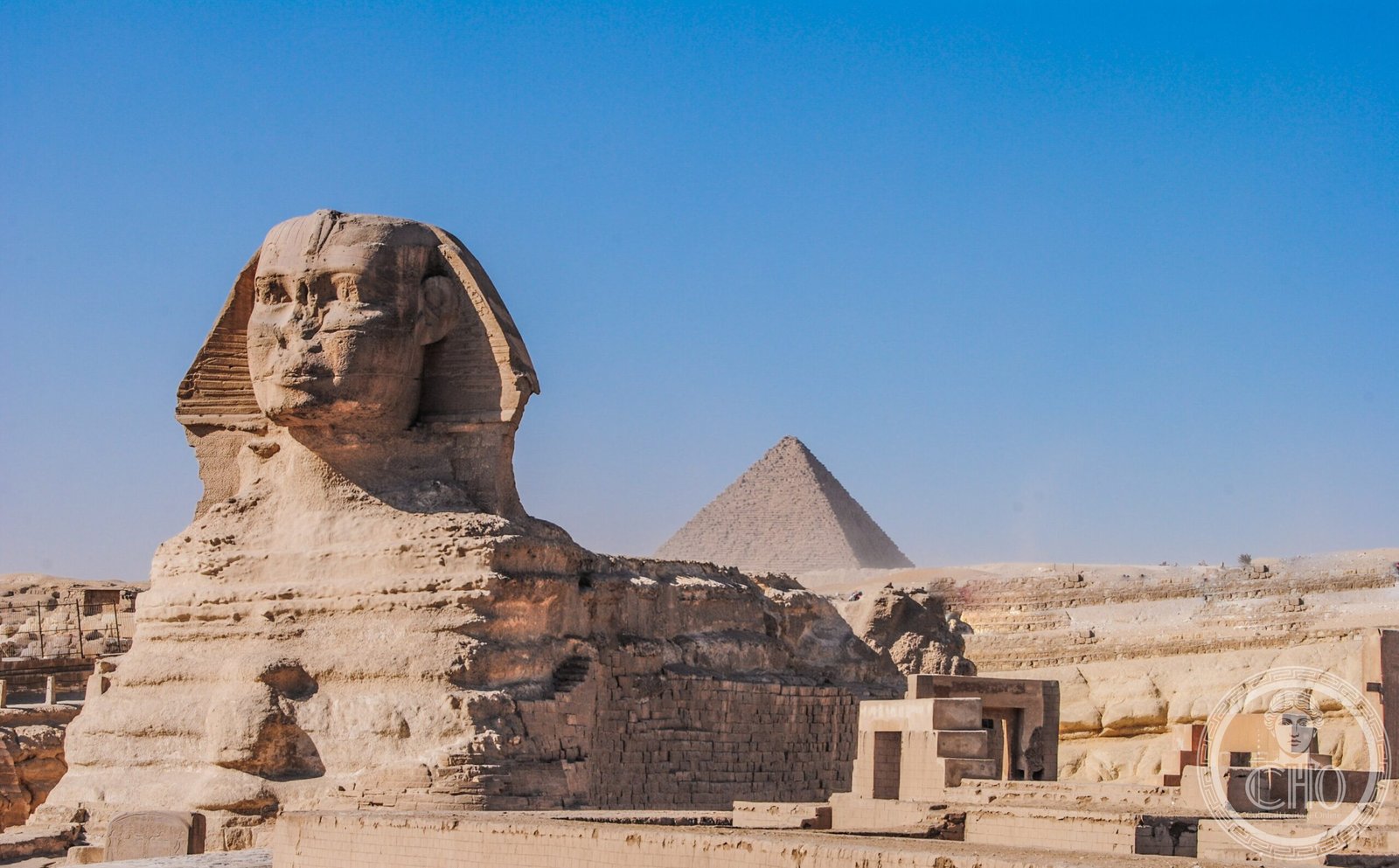
A colossal limestone sphinx carved from bedrock during Egypt’s Old Kingdom, the Great Sphinx remains the world’s oldest monumental sculpture, its weathered gaze commanding the Giza Plateau for nearly 4,600 years.
At a glance
This legendary guardian of the Giza Plateau combines a human head with a lion’s body, carved entirely from the living limestone of the Eocene-aged Mokattam Formation. Facing east across the desert, it stands as Egypt’s most iconic monument and a UNESCO World Heritage Site within the broader Memphite Necropolis.
History
Archaeological evidence points to construction during the Old Kingdom, most likely under Pharaoh Khufu (c. 2590–2566 BC) or his successor Khafre (c. 2558–2532 BC). The identity of the face—whether representing Khufu, his son Djedefre, Khafre, or another royal figure—remains disputed among scholars, with no scholarly consensus yet reached.
The Sphinx’s most distinctive loss, its nose, occurred through deliberate damage involving rods or chisels. Contrary to popular legend, Napoleon’s 1798 Egyptian campaign was not responsible, despite centuries of attribution to French cannonfire.
Multiple restoration campaigns have preserved the monument. Recent work replaced limestone blocks around the base, addressing centuries of weathering and structural stress.
What you see
The Sphinx measures 73 metres (240 feet) from paw to tail, rises 20 metres (66 feet) from base to crown, and spans 19 metres (62 feet) across its rear haunches. Its massive scale was achieved through direct carving from bedrock rather than assembly—a feat of Old Kingdom engineering and artistry that demonstrates sophisticated understanding of stone work and monumental planning.
Cultural significance
As Egypt’s oldest known monumental sculpture, the Sphinx defined the visual language of pharaonic power and endurance. Its hybrid form—human intelligence united with leonine strength—expressed ideals central to royal iconography. For millennia it has symbolized ancient Egypt itself, captivating explorers, scholars, and pilgrims across the world.
Key facts
- Country: Egypt
- City: Giza
- Coordinates: 29.97526, 31.13758
- Period: Old Kingdom (c. 2590–2532 BC)
- Dimensions: 73 m long, 20 m high, 19 m wide at haunches
- UNESCO World Heritage Site (Memphite Necropolis)
- Material: Limestone (Mokattam Formation)
Practical information & getting there
The Great Sphinx is located on the Giza Plateau, on the west bank of the Nile River near Cairo. It forms part of the Giza pyramid complex and is accessible year-round to visitors. Plan your visit in cooler morning or late afternoon hours. For detailed opening hours, admission prices, and current restoration updates, consult official Egyptian tourism resources before traveling.
Sources & resources
Find it on the map
See this place and what’s around it →📷 Become a Cultural Heritage Online photographer
Share your photos of places: they stay published under your name as the author. The more they're seen, the more you get noticed — and soon a contest will reward the most appreciated photos.
Log in or sign up free to add a photoIs this page about you?
This page is read by travellers and heritage enthusiasts who find it on Google. Tell us how you are connected to this place and we will take it from there.