
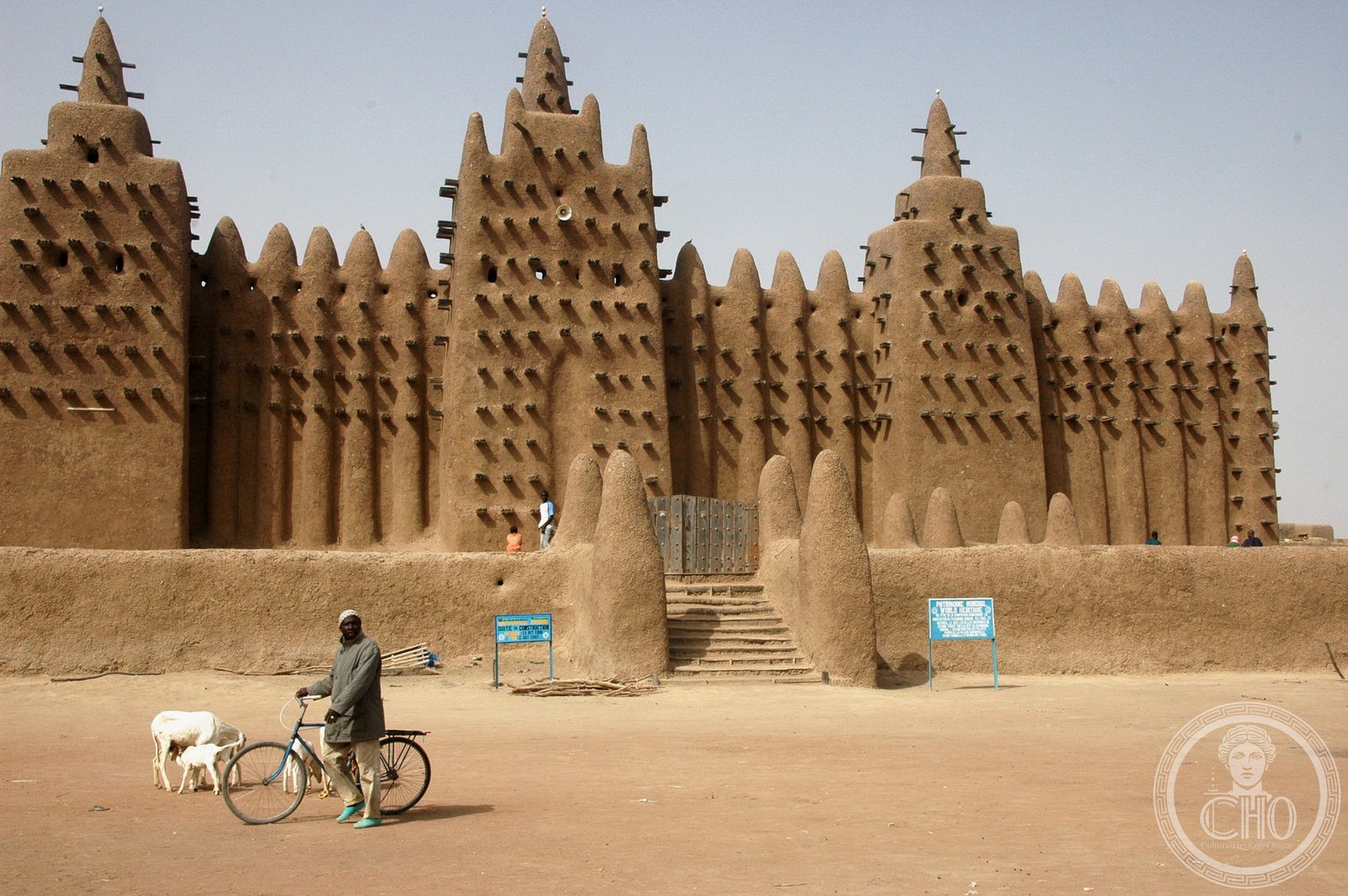
The world’s largest adobe brick building stands as a masterpiece of Sudano-Sahelian architecture and the spiritual heart of a historic West African city.
At a glance
This monumental mosque dominates the city of Djenné on Mali’s Bani River floodplain. Constructed entirely of mud brick, it represents both a technical achievement and a symbol of Islamic faith in the Sahel. Its fortress-like silhouette and projecting wooden beams are instantly recognizable across the continent.
History
A mosque has occupied this site since around the 13th century, reflecting Djenné’s emergence as a major Islamic center. The current structure was rebuilt in 1907, replacing an earlier version that had deteriorated. This reconstruction established the form that defines the city’s skyline today and remains central to Djenné’s identity as a spiritual and commercial hub.
What you see
The Great Mosque showcases Sudano-Sahelian design principles: a massive rectangular plan with a projecting entrance portico, three minarets, and a distinctive façade studded with wooden scaffolding poles. These protruding timbers serve both structural and aesthetic functions, their regular pattern creating visual rhythm across the earthen walls. The building’s scale and material—sun-dried adobe—make it an engineering marvel in a region prone to heavy seasonal rains.
Cultural significance
The mosque is far more than a place of worship; it anchors Djenné’s community life and represents a continuous African Islamic tradition spanning centuries. Its form influenced architectural practice across the Sahel and exemplifies how local materials and climate shape monumental design. UNESCO recognized both the mosque and the Old Towns of Djenné as World Heritage Sites in 1988, acknowledging their outstanding universal value.
Key facts
- Location: Djenné, Mali
- Coordinates: 13.9053°N, 4.5556°W
- Built: 1907 (earlier mosque from c. 13th century)
- Material: Adobe brick
- UNESCO World Heritage Site: 1988
- Architectural style: Sudano-Sahelian
Practical information & getting there
Djenné is accessible by road from Bamako, Mali’s capital, though travel times vary with seasonal flooding on the Bani River. The mosque remains an active place of worship; visitors should respect prayer times and dress modestly. The surrounding city retains much of its medieval character and is worth exploring. Consult current travel advisories before planning your visit.
Sources & resources
Find it on the map
See this place and what’s around it →📷 Become a Cultural Heritage Online photographer
Share your photos of places: they stay published under your name as the author. The more they're seen, the more you get noticed — and soon a contest will reward the most appreciated photos.
Log in or sign up free to add a photoIs this page about you?
This page is read by travellers and heritage enthusiasts who find it on Google. Tell us how you are connected to this place and we will take it from there.