
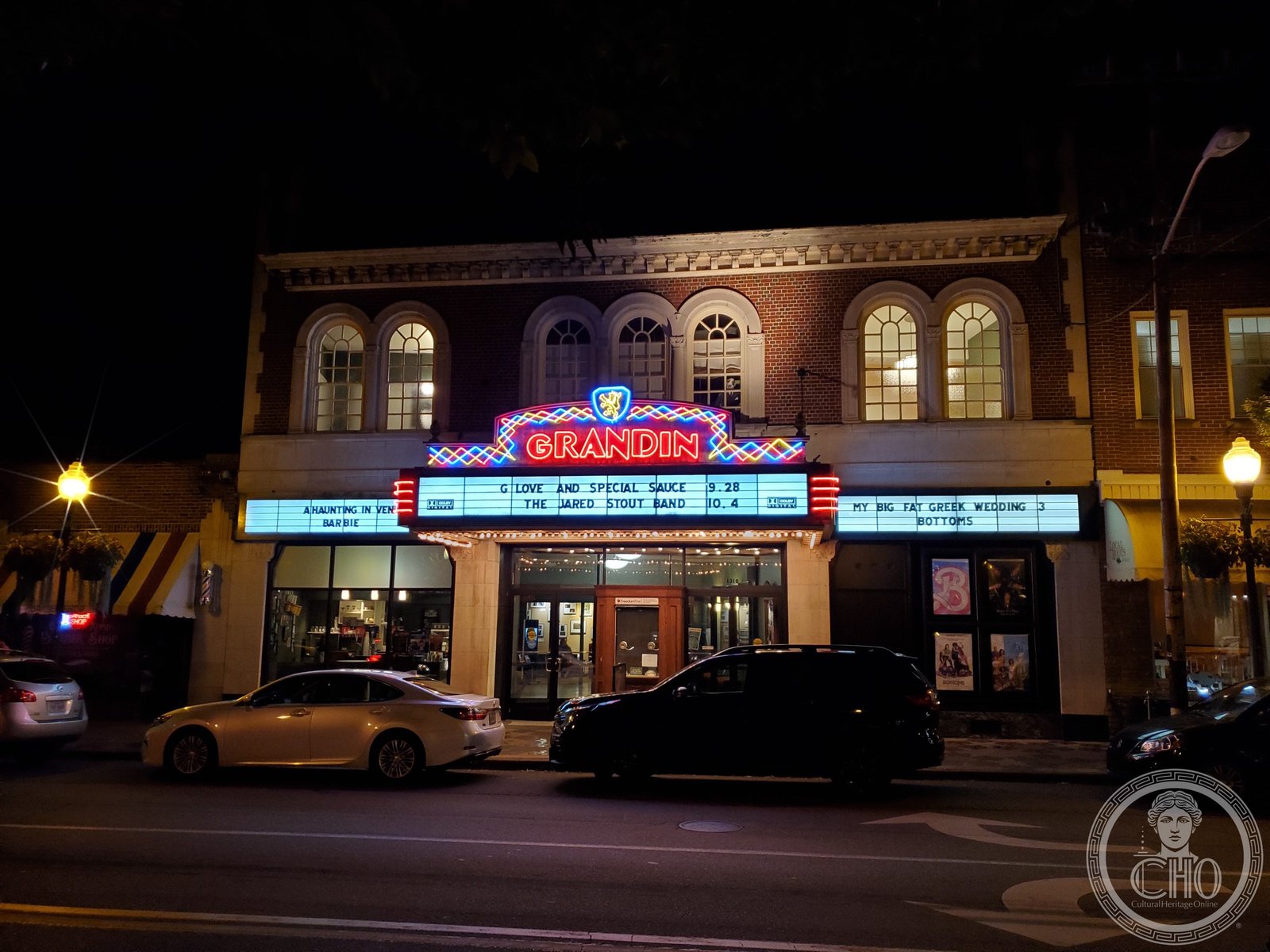
Opened in 1932 on a commercial street in the Grandin Village neighborhood of southwest Roanoke, the Grandin Theatre has operated as a cinema for over nine decades through the decline of the neighborhood movie house, becoming in the process one of the oldest continuously operating independent cinemas in Virginia.
At a glance
The Grandin Theatre occupies a particular position in Roanoke’s cultural geography: not the downtown picture palace (Roanoke has those, and they belong to a different chapter of the city’s history) but the neighborhood cinema, the theater that served the residents of the residential streets spreading southwest from downtown toward the Blue Ridge foothills. Grandin Village — a mixed commercial and residential district laid out in the first decades of the twentieth century — gave the theater its name and its audience: middle-class Roanoke families who could walk to the movies on a Friday evening without needing the Norfolk and Western Railway station or the downtown hotels. The theater opened in 1932 and has operated in this capacity, with interruptions and near-closures that tested its community’s attachment, for over nine decades. It now runs as an independent cinema with a programming calendar that combines current releases, repertory screenings, and community events, and its survival has become a story told in Roanoke as an example of what a neighborhood can accomplish when it decides to keep something.
Key facts
- Built: 1932
- Style: Art Deco
- Address: 1310 Grandin Road SW, Roanoke, Virginia 24015
- Neighborhood: Grandin Village Historic District
- Current use: Independent cinema and community venue
- GPS: 37.2560° N, −79.9825° W
History
Roanoke in 1932 was a railroad city in the Virginia Blue Ridge, its economy organized around the Norfolk and Western Railway shops and headquarters that had transformed a crossroads settlement into a small industrial city in the 1880s. The Grandin Village neighborhood, developed in the early twentieth century as streetcar-accessible residential territory southwest of downtown, was the kind of middle-class urban fabric that supported neighborhood cinemas — close enough to walk, far enough from downtown to justify its own local entertainment corridor.
The theater that opened at 1310 Grandin Road in 1932 served this neighborhood through the golden years of American cinema, the transition to television in the 1950s, the suburban multiplex competition of the 1960s and 1970s, and the economic pressures that shuttered most comparable theaters across the country. Each time the Grandin faced closure, a community response kept it operating: fundraising campaigns, volunteer labor, and the kind of organized civic attachment that forms around places people have been going to since childhood.
The theater was added to the Grandin Village Historic District on the National Register of Historic Places, alongside the commercial strip that grew up around it in the 1920s and 1930s. The district preserves the streetscape of early-twentieth-century neighborhood commercial development in Roanoke at a level of completeness unusual for Virginia’s urban interior.
What you see
The Grandin Theatre facade on Grandin Road is a restrained but coherent Art Deco composition: geometric ornament above the entrance, horizontal banding across the brick face, vertical emphasis at the marquee that draws the eye upward from the sidewalk. The theater is not a grand palace — its scale matches the neighborhood rather than the downtown commercial district — but its detailing is consistent and correct, the product of an architectural culture that had developed a professional vocabulary for buildings of this type and size.
Inside, the auditorium is a single-screen room whose proportions have been maintained through the decades of operation. The restored interior and the updated projection equipment coexist with the original layout in a way that characterizes surviving neighborhood cinemas: the bones are historic, the systems are contemporary, and the combination produces a movie-watching experience that the multiplexes cannot replicate.
Practical information
- Cinema schedule: current releases plus repertory programming; check the Grandin Theatre website for current calendar
- Tickets: available online and at the box office
- Parking: street parking on Grandin Road and adjacent residential streets; a short walk from either direction on the commercial strip
- Time needed: allow time for the film plus a walk along Grandin Village’s commercial strip of independent restaurants and shops
Getting there
Roanoke-Blacksburg Regional Airport (ROA) is approximately 5 miles northeast of the Grandin Theatre; the airport connects to Charlotte, Atlanta, Philadelphia, and Washington Dulles. Roanoke is on Interstate 81, one of the primary north-south corridors of the Virginia Appalachians; the city is approximately 45 miles south of Lexington and 55 miles north of Christiansburg along the Valley floor. From Roanoke’s downtown, the Grandin Theatre is about 2 miles southwest along Brandon Avenue SW and Grandin Road SW.
Nearby
- Taubman Museum of Art — regional and American art collection in a landmark landmark Randall Stout Architects building (2008); approximately 2 miles northeast in downtown Roanoke
- Mill Mountain Star — the neon star visible from most of Roanoke on the 1,700-foot summit of Mill Mountain, accessible from the Grandin Village side via the Mill Mountain Greenway; 1.5 miles southeast
- Blue Ridge Parkway — the scenic motor road connecting Shenandoah and Great Smoky Mountains national parks passes immediately south of Roanoke; the nearest access point is the Roanoke Mountain Campground, approximately 5 miles south
- Roanoke City Market — Virginia’s oldest continuously operated open-air market (1874), downtown at Market Square; a mix of produce, crafts, and regional food
Sources
- Grandin Theatre, Roanoke — operating history and venue documentation
- National Register of Historic Places — Grandin Village Historic District nomination
- Virginia Department of Historic Resources — Roanoke architectural surveys
- Roanoke Times — archival coverage of theater history and preservation campaigns
- Wikimedia Commons — building image
Find it on the map
See this place and what’s around it →📷 Become a Cultural Heritage Online photographer
Share your photos of places: they stay published under your name as the author. The more they're seen, the more you get noticed — and soon a contest will reward the most appreciated photos.
Log in or sign up free to add a photoIs this page about you?
This page is read by travellers and heritage enthusiasts who find it on Google. Tell us how you are connected to this place and we will take it from there.