
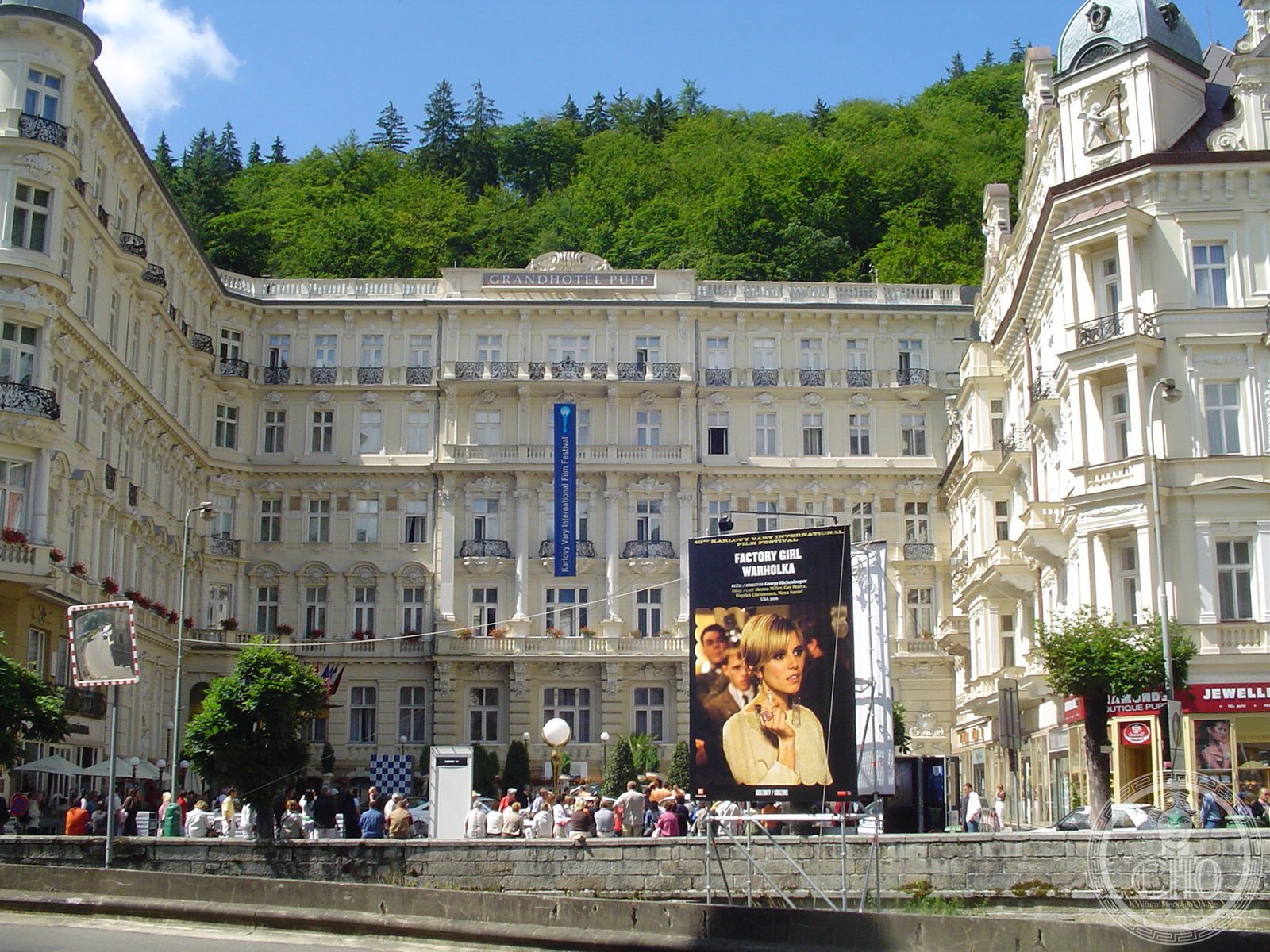
One of Central Europe’s oldest grand hotels, the Pupp has anchored Karlovy Vary’s spa promenade since 1701 — its Neo-Baroque silhouette unchanged since Fellner & Helmer rebuilt it at the dawn of the twentieth century.
At a glance
Rising above the Teplá river colonnade at Mírové náměstí, the Grandhotel Pupp is the architectural centrepiece of a spa town now inscribed on the UNESCO World Heritage List. Ferdinand Fellner (1847–1916) and Hermann Helmer (1849–1919) — the Austro-Hungarian duo responsible for more than 200 theatres and grand buildings across the empire — unified two older ballroom halls into a single Neo-Baroque palace between 1896 and 1907. The result is 228 rooms of sustained Belle Époque luxury. Each summer the hotel serves as the beating heart of the Karlovy Vary International Film Festival, one of Europe’s longest-running cinema events.
Key facts
- Built: 1701 (original Saxony Hall); rebuilt 1896–1907 by Fellner & Helmer
- Style: Neo-Baroque with Art Nouveau detailing
- Status: Operating luxury hotel (228 rooms)
- Address: Mírové náměstí 2, 360 01 Karlovy Vary, Czech Republic
- GPS: 50.2194, 12.8789 — Open in Google Maps
- UNESCO/Listed: Part of “The Great Spa Towns of Europe” UNESCO World Heritage Site (inscribed 2021, criteria ii, iii)
History
The story begins in 1701, when Karlovy Vary’s Burgomaster Deiml erected the Saxony Hall on the western bank of the Teplá — a public venue for the aristocratic visitors who came each season to take the curative waters. A second structure, the Bohemia Hall, followed nearby. Jan Jiří Popp, a confectioner of Franconian origin, arrived in the town in 1760; he married into the Mitterbach family in 1775, acquiring a share in the Bohemia Hall, and by 1776 the Popp — later Pupp — family held full control. The commercial instinct ran deep: in 1890 the family also purchased the Saxony Hall, uniting both properties under one ownership.
With two ageing wooden halls under their belt, the Pupps commissioned the Vienna firm of Fellner & Helmer to create something worthy of the fin-de-siècle spa season. Construction ran from 1896 to 1907, replacing the original structures with a monumental Neo-Baroque complex. The hotel’s fortunes changed abruptly in 1950, when the newly communist Czechoslovak state nationalized it and renamed it Grandhotel Moskva. The original name was not restored until 1989, following the Velvet Revolution and subsequent privatisation.
The Grandhotel Pupp gained a new layer of international recognition when it served as a stand-in for the fictional Casino Royale Montenegro in the 2006 James Bond film of the same name. Karlovy Vary’s wider spa district — of which the hotel is the defining monument — was inscribed on the UNESCO World Heritage List in 2021 as part of the transnational “Great Spa Towns of Europe” property.
What you see
The principal façade stretches in creamy stucco across Mírové náměstí, its central projecting bay crowned by a mansard roof and flanked by symmetrical wings. Fellner & Helmer applied their theatre-trained sense of grandeur: rusticated lower storeys give way to pilasters and arched windows at piano nobile level, while ornamental cartouches punctuate the cornice. The effect is of controlled imperial splendour rather than florid excess. Step back across the square and the roofline reads as one unbroken gesture — rare for a building assembled from two older structures.
Inside, the Grand Restaurant retains its original coffered ceiling and gilded stucco columns, the room tall enough that conversation carries a faint echo. The Pupp’s ballroom — historically the main draw for visiting aristocracy — preserves parquet flooring and wall sconces that recall the Austro-Hungarian seasons when Emperor Franz Joseph was among the regulars. Corridors lined with period photographs document successive generations of the spa clientele, from royalty to twentieth-century film stars.
Practical information
- Open to hotel guests and restaurant diners; the Grand Restaurant and café are accessible without a room reservation
- Best season: May–September for the spa promenade and film festival (early July); winter for quieter visits
- Guided hotel tours: available on request; the Karlovy Vary Tourist Board offers guided spa-town walks that include the Pupp
- Estimated visit time: 1–2 hours for a walk through public spaces, longer for dining
Getting there
Karlovy Vary Airport (KLV) handles limited international flights; most visitors arrive via Prague (Václav Havel Airport, PRG), roughly 130 km east. Direct coach services from Prague’s Florenc bus terminal reach Karlovy Vary in approximately 2 hours. From the main bus terminal in Karlovy Vary, the hotel is a 10-minute walk along the Teplá colonnade — follow the river south-west. City buses run to stops on Václavské náměstí, a five-minute walk from Mírové náměstí.
Nearby
- Mill Colonnade (Mlýnská kolonáda): The largest of Karlovy Vary’s colonnades, a Neo-Renaissance arcade by Josef Zítek (1871–1881) housing five mineral springs, a 10-minute walk north-east along the Teplá.
- Church of Mary Magdalene: A Baroque pilgrimage church by Kilián Ignác Dientzenhofer (1736), standing directly above the hot spring, its twin towers framing the upper spa district.
- Moser Glassworks Museum: The showroom and museum of the historic Moser glass manufactory, founded 1857, a short bus ride from the town centre — known for crystal supplied to the Austro-Hungarian court.
- Imperial Spa (Lázně I): The grandest of the spa treatment houses, a Neo-Baroque complex dating from 1895–1901, now partly converted into a thermal hotel and treatment centre.
Sources
Find it on the map
See this place and what’s around it →Historical events at this place (1)
📷 Become a Cultural Heritage Online photographer
Share your photos of places: they stay published under your name as the author. The more they're seen, the more you get noticed — and soon a contest will reward the most appreciated photos.
Log in or sign up free to add a photoIs this page about you?
This page is read by travellers and heritage enthusiasts who find it on Google. Tell us how you are connected to this place and we will take it from there.