
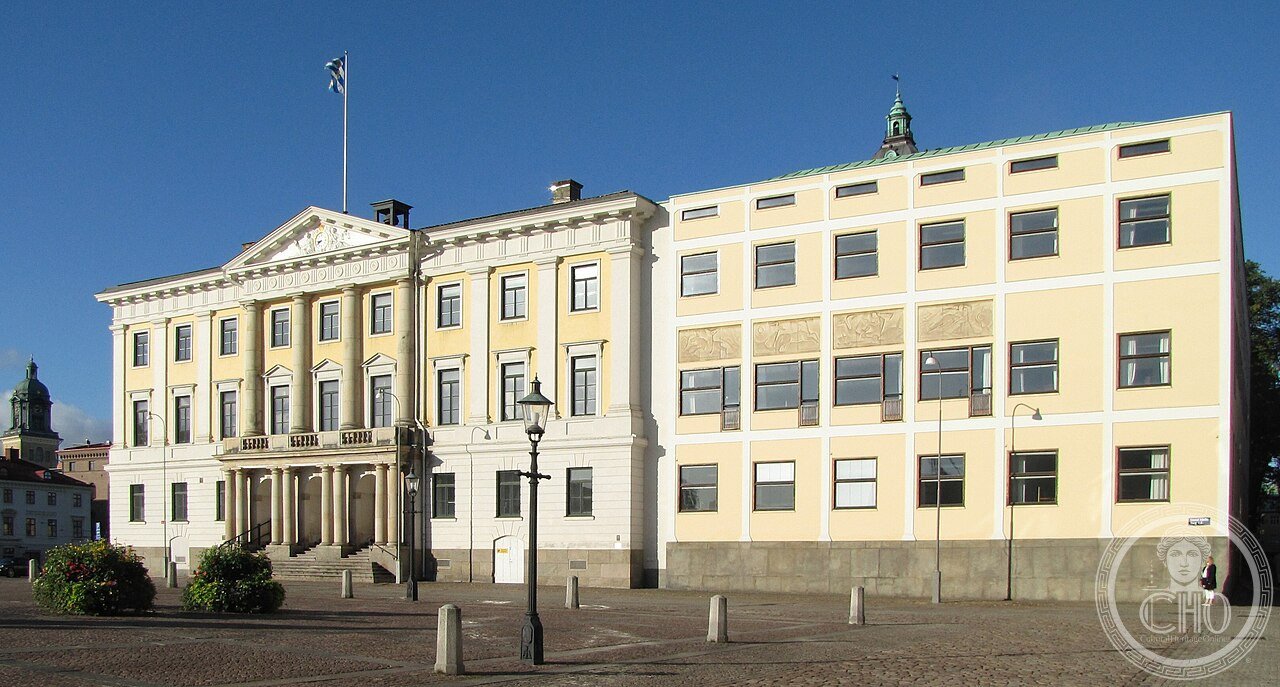
On the three-hundredth anniversary of Gothenburg’s founding, Sweden handed its greatest living architect an impossible challenge: add a modern wing to the city’s seventeenth-century Law Courts without betraying either building. Gunnar Asplund’s answer — a sheer glass-and-steel curtain wall fused to the old stone facade — became one of the defining moments of twentieth-century architecture. Inside, a lobby of full-height glazing opens onto a courtyard garden, flooding the building with Nordic light. The courtrooms are precise, calm, and rigorously proportioned. Completed in 1937, three years before Asplund’s death, the extension stands alongside the Stockholm Exhibition of 1930 as the fullest expression of his mature vision: modernity not in conflict with tradition but in honest, generous dialogue with it. Its influence on Alvar Aalto, Jørn Utzon, and the whole arc of Nordic Modernism is direct and acknowledged.
At a glance
- Type
- Civic building / court of law
- Period
- 1934–1937
- Style
- Scandinavian Functionalism
- Location
- Central Gothenburg, Sweden
- Coordinates
- 57.7072° N, 11.9668° E
- Architect(s)
- Gunnar Asplund
Overview
The Gothenburg Law Courts Extension is the last major completed work of Gunnar Asplund, widely considered the father of Swedish Modernism. Commissioned to celebrate the city’s tercentenary, the project required Asplund to extend the existing neoclassical courthouse built in 1672. His solution was radical yet respectful: a transparent curtain-walled block that acknowledges the mass of the original building while declaring, in its lightness and openness, an unambiguous commitment to the modern world. The building demonstrates that architectural innovation need not erase history — it can amplify it.
History
Asplund had already electrified the architectural world with the Stockholm Exhibition of 1930, a temporary festival of International Style buildings that permanently shifted Swedish design. The Gothenburg commission, awarded in 1934, gave him the chance to prove that functionalist principles could work in a permanent civic context embedded in a historic urban fabric. Construction proceeded carefully to preserve the structural integrity of the 1672 courthouse. Asplund supervised the project until his death in September 1940; the building had been in use for three years by then and was already recognized as a masterwork. The 1672 courthouse and the 1937 extension now function as a unified complex still used by the Swedish courts system.
Architecture & Design
The extension’s defining gesture is its curtain wall of steel and glass — one of the earliest large-scale applications of the technology in Scandinavia. The wall reads as transparent and weightless against the massive granite blocks of the original courthouse, creating a productive visual tension. The entrance lobby exploits this transparency fully: full-height glazing looks into an interior courtyard garden, so that the building’s civic heart is visible from the street. Courtrooms are arranged along the upper floors with deliberate restraint — no ornamental excess, only proportion, natural light, and the careful modulation of acoustic space. The staircase detailing and ironwork show Asplund’s characteristic refinement of the industrial vocabulary into something approaching warmth.
Cultural significance
The Gothenburg Law Courts Extension is regarded by architectural historians as a proof-of-concept for humane modernism: the demonstration that the functionalist vocabulary could produce buildings of civic dignity and emotional resonance. Aalto cited Asplund as a decisive influence; Utzon visited Gothenburg while developing his approach to the Sydney Opera House. The building shaped the Nordic Modernism that would become one of the most influential design traditions of the twentieth century — from Finnish schools to Danish housing to Norwegian community centers.
Visiting today
The building functions as an active courthouse and public access is limited to the lobby and public hearing rooms during court hours. The exterior and lobby can be viewed freely on weekdays. Guided architecture tours organized by Gothenburg’s architecture community occasionally include the building. Check the Swedish Courts Administration (Domstolsverket) website for current public access information.
Getting there
Located in central Gothenburg near Kungsportsplatsen. From Gothenburg Central Station take tram lines 1, 3, 6, or 8 toward Brunnsparken, then walk approximately 10 minutes south along Östra Hamngatan. Trams 2 and 13 also stop at Kungsportsplatsen. The building is a five-minute walk from the main shopping district on Avenyn.
Sources & resources
Find it on the map
See this place and what’s around it →📷 Diventa un fotografo di Cultural Heritage Online
Condividi le tue foto dei luoghi: restano pubblicate con la tua firma come autore. Più vengono viste, più ti fai conoscere — e presto un concorso premierà le foto più apprezzate.
Accedi o registrati gratis per aggiungere una fotoDo you manage this place?
This page is read by travellers and heritage enthusiasts who find it on Google. Keep it accurate — and make it work for you. Free for non-profit heritage institutions.