
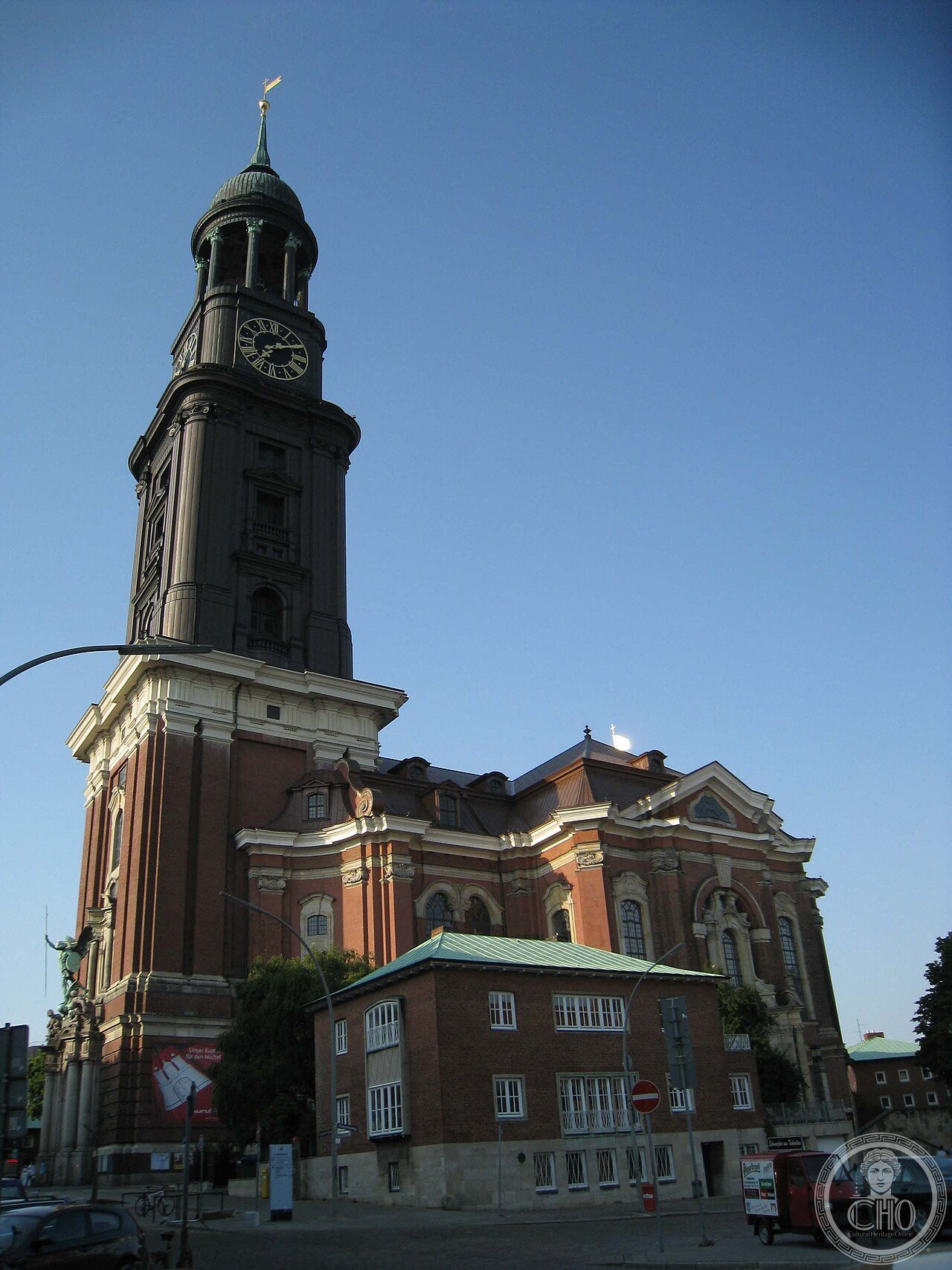
Un fulmine incendiò la prima chiesa il 10 marzo 1750. La seconda, barocca, brucerà ancora nel 1906 per una fiamma ossidrica lasciata incustodita nella torre. Ricostruita una terza volta tra il 1906 e il 1912 sugli stessi disegni, questa volta in acciaio e cemento, la torre di 132 metri del “Michel” resta il simbolo di Amburgo e, un tempo, un punto di riferimento per la navigazione sull’Elba.
About St. Michael’s Church, Hamburg
St. Michael’s Church, universally known to Hamburgers as “der Michel,” is the third building on its site. The first church was built from 1647 to 1669 to serve the Neustadt, the new town created in 1625 within Hamburg’s expanded city walls, but was destroyed by a lightning strike on 10 March 1750. The foundation stone for a second, Baroque church was laid in 1751, built to designs by Johann Leonhard Prey and Ernst Georg Sonnin and inaugurated in 1762; between 1777 and 1786, Sonnin added the tower, built entirely of wood beneath its signature copper roof, reaching 132 metres and becoming both a defining feature of Hamburg’s skyline and a navigation aid for ships on the river Elbe. In 1906, workers using a blowlamp inside the tower caused a devastating fire that destroyed the church completely; the third and present St. Michael’s was built between 1906 and 1912, following the old plans but this time using steel and concrete within the surviving walls to guard against another fire. The church suffered heavy damage during the WWII bombing of Hamburg between 1943 and 1945, with the resulting war damage repaired between 1947 and 1952.
Key facts
- First church: 1647-1669, serving Hamburg’s new Neustadt district; destroyed by lightning 10 March 1750
- Second church: Baroque, built 1751-1762 by Johann Leonhard Prey and Ernst Georg Sonnin; wooden tower with copper roof added 1777-1786 by Sonnin, reaching 132 metres
- 1906 fire: caused by a blowlamp used by workers in the tower; church completely destroyed
- Third church: built 1906-1912, following the original plans but using steel and concrete construction
- WWII damage: heavily damaged in Allied bombing raids 1943-1945; repaired 1947-1952
- Tower’s role: a navigation landmark for ships sailing the Elbe, and Hamburg’s most recognisable skyline feature
History
The Michel’s repeated destruction by fire — first lightning in 1750, then a workman’s blowlamp in 1906 — and its equally repeated, faithful reconstruction on the original plans each time reflects the building’s deep civic significance to Hamburg well beyond its purely religious function: a merchant port city whose wealth and identity depended heavily on its skyline being visible and recognisable to ships approaching from the Elbe had a direct practical as well as symbolic incentive to rebuild its most prominent landmark exactly as it had stood before, rather than take the opportunity to redesign. The specific decision, after the 1906 fire, to reconstruct using modern steel and concrete within the historic walls exemplifies a broader early-20th-century pattern of using contemporary structural engineering to preserve a building’s traditional external appearance while addressing the practical vulnerabilities — in this case, fire risk from a wooden tower — that had caused its destruction.
The tower’s dual civic and maritime function, serving simultaneously as parish church steeple and navigational landmark for Elbe shipping, situates the Michel within a broader tradition of prominent church towers in port and river cities serving practical wayfinding purposes long before modern lighthouse and beacon technology made such dual-use religious-navigational landmarks unnecessary — a role the tower’s continuing visibility across Hamburg’s skyline still evokes even though its practical navigational function has long since been superseded.
What you see
The 132-metre tower, with its distinctive copper roof, remains the essential feature for visitors, offering a viewing platform with panoramic views over Hamburg and its harbour. The Baroque interior, rebuilt in steel and concrete after 1906 but faithful to the original 18th-century design, gives visitors a spacious, light-filled worship space characteristic of North German Protestant Baroque church architecture. The church’s continuing role as one of Hamburg’s five principal Lutheran parish churches (Hauptkirchen) situates it within the city’s historic ecclesiastical structure.
Practical information
- Opening hours: generally open daily, check current hours before visiting; tower ascent has separate admission fee
- Address: Englische Planke 1, 20459 Hamburg
Getting there
Hamburg’s St. Michael’s Church is a short walk from the Landungsbrücken and Rödingsmarkt U-Bahn/S-Bahn stations. By car, the church sits near Hamburg’s Neustadt district close to the harbour. GPS: 53.5484° N, 9.9789° E.
Nearby
- Hamburg Speicherstadt — a UNESCO World Heritage warehouse district, a short walk away
- Landungsbrücken — Hamburg’s historic harbour piers, on the Elbe
- Krameramtswohnungen — a preserved 17th-century almshouse courtyard, immediately adjacent to the church
Sources
- Wikipedia — “St. Michael’s Church, Hamburg” (en.wikipedia.org)
- St. Michaelis Hamburg — official history portal (st-michaelis.de)
- SpottingHistory — heritage documentation (spottinghistory.com)
Find it on the map
See this place and what’s around it →📷 Become a Cultural Heritage Online photographer
Share your photos of places: they stay published under your name as the author. The more they're seen, the more you get noticed — and soon a contest will reward the most appreciated photos.
Log in or sign up free to add a photo