
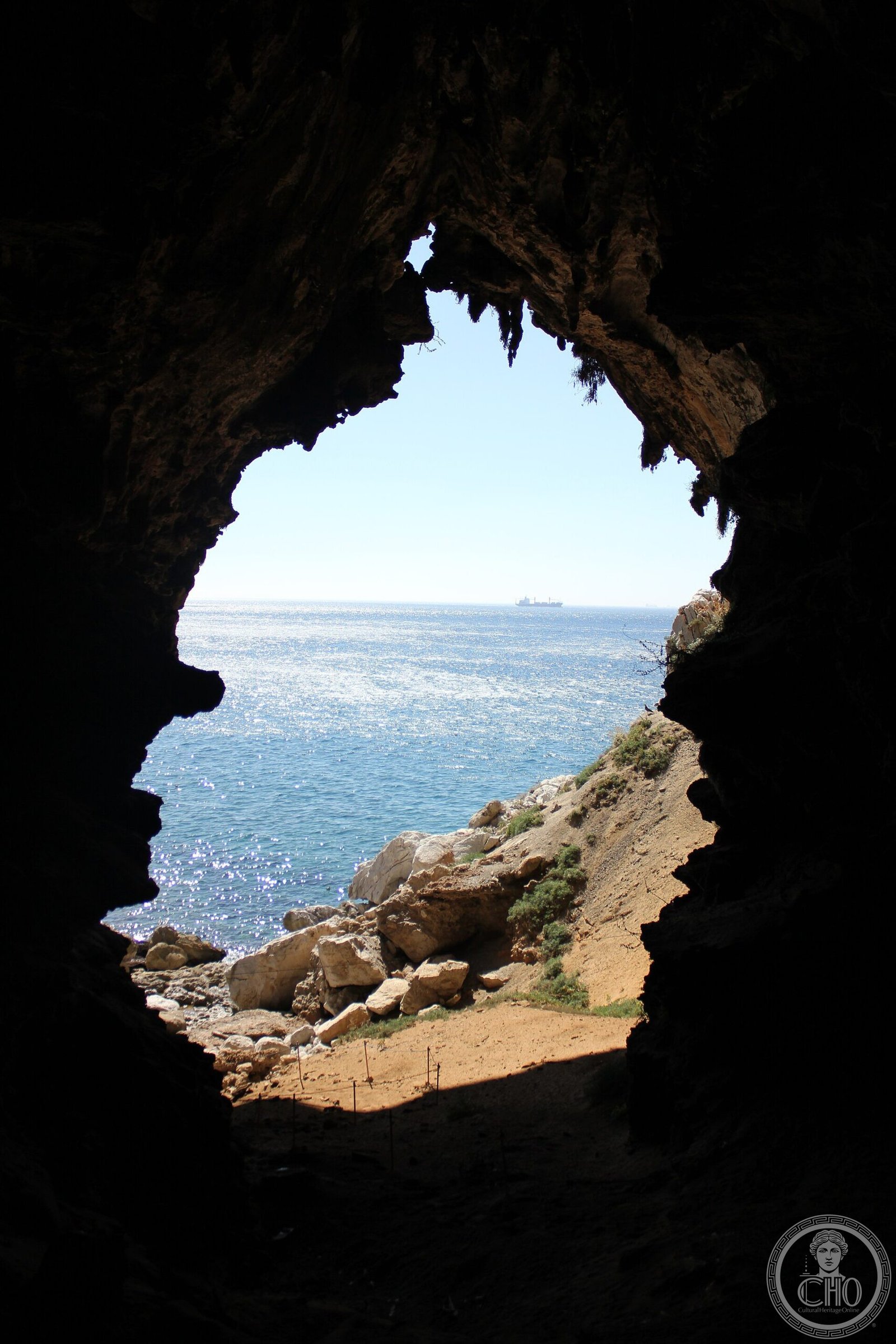
The last place on Earth where Neanderthals lived — a complex of four caves at the base of the Rock of Gibraltar containing evidence of Neanderthal habitation as recently as 24,000 years ago, including sophisticated food-gathering, possible symbolic engraving, and feather-based decoration, upending earlier assumptions about Neanderthal behaviour.
At a glance
Gorham’s Cave Complex — comprising Gorham’s Cave, Vanguard Cave, Hyaena Cave, and Bennett’s Cave at the southeastern base of the Rock of Gibraltar — contains the most recent evidence of Neanderthal occupation anywhere in the world. While Neanderthal populations had disappeared from the rest of Europe by approximately 40,000 years ago, Gibraltar’s Neanderthals survived until roughly 24,000–30,000 BCE — a gap of at least 10,000 years after the last known Neanderthals elsewhere. The caves preserve stratified deposits across 125,000 years of occupation, from the last interglacial period through the Upper Palaeolithic. UNESCO inscribed the site in 2016 as evidence of “the later phases of Neanderthal life and their subsequent disappearance.”
Key facts
- Caves: Gorham’s Cave, Vanguard Cave, Hyaena Cave, Bennett’s Cave
- Location: base of the Rock of Gibraltar, facing east toward the Mediterranean
- Neanderthal occupation: evidence from c. 125,000 BCE to c. 24,000–30,000 BCE
- Significance: latest dated evidence of Neanderthal occupation anywhere in the world
- Key discoveries: marine food consumption (shellfish, seals, dolphins, large fish); scraped eagle feathers and raptor bones; possible geometric rock engraving (crosshatch pattern); Phoenician, Carthaginian, and Roman votive deposits
- Named for: Captain A.E.H. Gorham, British garrison officer who rediscovered the cave in 1907 CE
- UNESCO inscription: 2016
- Current access: restricted — managed by the Gibraltar Museum; guided tours available seasonally
History
Gorham’s Cave was first noted scientifically when Captain A.E.H. Gorham of the Royal Munster Fusiliers explored it while stationed in Gibraltar in 1907, reporting animal bones and artefacts. Systematic excavation began in the 1950s and has continued, with increasing sophistication, ever since. The discovery of Neanderthal occupation layers dated to 24,000–30,000 BCE — confirmed by electron spin resonance dating and other modern techniques — was scientifically revolutionary: it pushed the survival of Neanderthals far beyond all previous estimates.
Vanguard Cave, excavated from the 1990s onwards by Clive Finlayson and the Gibraltar Museum team, produced some of the most significant evidence. Hearth deposits showed that Neanderthals were cooking shellfish — mussels, limpets, and clams — as well as seals, monk seals, and what appears to be dolphin, demonstrating a sophisticated coastal foraging strategy. Scraped and cut eagle and vulture bones suggested feathers were being removed intact — implying their use for decoration or adornment, a form of symbolic behaviour previously thought exclusive to anatomically modern humans.
In 2012, researchers announced the identification of what may be the only known example of Neanderthal rock art: a crosshatch pattern engraved into the bedrock of Gorham’s Cave, covered by undisturbed Neanderthal deposits and therefore definitively pre-dating modern human arrival in the area. The interpretation remains debated in the scientific community.
The later archaeological layers of the caves reveal post-Neanderthal use: Phoenician sailors and merchants left votive offerings from approximately the 8th century BCE, followed by Carthaginian and Roman deposits, testament to Gibraltar’s enduring significance as a landmark for Mediterranean seafarers.
What you see
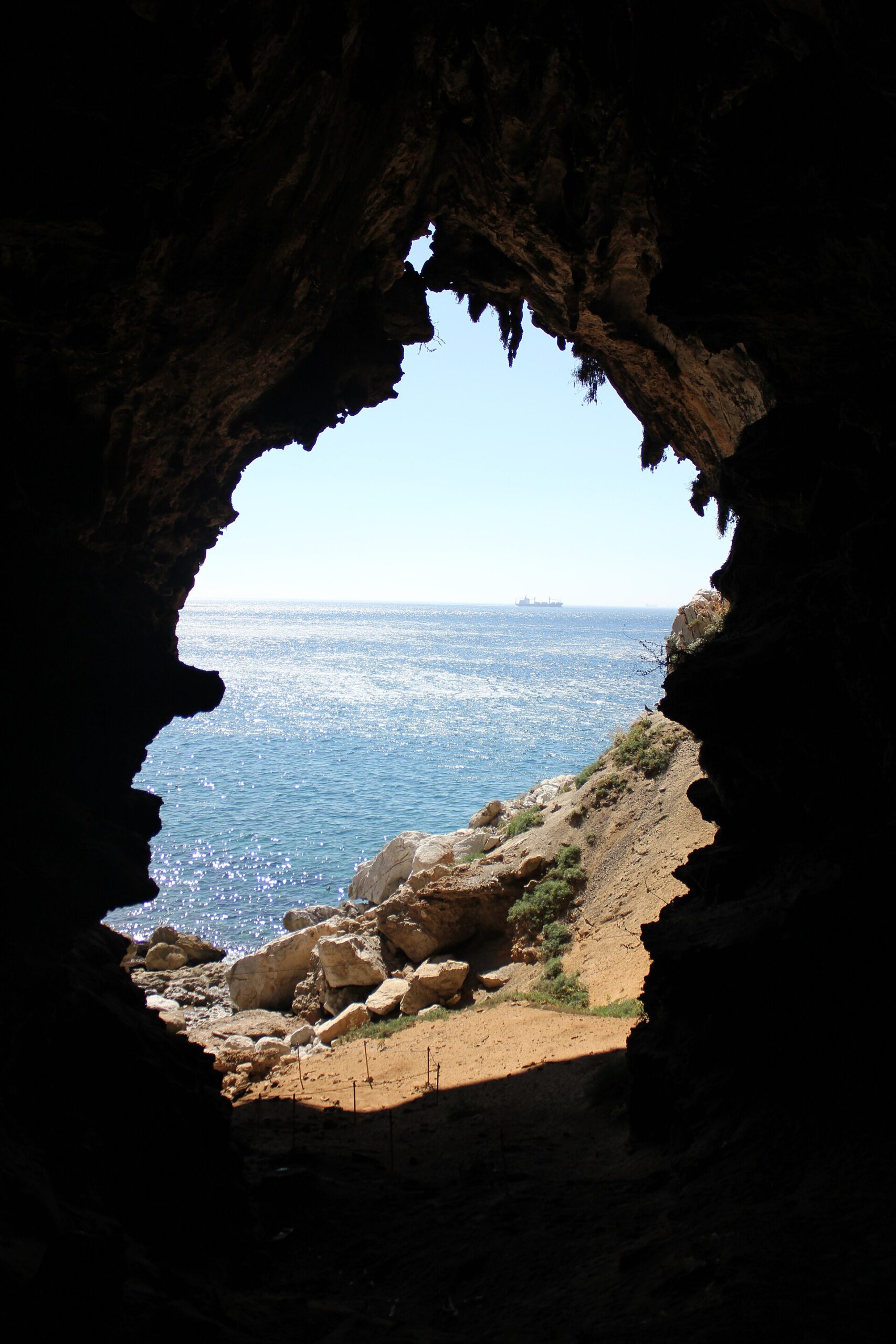
The caves are located in the vertical southeastern face of the Rock of Gibraltar, at the level of the present shoreline — though when the Neanderthals inhabited them, sea levels were considerably lower and the cave entrances would have faced a coastal plain now submerged beneath the Mediterranean. The setting is striking: the caves open in the shadow of the Rock’s massive limestone cliffs, facing east across the water toward Morocco.
Gorham’s Cave itself has a large, cathedral-like entrance chamber narrowing into deeper passages. The stratified occupation deposits — layers of ash, bone, and lithic artefacts — are visible in section cuts. Vanguard Cave, adjacent, is smaller but produced much of the key evidence about Neanderthal diet and behaviour. The sites are currently accessible only through managed visits organised by the Gibraltar Museum.
Practical information
- Access: restricted; managed by the Gibraltar Museum — contact the Museum for guided tour availability
- Gibraltar Museum: 18 Bomb House Lane, Gibraltar — permanent exhibition covering the cave complex, Neanderthal discoveries, and Gibraltar’s deep history; open Monday–Friday and Saturday mornings
- Rock of Gibraltar: the broader Rock area is a Nature Reserve; access to the Upper Rock (apes, siege tunnels, St Michael’s Cave) is ticketed and via cable car or on foot
- St Michael’s Cave: large show cave on the upper Rock, with guided tours available — not related to the Gorham’s Cave Complex but impressive in its own right
- Best time to visit: spring and autumn for most comfortable temperatures; summer can be crowded
Getting there
Gibraltar is accessible by air (Gibraltar International Airport, direct flights from UK and several European cities), by land from Spain across the La Línea de la Concepción border crossing, and by ferry from Tarifa (Spain) and Tangier (Morocco). From La Línea bus station: taxis and regular buses into Gibraltar town centre (approximately 2 km). From Gibraltar town centre to the caves: the southeastern base of the Rock is not accessible by standard public transport — visitors reach the cave area as part of organised tours or by arrangement with the Gibraltar Museum.
Nearby
- Gibraltar Museum (town centre): the essential companion to the cave complex — the best collection of artefacts from the Gorham’s Cave excavations, plus Gibraltar’s Moorish and British colonial history
- Great Siege Tunnels: 18th-century military tunnels carved through the Rock during the Great Siege of Gibraltar (1779–1783); accessible from the Upper Rock Nature Reserve
- Barbary Macaques: Europe’s only wild primate population lives on the upper Rock; protected and habituated to visitors
- Tarifa (Spain, 37 km): the southernmost point of continental Europe; whale and dolphin watching in the Strait of Gibraltar; crossing point for ferries to Tangier
Sources
- UNESCO World Heritage List: Gorham’s Cave Complex — whc.unesco.org
- Wikipedia: Gorham’s Cave — en.wikipedia.org
- Finlayson, Clive: The Humans Who Went Extinct: Why Neanderthals Died Out and We Survived (2009)
- Gibraltar Museum: ongoing excavation reports and public interpretation
- Rodríguez-Vidal, J. et al.: “A rock engraving made by Neanderthals in Gibraltar,” PNAS (2014)
Gallery
Find it on the map
See this place and what’s around it →📷 Become a Cultural Heritage Online photographer
Share your photos of places: they stay published under your name as the author. The more they're seen, the more you get noticed — and soon a contest will reward the most appreciated photos.
Log in or sign up free to add a photo