
Three concentrated fields of megalithic stone tombs in South Korea holding approximately 40% of all dolmens known to exist in the world — a Bronze Age monument-building tradition entirely independent of and comparable in scale to Stonehenge and Carnac.
At a glance
In three regions of South Korea — Gochang in North Jeolla Province, Hwasun in South Jeolla Province, and Ganghwa Island near Incheon — approximately 35,000 dolmens survive in concentrated fields. This extraordinary number represents around 40% of all dolmens known to exist worldwide. Inscribed as a UNESCO World Heritage Site in 2000, the sites transformed the standard narrative of prehistoric megalithism by demonstrating that Europe’s stone monument tradition had a parallel of comparable scale in East Asia, flourishing from approximately 1000 to 300 BC during the Korean Bronze Age, entirely independent of European megalithism.
Key facts
- UNESCO inscription: 2000 (World Heritage Site)
- Period: Korean Bronze Age, c. 1000–300 BC
- Total dolmens preserved: c. 35,000 across three sites
- World share: approximately 40% of all known dolmens on Earth
- Largest capstones: up to 300 tonnes (Gochang cluster) — among the largest single stones moved by any prehistoric culture
- Two main types: table-type (goindol — upright stones + capstone) and go-board type (ground slab over underground burial chamber)
- Sites: Gochang (North Jeolla Province), Hwasun (South Jeolla Province), Ganghwa Island (Incheon)
History and significance
The Korean dolmens were constructed during the Korean Bronze Age, approximately 1000 to 300 BC. They served simultaneously as burial chambers — cremated remains and grave goods including bronze daggers, stone daggers, and red-burnished pottery have been found inside many — and as landscape markers declaring territorial ownership and ancestral lineage. The monuments were almost certainly built for chiefs or lineage heads whose communities could mobilise and command large labour forces: the engineering challenge of moving a 300-tonne capstone implies a level of social organisation and coordinated human effort that tells us as much about Bronze Age Korean society as any burial object.
The scale of the phenomenon was not recognised by Western scholarship until relatively recently. While European megalithic sites — Stonehenge (England), the alignments at Carnac (France), the passage tombs of Ireland — had been studied for two centuries, the concentration of equivalent monuments in Korea remained largely unknown outside specialist East Asian archaeology. The UNESCO inscription in 2000 was a landmark moment: it formally established that megalithic tomb-building was a global phenomenon with independent parallel traditions, and that Korea’s Bronze Age builders were among the most prolific constructors of stone monuments in human history.
The monuments
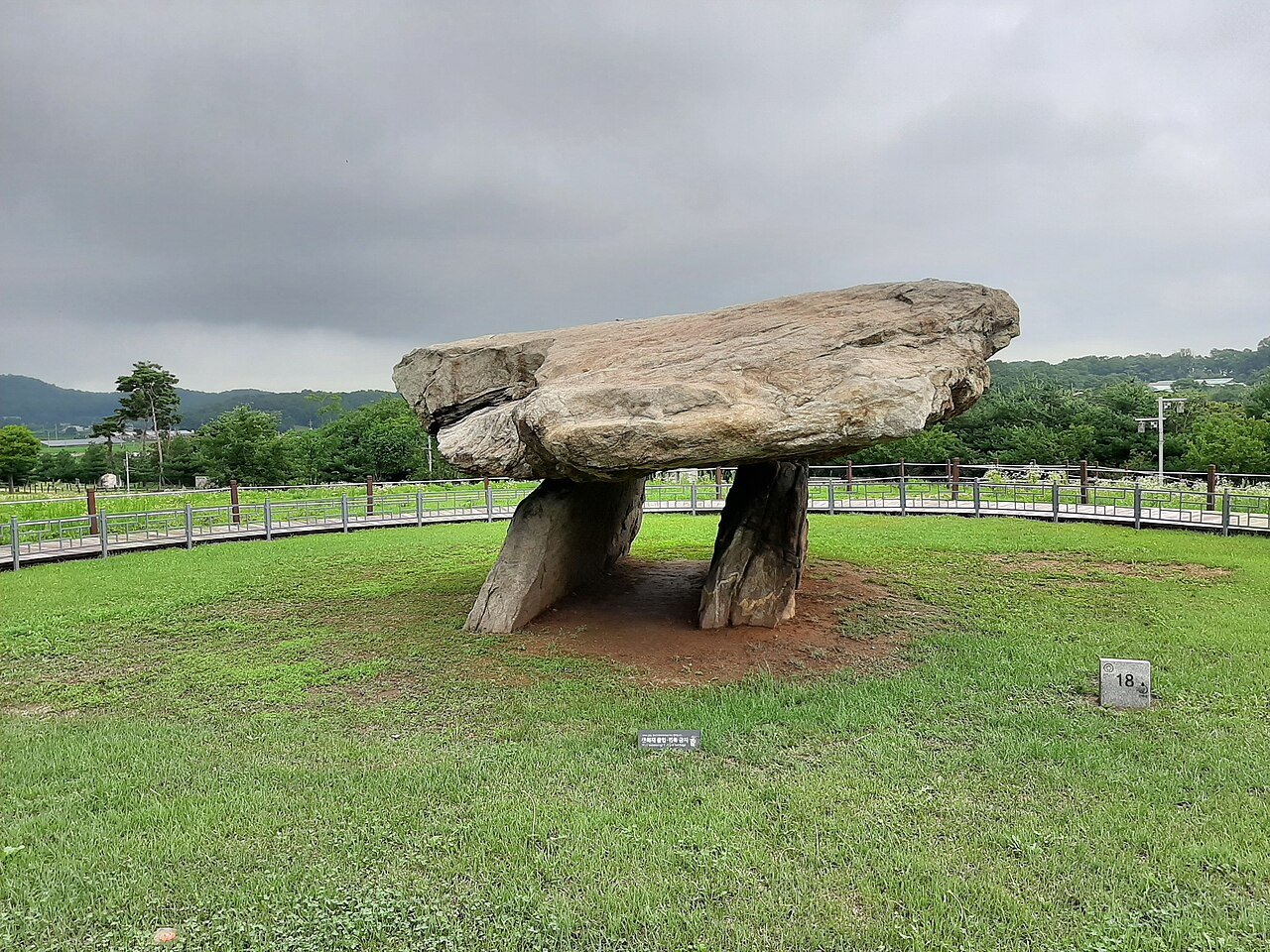
The two main dolmen types reflect different constructional traditions. The table-type dolmen (goindol) — two or more upright stones supporting a massive horizontal capstone — is the visually striking form: it resembles an enormous stone table rising from the landscape, with the capstone weighing between a few tonnes and, in the largest examples at Gochang, up to 300 tonnes. Moving such stones required sophisticated organisation of human labour: no metal tools, no wheels — ropes, wooden rollers, earthen ramps, and the coordinated effort of entire communities. The go-board type — a large flat stone at ground level concealing an underground stone-lined burial chamber — is less visually dramatic but numerically dominant at Hwasun. The Gochang site alone contains over 400 dolmens distributed across a hillside, visible as a field of stone tables scattered among the rice paddies below — a landscape of extraordinary visual impact that conveys the density of the Bronze Age funerary tradition.
Korea and the global megalith tradition
The discovery of dolmens as a global phenomenon — not merely a European curiosity — fundamentally changed the archaeology of prehistory. Dolmens exist across a belt from Western Europe through the Middle East to Korea and Japan, but Korea’s concentration is without parallel: while the British Isles have perhaps 2,000 dolmens and France perhaps 4,500, Korea has preserved ten times that number. The reasons are partly geological (abundant local granite), partly topographical (hillside locations that made agricultural conversion difficult), and partly cultural (continuous veneration of the sites in local tradition that discouraged destruction). The Ganghwa Island dolmen — a single massive capstone weighing approximately 80 tonnes — is one of the most photographed prehistoric monuments in East Asia, comparable in symbolic weight to the stones of Stonehenge in the Western tradition.
Practical information
- Gochang: Dolmen Museum adjacent to the site; open Tuesday–Sunday; admission fee applies
- Hwasun: Open access site; Hwasun Dolmen Museum in town
- Ganghwa Island: Dolmens scattered across the island; most accessible near Bugeun-ri; ferry from Gimpo
- Best time: Spring (April–May) or autumn (September–November) for comfortable temperatures
- From Seoul: Gochang is approximately 3.5 hours by bus; Ganghwa Island approximately 1.5 hours
Getting there
The three sites are spread across South Korea and best visited separately. Ganghwa Island is the most accessible from Seoul (approximately 1.5 hours by bus from Sinchon Terminal); Gochang requires an intercity bus from Seoul Express Bus Terminal (approximately 3.5 hours); Hwasun is reached from Gwangju by local bus. All three sites have dedicated visitor centres and are well signed.
Nearby
Sources
Find it on the map
See this place and what’s around it →📷 Become a Cultural Heritage Online photographer
Share your photos of places: they stay published under your name as the author. The more they're seen, the more you get noticed — and soon a contest will reward the most appreciated photos.
Log in or sign up free to add a photo