
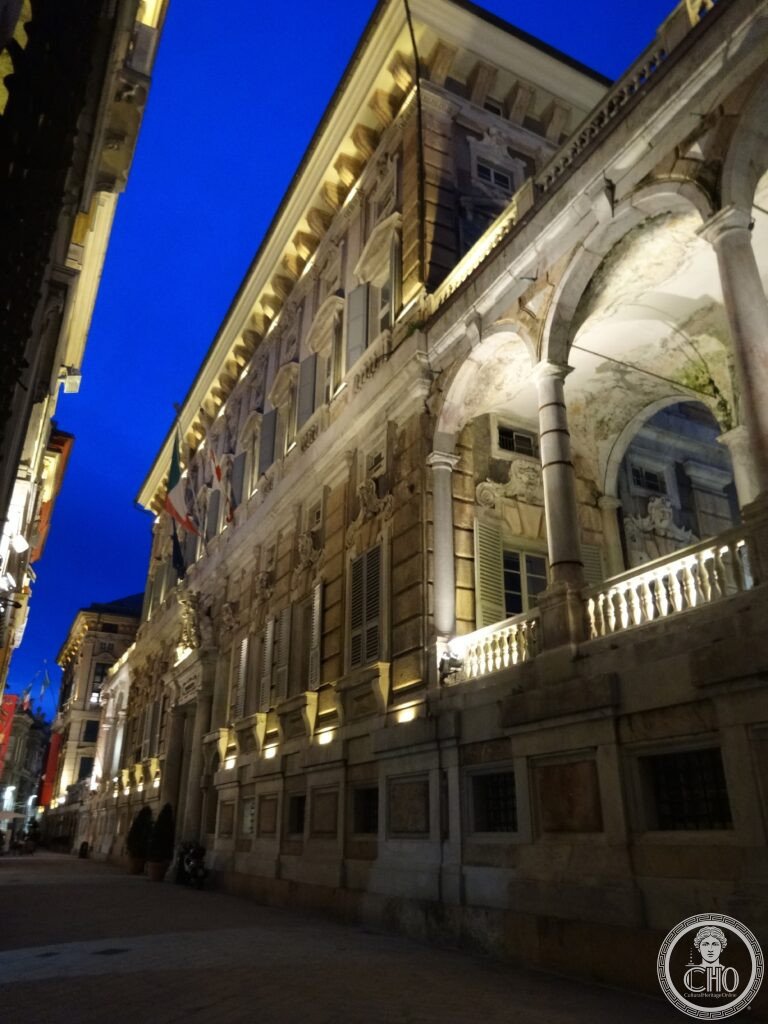
Via Garibaldi, once Strada Nuova, lines up a row of sixteenth-century merchant-banking palaces behind uniform, aligned facades. The forty-two houses named on Genoa’s 1576 Rolli list formed the first regulated system in Europe for hosting visiting heads of state in private homes, an arrangement Rubens later held up as a model for northern architecture.
At a glance
Via Garibaldi was built between 1550 and 1558 to a design attributed to Bernardino Cantone, on the slope above Genoa’s medieval centre. Every palace along it was required to share the same cornice height and setback, making it one of the earliest streets in Europe designed with mandatory facade alignment. The street is narrow, built for pedestrians and processions rather than carriages.
In 1576 the Genoese Senate drew up the Rolli, a list of forty-two palaces graded by size and assigned by lottery whenever a foreign monarch or dignitary visited, so that no single family could monopolise the prestige and connections that came with hosting a state guest. The list was revised in 1599 and 1664, and over time a total of 113 palaces appeared on it.
Key facts
- Street: Via Garibaldi, formerly Strada Nuova, built 1550–1558, roughly 230 metres long and 6.5 metres wide.
- Rolli system: forty-two palaces listed in 1576, chosen by lottery to host state guests; lists updated in 1599 and 1664.
- Materials: facades in local slate (pietra di Finale) with stucco decoration and marble surrounds.
- Palazzo Doria Tursi: the widest and tallest palace on the street, now Genoa’s city hall, with a courtyard loggia of 1596 opening onto a hanging garden.
- UNESCO status: inscribed as a World Heritage Site in 2006 (reference 1211).
History
Genoa appears in Byzantine sources from the sixth century as a naval base for the western Mediterranean. As an independent maritime republic from 1005, it dominated Black Sea trade from the 1261 Treaty of Ninfeo until the Ottoman conquest of Constantinople in 1453, running colonies at Caffa, Pera and Chios. The loss of the eastern trade routes pushed Genoese capital towards Spanish Atlantic finance.
Between 1528 and 1627, Genoese merchant-banking families, among them the Doria, Grimaldi, Spinola, Pallavicino and Balbi, effectively ran the credit network behind the Spanish Empire, financing Habsburg military campaigns and settling international exchange contracts at the fairs of Piacenza. This period is remembered as the Genoese century. It ended in 1627 when Philip IV of Spain defaulted on his debts, after which capital flows shifted to Amsterdam.
It was during this era of wealth that Strada Nuova was built and the Rolli system established. In 1622 the painter Peter Paul Rubens, who had spent months in Genoa in 1607, published Palazzi di Genova in Antwerp, two volumes of measured engravings recording seventy-one Genoese palaces. He presented the Genoese palazzo, with its central courtyard, lateral staircase and ceremonial piano nobile, as a more practical model for northern European town houses than the villa tradition. The street and its palaces were inscribed as a UNESCO World Heritage Site in 2006.
What you see
Walking along Via Garibaldi means passing beneath a continuous run of tall, decorated facades, three of which house museums: Palazzo Bianco, with its Genoese painting collection including a work attributed to Caravaggio and portraits by Van Dyck, who lived in Genoa in the 1620s and set the tone for aristocratic portraiture across northern Europe; Palazzo Rosso, whose rooftop terrace gives the clearest view down the aligned street front; and Palazzo Doria Tursi, now the city hall, where Paganini’s Guarneri del Gesù violin, known as Il Cannone, is kept in the Sala del Sindaco and is played in public twice a year. Its courtyard loggia leads through to a hanging garden on the hillside behind.
Behind the grand street runs a different Genoa: the caruggi, a dense web of medieval lanes barely wide enough for two people to pass. These lead to Piazza San Matteo, the private square of the Doria family, with the twelfth-century church of San Matteo bearing Doria inscriptions on its facade and, in the crypt, the sarcophagus of Andrea Doria. Above the old town, the Spianata Castelletto offers a wide view over the port and the historic centre.
Practical information
- Rolli Days: twice a year, in spring and autumn, most of the palaces on the original Rolli lists open their private apartments, painted ceilings and courtyard gardens to the public free of charge; dates are announced in advance on the Comune di Genova’s own tourism website.
- Museums: Palazzo Bianco, Palazzo Rosso and Palazzo Doria Tursi can be visited together on a combined ticket; check current admission arrangements directly with the museums.
- Getting around: Via Garibaldi is a walking street within easy reach of both of Genoa’s main railway stations, Piazza Principe and Brignole.
Getting there
Via Garibaldi lies within Genoa’s historic centre, reachable on foot from both Genova Piazza Principe, the main long-distance station, and Genova Brignole. Regular rail services connect Genoa to Milan, Turin and Rome; timetables and fares are best checked directly with Trenitalia.
Nearby
- The caruggi — immediately behind Via Garibaldi, Genoa’s network of narrow medieval lanes.
- Piazza San Matteo — a short walk away, the Doria family’s private square with the church of San Matteo and Andrea Doria’s tomb.
- Spianata Castelletto — a hilltop terrace above the old town, reached by funicular from Piazza del Portello, with views over the port.
Sources
- UNESCO (World Heritage Site reference 1211)
- Peter Paul Rubens, Palazzi di Genova (1622)
- Comune di Genova
Find it on the map
See this place and what’s around it →📷 Become a Cultural Heritage Online photographer
Share your photos of places: they stay published under your name as the author. The more they're seen, the more you get noticed — and soon a contest will reward the most appreciated photos.
Log in or sign up free to add a photo