
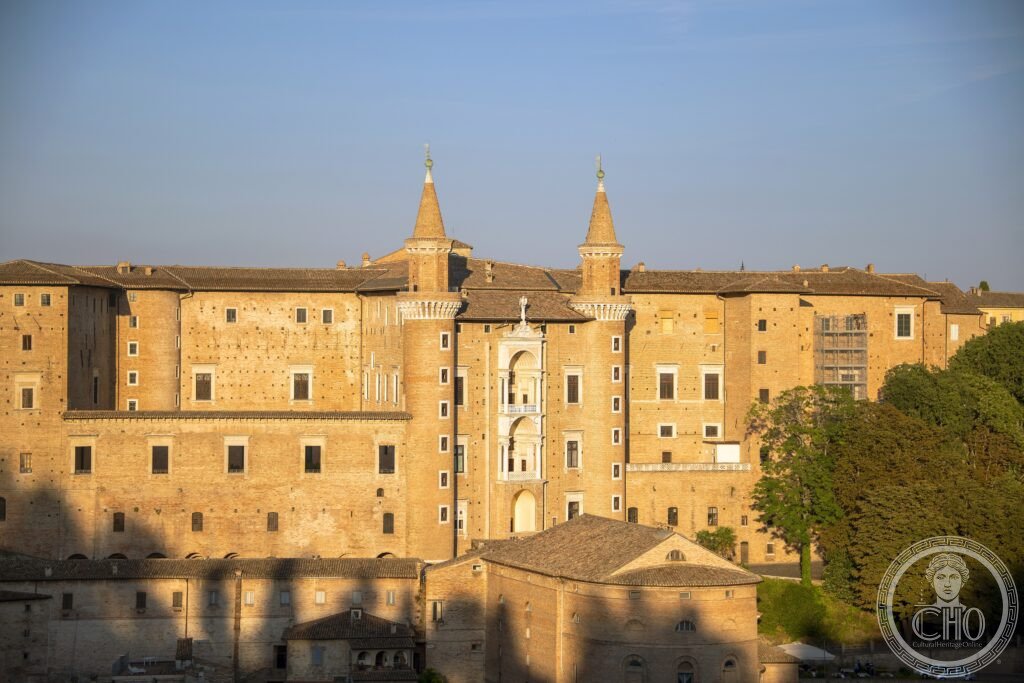
Urbino’s hilltop centre preserves, almost intact, the physical setting of a fifteenth-century Renaissance court. The Palazzo Ducale and its Studiolo, commissioned by Federico da Montefeltro, translate the ideal of the scholar-soldier prince into architecture and marquetry, while the town beyond the palace is also the birthplace of Raphael.
At a glance
Urbino’s historic centre grew around the court of Federico da Montefeltro, Count and later Duke of Urbino, who ruled from 1444 to 1482. A condottiere whose company fought for Florence, Milan, the Papacy and Naples, he channelled his earnings into building the Palazzo Ducale and assembling one of the largest private manuscript libraries in Italy, later acquired by the Vatican and now part of the Biblioteca Apostolica Vaticana. The court’s fame endured beyond Federico’s lifetime: Baldassare Castiglione set his dialogue Il Cortegiano, describing the ideal Renaissance courtier, in Urbino under Federico’s son Guidobaldo, and the book became one of the most widely read and translated works of the sixteenth century.
Key facts
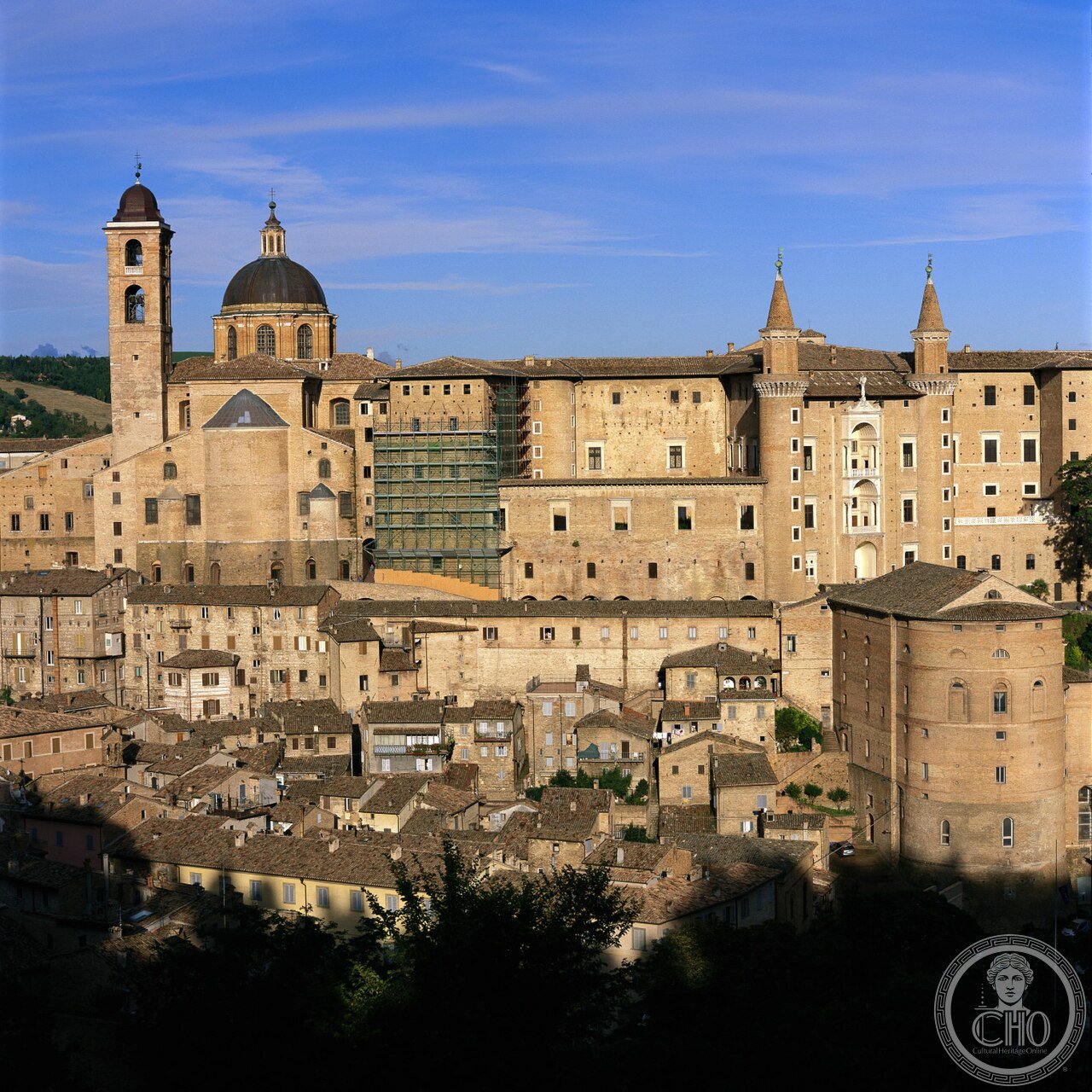
- Palazzo Ducale: designed by Luciano Laurana from 1466 for Federico da Montefeltro; its Torricini facade, with two cylindrical towers framing a loggia, is the building’s best-known feature.
- The Studiolo: Federico’s private study on the palace’s first floor, its walls covered in intarsia panels that use inlaid wood alone, without paint, to create illusions of books, weapons, musical and scientific instruments in perspective.
- The Famous Men portraits: twenty-eight painted panels of historical figures, by the Flemish painter Joos van Wassenhove (Juste de Gand) with some attributed to Pedro Berruguete, originally installed above the intarsia; fourteen remain in the Galleria Nazionale delle Marche and fourteen are in the Louvre.
- Piero della Francesca’s Flagellation: a small oil-tempera panel held in the Galleria Nazionale delle Marche, notable for its precise, still-debated perspective construction.
- Recognition: Urbino’s historic centre and the Palazzo Ducale were inscribed on the UNESCO World Heritage List in 1998.
History
Urbino is recorded from the ninth century as a Lombard settlement, and a County of Urbino was established in the tenth century. The Montefeltro family acquired the county in 1213 and held it, later as a duchy, for nearly three centuries. Federico da Montefeltro’s rule from 1444 marked its high point, followed by his son Guidobaldo, whose court hosted Baldassare Castiglione and inspired Il Cortegiano.
When Guidobaldo died without an heir, the duchy passed to Francesco Maria I della Rovere, whose family held Urbino for over a century. In 1631 the last della Rovere duke ceded Urbino to the Papacy, after which it became a Legation of the Papal States. The university founded in the city in 1506, the oldest in the Marche, survived the change of rulers and remains central to the town today.
What you see
The Palazzo Ducale now houses the Galleria Nazionale delle Marche. Its principal draw is the Studiolo, reached from the Sala degli Angeli, where the intarsia panels are shown under deliberately low light so that the trompe-l’œil effect reads correctly. Piero della Francesca’s Flagellation of Christ hangs nearby, a small panel whose two seemingly unrelated groups of figures share a single, mathematically consistent perspective space. Outside, the Torricini facade with its twin towers and triple loggia is best seen from the gardens below the palace.
A short walk through the old town leads to the Casa di Raffaello, the house where Raphael was born, which preserves the room of his birth along with a fresco of the Madonna attributed to his father, Giovanni Santi, or possibly the young Raphael himself, and portraits of his parents.
Practical information
- Museum access: the Galleria Nazionale delle Marche and the Studiolo are within the Palazzo Ducale; check the museum’s own channels for current opening arrangements and admission.
- Casa di Raffaello: a separate, smaller site in the old town on Via Raffaello; opening details are best confirmed directly with the house.
- Piero della Francesca trail: Urbino is one stop on a wider itinerary linking sites that preserve his surviving works.
Getting there
Urbino has no railway station of its own. The nearest rail connections are at Pesaro, from where regional bus services run up to the town; travellers should check current timetables with the local transport operator, Adriabus, or consider car hire for more flexibility.
Nearby
- Pesaro — the nearest town with a railway station, linked to Urbino by regional bus.
- Casa di Raffaello — within Urbino’s historic centre, a short walk from the Palazzo Ducale.
- Piero della Francesca itinerary — Urbino forms part of a wider trail of towns holding his major works.
Sources
- UNESCO World Heritage List.
- Galleria Nazionale delle Marche.
- Biblioteca Apostolica Vaticana.
- Baldassare Castiglione, Il Cortegiano.
- Vespasiano da Bisticci.
Gallery
Find it on the map
See this place and what’s around it →📷 Become a Cultural Heritage Online photographer
Share your photos of places: they stay published under your name as the author. The more they're seen, the more you get noticed — and soon a contest will reward the most appreciated photos.
Log in or sign up free to add a photo