

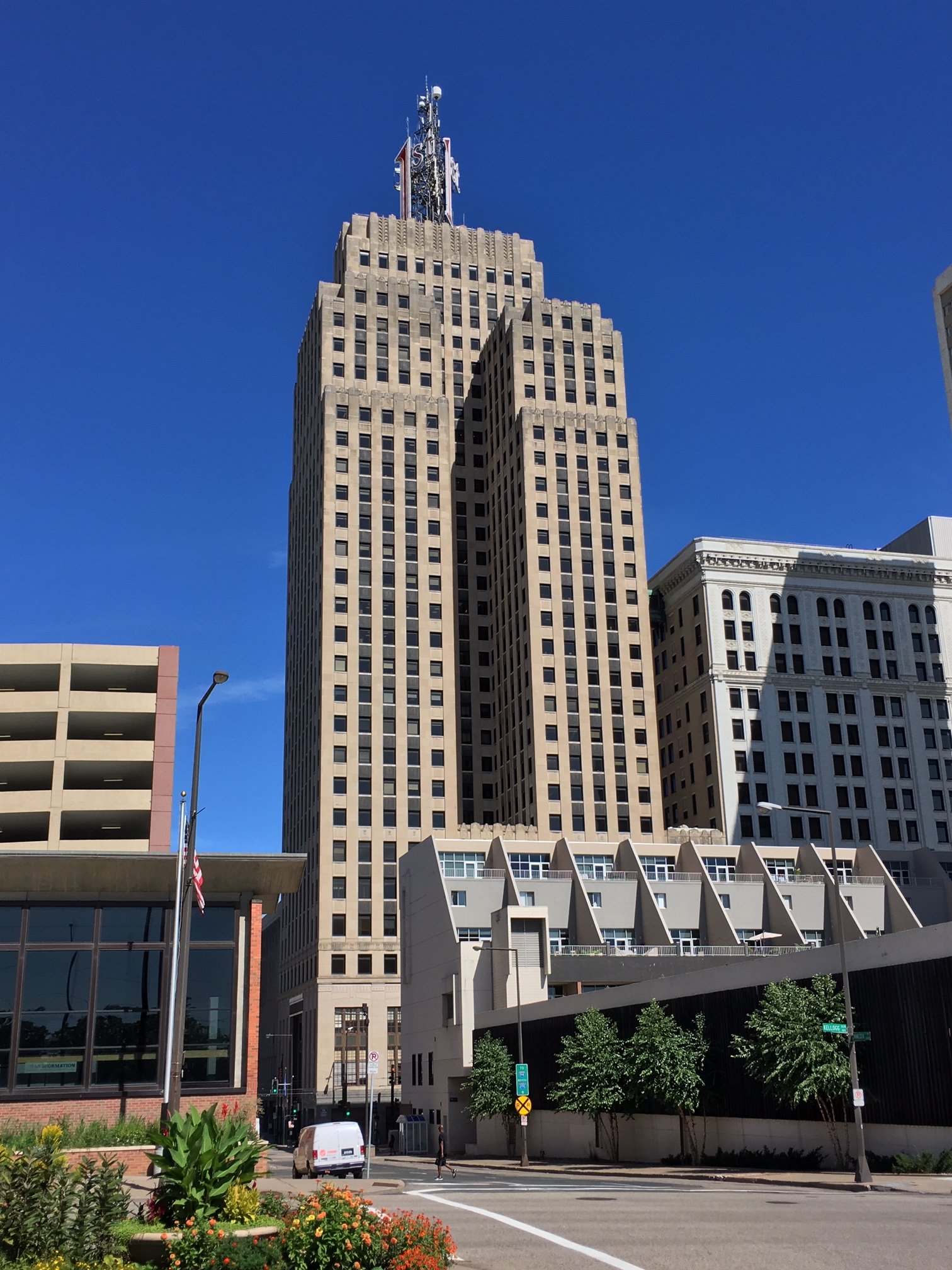
At 417 feet and 32 stories, Saint Paul’s dominant Art Deco skyscraper crowned the Minnesota capital’s skyline from 1931 to 1986—and still marks it from 75 miles away at night through the red glow of its famous three-sided “1st” neon sign.
At a glance
The First National Bank Building at 332 Minnesota Street stands as one of the Midwest’s finest Art Deco commercial towers and was Saint Paul’s tallest building for over half a century. Designed in 1931 by Graham, Anderson, Probst & White—the Chicago firm responsible for the Merchandise Mart and other landmark buildings—it replaced the earlier Merchants Bank Building on the same property and rose to 32 stories while the Empire State Building was under simultaneous construction, causing supply shortages that complicated the project. The building introduced what is believed to have been the world’s first modern skyway bridge, connecting its 17th floor to the adjacent Merchants Bank Building. Its rooftop “1st” sign, a 50-foot, three-sided neon tower visible for dozens of miles, has been a Saint Paul landmark since the building’s opening.
Key facts
- Completed: 1931; cost $3,340,185 (1932 figure)
- Architect: Graham, Anderson, Probst & White (Chicago)
- Style: Art Deco
- Height: 417 feet (roof), 32 stories
- Skyway: 17th-floor connection to Merchants Bank Building — believed to be the world’s first modern skyway
- Address: 332 Minnesota Street, Saint Paul, MN 55101
- GPS: 44.94671°N, 93.09106°W
History
The site’s first major structure, the Merchants Bank Building, was completed in 1916—at 228 feet, the tallest building in Saint Paul until it was overtaken by the very tower built to replace it. When Merchants National Bank merged with First National Bank, the decision was made to construct an entirely new skyscraper rising from the same block. Graham, Anderson, Probst & White, who had already defined the scale of American commercial architecture with buildings like the Wrigley Building and the Merchandise Mart in Chicago, won the commission. The project encountered an unusual obstacle: both the First National Bank Building and the Empire State Building broke ground in 1930, and the concurrent demand for steel, glass, and finish materials created supply shortages that slowed construction in Saint Paul.
The building was completed in 1931, its total cost of $3,340,185 recorded in 1932 accounts. Among its most celebrated features was the skyway bridge connecting the 17th floor to the adjacent Merchants Bank Building tower—a pedestrian link between two skyscrapers at altitude that anticipated by decades the extensive Minneapolis–Saint Paul skyway network now stretching through both downtowns. The building held its position as Saint Paul’s tallest from 1931 until 1986, when it was overtaken by the Galtier Plaza (now Cray Plaza). The building is eligible for but has not yet been listed on the National Register of Historic Places.
What you see
The tower’s Art Deco design is expressed through vertical emphasis and setbacks characteristic of the late 1920s skyscraper formula. The base is anchored to its downtown block with a substantial masonry plinth; above it, the tower steps back at intervals as it rises, concentrating the sense of height and drawing the eye upward toward the crown. The facade ornament is restrained—the building’s presence comes primarily from its sheer mass and vertical articulation rather than from applied ornament, distinguishing it from the more exuberant Deco towers of New York.
The rooftop sign is the building’s signature feature: a 50-foot, three-sided tower displaying “1st” in neon tubes. The sign was dark from 1973 to 1983 during the energy crisis, then restored with new tubing and relaunched with a renovation. In 2016 it was converted to LED technology and gained color-changing capability; the first major color variation was ice blue for the 2017 Saint Paul Winter Carnival. The sign’s reach—claimed at 75 miles visibility at night, 20 miles on a clear day—made it one of Minnesota’s most recognizable commercial landmarks well before the LED era.
Practical information
- Type: Active commercial office building; lobby accessible during business hours
- Skyway connection: The building is part of the downtown Saint Paul skyway system; access from the enclosed pedestrian network
- Best time to see the sign: After dark, when the neon or LED “1st” crown is visible from across the metro area
- Exterior photography: Unrestricted from public sidewalk; best angles from the pedestrian plaza along Minnesota Street
Getting there
The building is at 332 Minnesota Street in the heart of downtown Saint Paul, two blocks from Rice Park and the Ordway Center. Minneapolis–Saint Paul International Airport (MSP) is approximately 10 miles southwest; the Metro Green Line light rail connects the airport to downtown Saint Paul’s Union Depot station in about 45 minutes. From Union Depot, the building is an 8-minute walk west along Kellogg Boulevard. Underground and surface parking are available in the downtown core.
Nearby
- Minnesota State Capitol — 10-minute walk north; Cass Gilbert’s Beaux-Arts dome (1905) is visible from the First National Building’s upper floors
- Saint Paul City Hall and Ramsey County Courthouse — one block east; Art Deco masterpiece (1932) with Vision of Peace onyx sculpture in the lobby
- James J. Hill House — 15-minute walk north; Victorian mansion (1891) of the railroad magnate, open for tours
Sources
- Wikipedia: “First National Bank Building (Saint Paul, Minnesota)” — https://en.wikipedia.org/wiki/First_National_Bank_Building_(Saint_Paul,_Minnesota)
- Hess, Jeffrey A. and Clifford Larson, St. Paul’s Architecture: A History, University of Minnesota Press, 2006, pp. 161
- Chappell, Kitt and Sally A., Architecture and Planning of Graham, Anderson, Probst, and White, 1912–1936, University of Chicago Press, 1992, pp. 241–243
Find it on the map
See this place and what’s around it →Record researched and written by Luigi De Marchi for Cultural Heritage Online, 2026.
📷 Become a Cultural Heritage Online photographer
Share your photos of places: they stay published under your name as the author. The more they're seen, the more you get noticed — and soon a contest will reward the most appreciated photos.
Log in or sign up free to add a photoIs this page about you?
This page is read by travellers and heritage enthusiasts who find it on Google. Tell us how you are connected to this place and we will take it from there.