
Fes

Fes el Bali medina Morocco rooftops minarets Chouara tannery leather UNESCO
The rooftop panorama over Fes el-Bali (the Old Fes medina; the largest car-free urban area in the world; the original city founded in 789 CE), looking southeast toward the Quaraouiyine Mosque (الجامع القرويين; 859 CE; the oldest continuously operating university in the world) and the minarets of Fes el-Bali, with the Chouara tannery (the oldest tannery in Fes; in continuous operation since the 11th century CE; the circular stone vats of natural dyes — saffron, indigo, poppy, henna, pomegranate — visible in the foreground), Fes el-Bali, Province of Fes, Fès-Meknès Region, Morocco. UNESCO World Heritage Site 1981. Photo via Wikimedia Commons.
Fès-Meknès Region, Morocco · Founded 789 CE Idrisid; University of al-Qarawiyyin 859 CE oldest in world; car-free medina; Chouara tannery 11th century CE; UNESCO WHS 1981

Fes

The oldest and largest medieval Islamic city in the world and home to the oldest continuously operating university in history — Fes el-Bali (Fès-Meknès Region, Morocco; UNESCO WHS 1981) is a 9,400-hectare car-free labyrinth of 9,400 streets and alleys, 2,000 dead-end passages (derb), and 40,000 workshops and craftsmen, where the University of al-Qarawiyyin (859 CE) has been in continuous operation for over 1,160 years.

At a glance

Fes (the most precisely FesMorocco single Fes el-Bali 9400 hectares largest car-free urban area world 156000 population Fes el-Bali medina 300 mosques 120 hammams steam baths 40 Qur’anic schools Medersa 9400 named streets alleys 2000 dead-end passages derb no motor vehicles allowed inside medina mule donkey only transportation inside labyrinthine streets Fes el-Jedid New Fes 1276 CE Marinid dynasty new quarter Mellah Jewish quarter 1438 CE oldest Mellah Morocco 1438 CE Marinids moved Jewish community separate quarter Mellah = salt Fes Bali oldest medieval Islamic city in world oldest tannery world Chouara tannery 11th century CE in continuous operation 9 UNESCO heritage: why Fes is the most intact medieval Islamic city in the world (the accident of geography that preserved Fes): the Fes medina’s survival in its medieval form is the product of its geographic isolation; unlike Marrakech (which was accessible and heavily influenced by French urban planning after 1912 CE) or Tunis (whose medina was partly rebuilt), Fes el-Bali sits in a valley (the Fes River valley) between two ridges; when the French Protectorate was established in 1912 CE, the French Résident Général Hubert Lyautey instituted a strict urban policy (the politique des égards) that prohibited construction inside the medina and built a completely separate new ville nouvelle (modern French-planned city) on the plateau to the north; this policy — motivated both by pragmatic concern for traffic flow and by a genuine respect for the medieval city — was the primary reason the medina was not demolished; it is the model for UNESCO urban conservation policy)) — the most precisely FesMorocco single Fes el-Bali 9400 hectares largest car-free world 156000 population 300 mosques 120 hammams 40 Qur’anic schools 9400 named streets 2000 derb dead-end no motor vehicles mule donkey only transport Fes el-Jedid New Fes 1276 CE Marinid Mellah Jewish quarter 1438 CE oldest Mellah Morocco oldest medieval Islamic city oldest tannery world Chouara 11th century CE French Résident Lyautey politique des égards 1912 CE no build inside medina separate ville nouvelle plateau preserved medina model UNESCO urban conservation UNESCO heritage in any UNESCO world heritage site)).

Key facts

  • The University of al-Qarawiyyin (859 CE): the oldest continuously operating university in the world: the most precisely FesMorocco single University al-Qarawiyyin University of the Quaraouiyine Fes Morocco 859 CE founded Fatima al-Fihri 859 CE she was daughter wealthy Tunisian merchant Muhammad al-Fihri family emigrated Kairouan Tunisia to Fes founded mosque and attached school 859 CE funded by her entire inheritance she was educated woman female founder oldest university world Guinness World Records oldest university continuous operation UNESCO 2013 CE al-Qarawiyyin named oldest operating university world originally Qur’anic school evolved into full university curriculum grammar rhetoric logic mathematics astronomy by 12th century CE Pope Sylvester II Gerbert of Aurillac possible student 970s CE studied at Fes or Andalusia transmitted Arabic numerals Hindu-Arabic number system to Europe Maimonides student of Fes Morocco not al-Qarawiyyin but studied Moroccan Muslim scholars Ibn Khaldun taught 14th century CE greatest medieval historian Ibn Rushd Averroes Andalusian philosopher studied at Fes 1969 CE Moroccan state took over administration converted to modern university UNESCO heritage — one of the most significant facts in the history of education: the University of al-Qarawiyyin (جامع القرويين; the Mosque of the Quaraouiyine; named after the people of Kairouan, Tunisia, who migrated to Fes) was founded in 859 CE by Fatima al-Fihri (فاطمة الفهرية; the daughter of a wealthy Tunisian merchant, Muhammad al-Fihri, who had emigrated from Kairouan to Fes); Fatima used her entire inheritance to fund the mosque and the attached educational institution; the institution has been in continuous operation for over 1,160 years — the longest in the world for any institution of higher education; it influenced the transmission of Arabic numerals and the decimal system to Europe; Pope Sylvester II (Gerbert of Aurillac; ruled 999-1003 CE) may have studied in Fes or in Andalusia and was responsible for introducing Hindu-Arabic numerals to Europe
  • GPS: 34.0622° N, 4.9736° W

History

From Idrisid foundation to Marinid golden age to Alaouite imperial capital (the most precisely FesMorocco single 789 CE Idris I founder Idrisid dynasty Morocco first Moroccan Islamic dynasty Arab Berber founded Fes right bank Oued Fes river 808 CE Idris II son founded Fes left bank two separate cities right bank Adwat al-Andalus (Andalusia Quarter) Berber tribes Berber settlers left bank Adwat al-Qarawiyyin Kairouan Quarter Arab Tunisian settlers from Kairouan two banks unified 1069 CE Almoravid dynasty Yusuf ibn Tashfin unified Fes walls extended 1143 1145 CE Almohad dynasty replaced Almoravids in Fes Marinids 1248 1465 CE Moroccan Berber dynasty Marinid most important patrons Fes 1276 CE Fes el-Jedid New Fes palace city capital built south west of Fes el-Bali Marinid madersas Ben Youssef Bou Inania 1350 1357 CE Abu Inan Faris best Marinid madrasa finest Islamic architecture Morocco 14th century CE Bou Inania Medersa unique feature in Morocco only building open as mosque to non-Muslims 1420 CE Wattasids replaced Marinids 1472 CE Saadian replaced 1549 CE 1554 CE Saadian capital moved to Marrakech Fes secondary city 1666 CE Alaouite dynasty current ruling dynasty Morocco Moulay Rashid Moulay Ismail 1672 1727 CE Ismail Fes royal palace Dar al-Makhzen 1912 CE French Protectorate Lyautey politique des égards preserved 1956 CE Moroccan independence 1981 CE UNESCO UNESCO heritage: the Marinid madrasas (the golden century of Islamic education architecture, 14th century CE): the Marinid dynasty (1248-1465 CE) built the most ambitious programme of Islamic educational architecture in medieval history; the Marinid madrasas (Bou Inania, Sahrij, Seffarine, Misbahiyya, Cherratine, Attarine — all in Fes; plus Ben Youssef in Marrakech) were built to extend and legitimise the Marinid dynasty through religious patronage; each madrasa combines the same three-material decorative programme: zellige (tilework); carved stucco (plaster); carved cedarwood (the Bou Inania madrasa (1350-1357 CE) is the largest and finest: the water clock on the façade (the only surviving medieval Islamic water clock in Africa; 13 wooden beams operated by water pressure from an internal cistern activated a bronze gong at each hour); the interior courtyard (the standard zenith of Moroccan decorative arts in a single space))) — the most precisely FesMorocco single 789 CE Idris I Idrisid first Moroccan Islamic dynasty right bank Oued Fes 808 CE Idris II left bank Adwat al-Andalus Berber Adwat al-Qarawiyyin Arab Tunisian Kairouan 1069 CE Almoravid Yusuf ibn Tashfin unified 1276 CE Fes el-Jedid Marinid palace city capital 1350 1357 CE Bou Inania Medersa Abu Inan Faris finest Morocco unique open mosque non-Muslims water clock façade only surviving medieval Islamic water clock Africa 1912 CE Lyautey politique des égards 1981 CE UNESCO heritage in any UNESCO world heritage site)).

What you see

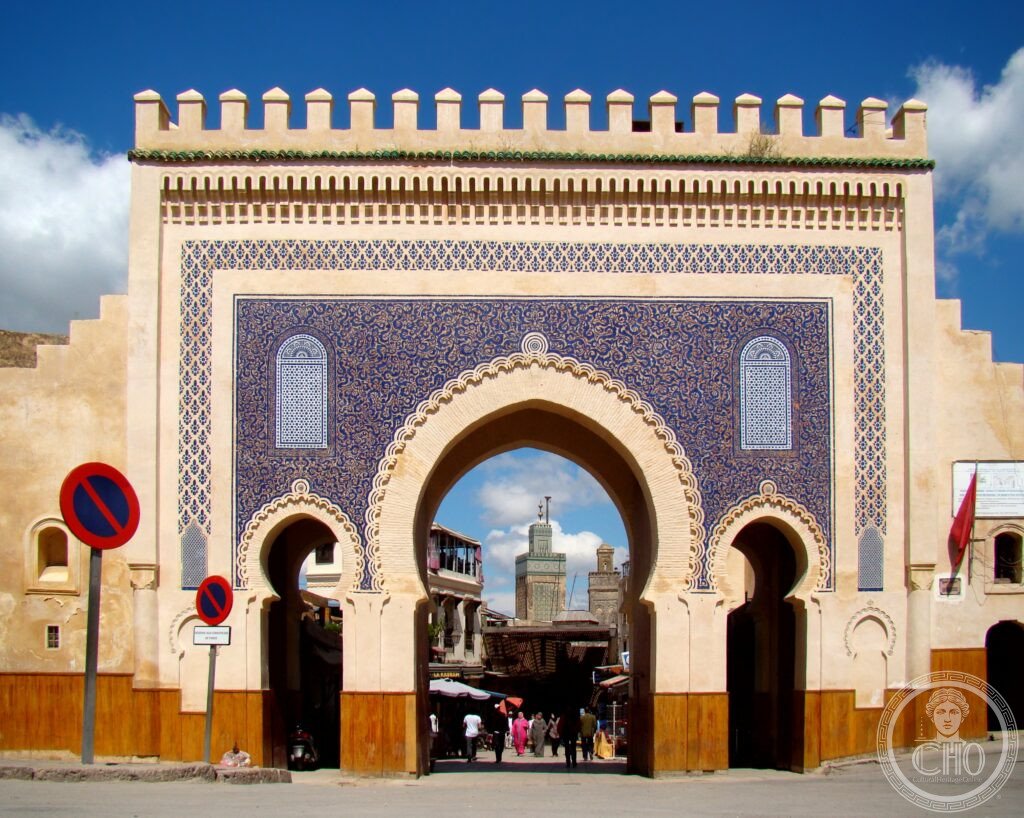
Al-Qarawiyyin, Bou Inania Medersa, Chouara tannery, and the labyrinthine souks (the most precisely FesMorocco single al-Qarawiyyin mosque university 22 naves 18 doors 29 interior pillars capacity 22000 worshippers non-Muslims cannot enter interior visible through open doors courtyard views ablution fountain courtyard Andalusian style 10th century CE decorated Bou Inania Medersa 1350 1357 CE Abu Inan Faris Marinid madrasa unique open mosque non-Muslims admission free water clock façade 13 wooden beams bronze gong medieval Islamic water clock only Africa central courtyard zellige floor stucco stalactite muqarnas ceiling cedar carved galleries 25 rooms student dormitories Chouara Chouwara tanneries largest oldest tannery Fes 11th century CE in continuous operation three dynasties natural dyes vats round stone vats circular saffron yellow poppy red indigo blue henna green white pigeon guano to soften leather workers barefoot standing in stone vats viewed from leather shops terraces above bring sprig mint to counteract smell Attarine souk spice market adjacent al-Qarawiyyin finest covered market street souk Seffarine Place metalwork brass copper craftsmen hammering Al-Attarine souk leads directly to entrance al-Qarawiyyin mosque UNESCO heritage: navigating Fes el-Bali (the most complex medieval urban environment in the world): Fes el-Bali has 9,400 named streets, 2,000 dead-end passages (derb), and no motor vehicles — it is navigated on foot or by mule; the medina has no grid — it follows the organic expansion patterns of 1,100 years of organic growth; the narrow streets (some as narrow as 50 cm, requiring walkers to press against the wall when a mule passes) follow property boundaries and water channels, not any planning principle; the reference points for orientation: the sound of the al-Qarawiyyin call to prayer (audible everywhere); the Bou Jeloud Gate (the blue-and-green tile gate; the main western entrance to the medina; the starting point for navigating east toward al-Qarawiyyin); the descent toward water (Fes el-Bali sits in a valley — streets descend toward the Oued Fes river, which passes through the medina in underground channels; if you are lost, descend until you find a main street following a water channel, then follow it upstream (west/uphill) toward the Bou Jeloud gate or downstream (east) toward the Chouara tanneries))) — the most precisely FesMorocco single al-Qarawiyyin 22 naves 29 pillars 22000 worshippers non-Muslims closed exterior visible open doors Bou Inania 1350 1357 CE unique open mosque non-Muslims water clock façade only medieval Islamic water clock Africa zellige stucco cedarwood muqarnas 25 student rooms Chouara tanneries 11th century CE 3 dynasties circular stone vats saffron indigo poppy henna pigeon guano soften leather 9400 streets 2000 derb dead-end no cars mule only transport Bou Jeloud Gate blue green tiles main west entrance UNESCO heritage in any UNESCO world heritage site)).

Practical information

  • Getting there: fly to Fes-Saïss Airport (FEZ; direct from London (3h20m), Paris (2h30m), Amsterdam (3h30m), Brussels (3h), Madrid (1h30m)); taxi from airport to medina: 100-150 MAD/€10-15 (30 min); or by train from Marrakech (7h; 2 changes; less efficient); the Bou Jeloud Gate (Bab Bou Jeloud; the blue tile gate; the main entrance; start all medina walks here); the Bou Inania Medersa (20 MAD/€2; one of the great bargains in travel — the finest single architectural interior in Morocco for almost nothing); the Chouara tannery viewpoints (free if you access from the leather shop terraces surrounding the tannery; bring a sprig of mint — offered at the entrance — to neutralize the smell of the natural dyes; the best light for photography: morning, 9-11 AM); the al-Qarawiyyin Mosque (closed to non-Muslims; views through the open doors from the adjacent Attarine souk); a guided walk (strongly recommended: the medina is genuinely disorienting; a licensed guide (200-300 MAD/€20-30 for 3h from the Bou Jeloud square) prevents hours of wandering dead-end passages; the best guides are licensed by the Ministry of Tourism (badge visible)); the best time (March-May and September-November; avoid July-August (extreme heat in the valley; 40°C+ regularly)); the Fes el-Bali carpet vendor pressure (significant — politely decline all offers to guide you to carpet shops; if you do enter a carpet shop, the social pressure to buy is intense and the prices are negotiable to approximately 40% of the asking price)

Getting there

FEZ airport → taxi 100-150 MAD (30 min). Start at Bab Bou Jeloud gate. Bou Inania Medersa: 20 MAD (finest architecture in Morocco). Chouara tanneries: free from leather shop terraces. Licensed guide: 200-300 MAD for 3h (strongly recommended). Best: March-May or September-November. GPS: 34.0622, -4.9736.

Nearby

  • Volubilis — 80 km northeast (UNESCO WHS 1997; the best-preserved Roman ruins in Morocco and one of the finest in Africa; the ancient Berber city became the capital of the Roman province of Mauretania Tingitana (1st-3rd century CE); the Triumphal Arch of Caracalla (217 CE; 8m high; the most prominent surviving monument); the extraordinary in-situ floor mosaics (the House of Orpheus; the House of Venus; the finest Roman mosaic collection outside Tunisia); the basilica; the Capitol; the olive presses; the site is rarely crowded and a spectacular afternoon visit from Fes)
  • Meknes — 60 km west (UNESCO WHS 1996; the city built by Moulay Ismail (1672-1727 CE) as the Moroccan Versailles; the Bab Mansour gateway (1732 CE; the most monumental gate in Morocco; a 20m-high arch decorated with green-and-white marble columns taken from Volubilis); the granaries of Moulay Ismail (the Heri es-Souani; the largest Royal Granary in Islamic history; 30m-high brick barrel vaults, once capable of storing food for 12,000 horses for 20 years; the underground cisterns beneath))

Sources

  • Wikipedia, Fes el Bali; University of al-Qarawiyyin; Chouara tannery; Bou Inania Madrasa, Fes, accessed June 2026
  • UNESCO, Medina of Fez, WHS reference 170, inscribed 1981

Hero image: Fes el-Bali, Morocco, Wikimedia Commons. Editorial text © Cultural Heritage Online, 2026.

📷 Diventa un fotografo di Cultural Heritage Online

Condividi le tue foto dei luoghi: restano pubblicate con la tua firma come autore. Più vengono viste, più ti fai conoscere — e presto un concorso premierà le foto più apprezzate.

Accedi o registrati gratis per aggiungere una foto
📋 Copy & share on social
Scroll to Top