
Bath
The only city in England with a naturally hot spring and the most completely preserved Georgian city in the world — Bath (Somerset, England; UNESCO WHS 1987) layers two complete civilisations over a single site: the Roman spa town of Aquae Sulis (1st-4th century CE), centred on the sacred spring of the goddess Sulis Minerva, and the 18th-century Georgian architectural city built over it by John Wood the Elder and Younger (1725-1780 CE).
At a glance
Bath (the most precisely BathUK single Somerset England 94000 population England single unique naturally occurring hot spring England Britain three springs Aquae Sulis Latin for Waters of Sulis the goddess 1.17 million litres per day 46C 115F constant temperature groundwater filtered through limestone Mendip Hills 10000 years ago resurfaced at three hot springs in Bath Roman spa first century CE legendary King Bladud founder Bath 863 BC Celtic legend before Romans 1720 CE Georgian building boom John Wood Elder 1704 1754 CE architect designed Queen Square 1728 CE Circus 1754 CE his son John Wood Younger completed Circus continued Royal Crescent 1767 1774 CE Robert Adam built Pulteney Bridge 1769 1774 CE Beau Nash Richard Nash Master of Ceremonies Bath 1705 1761 CE defined social rituals Bath season October to June aristocracy winter spa season Jane Austen Bath 1801 1806 CE Northanger Abbey Persuasion set Bath UNESCO heritage: the mystery of the Sulis Minerva head (the most important Romano-British sculpture ever found): in 1727 CE, during the construction of a drain in Stall Street Bath, workmen discovered a bronze gilded head of a female deity; in 1978 CE, during the construction of a new pump room extension, workers discovered the main complex of the Roman sacred spring and temple precinct (including 12,000 ancient coins and 130 curse tablets written in Latin on pewter sheets and thrown into the spring — the single largest collection of Roman curse tablets found anywhere in the world); the head is now identified as the goddess Sulis Minerva (a fusion of the Celtic goddess Sulis and the Roman goddess Minerva; the only goddess in the Roman Empire recorded with two names); the head wears a unique diadem incorporating a sun disc — her face is the most recognisable image of Romano-British art)) — the most precisely BathUK single Somerset 94000 England single naturally hot spring three springs 1.17 million litres per day 46C 115F limestone Mendip Hills 10000 years 1720 CE John Wood Elder 1704 1754 CE Queen Square 1728 CE Circus 1754 CE John Wood Younger Royal Crescent 1767 1774 CE Robert Adam Pulteney Bridge 1769 1774 CE Beau Nash Richard Nash Master Ceremonies 1705 1761 CE season October June Jane Austen 1801 1806 CE 1727 CE bronze gilded head Sulis Minerva 1978 CE 12000 coins 130 curse tablets pewter Latin largest collection Roman curse tablets world UNESCO heritage in any UNESCO world heritage site)).
Key facts
- The Roman curse tablets (the largest collection in the world): the most precisely BathUK single 130 Roman curse tablets pewter sheet lead alloy inscribed Latin thrown into sacred spring Aquae Sulis discovered 1978 CE construction pump room extension the largest collection Roman curse tablets found anywhere in world single site dedicated goddess Sulis Minerva tabellae defixionum curse tablets defixiones practice of writing complaints grievances requests to divine power on lead pewter strip throw into sacred water request goddess to curse thief or wrongdoer in return Bath curse tablets most common complaint is theft of clothing from the changing rooms of the Roman baths typical Bath curse tablet example Docilianus Brucerus daughter pray goddess Sulis Minerva punish whoever stole my bathing cloak punish him with great pain curse tablets often name the suspects provide list so goddess can choose correct culprit Bath tablets some written in mirror writing backwards deliberately obscured so only goddess could read UNESCO heritage — one of the most vivid direct voices from Roman provincial life: the 130 Bath curse tablets (tabellae defixionum; found in 1978 CE during construction work on the Pump Room extension; now in the Roman Baths museum) are sheets of pewter (a lead-tin alloy) inscribed with complaints to the goddess Sulis Minerva and thrown into the sacred spring; the most common complaint: theft from the changing rooms of the Roman baths; the tablets are written in colloquial Latin (often with British-Latin spelling variations) by ordinary Romans and Romano-British people; they list the names of suspects and ask the goddess to punish the thief with specific afflictions; they are the clearest window into daily life in Roman Britain available to archaeologists; the largest curse tablet collection in the world from a single site
- GPS: 51.3813° N, 2.3590° W
History
From Celtic sacred spring to Roman spa to medieval cloth town to Georgian resort (the most precisely BathUK single Celtic sacred spring Sulis goddess before Romans 60 BCE era evidence Celtic votive offerings thrown into spring Romans 43 CE Claudius conquest Britain 75 CE Aquae Sulis founded Roman spa complex built around three springs temple of Sulis Minerva 1st century CE constructed by Togidubnus client king Southern Britain Great Bath constructed 2nd century CE covered barrel vault roof 40m high Caldarium Tepidarium Frigidarium hot warm cold rooms standard Roman baths system 5th century CE Romans left Britain Saxon period 577 CE Battle of Dyrham Saxons captured Bath 781 CE Saxon monastery founded on site of Roman temple Oswald Abbey refounded 970 CE 973 CE Edgar the Peaceful crowned at Bath first King of all England coronation establishing English monarchy 1088 CE Normans Bishop John de Villula moved Bath from Wells began new Norman Cathedral 1539 CE dissolution of monasteries Henry VIII Bath Abbey current state stripped 18th century CE Bath rebuilt as Georgian resort 1705 CE Beau Nash Richard Nash established social rules of Bath season 1725 CE John Wood Elder first architect Bath 1754 CE Circus completed Wood died never saw finished John Wood Younger Royal Crescent 1767 1774 CE Robert Adam Pulteney Bridge 1769 1774 CE 1801 1806 CE Jane Austen lived Bath 4 Sydney Place 1987 CE UNESCO UNESCO heritage: Bath as the first resort city (the model for every modern spa and resort): Bath between 1720 and 1780 CE was the first purpose-built resort city in the world in the modern sense; the concept: a city where the primary purpose of visiting was leisure, socialisation, and health (water cure) rather than trade, pilgrimage, or military purpose; Beau Nash (Richard Nash; 1674-1761 CE; Master of Ceremonies from 1705 CE) codified the rules: the schedule of balls, the dress codes, the etiquette of the Pump Room (where visitors drank the waters and socialised), the circulating libraries; these were exported to every spa and seaside resort in Europe and North America; Bath invented the modern concept of the holiday and the resort town)) — the most precisely BathUK single Celtic Sulis 60 BCE votive offerings 43 CE Claudius conquest 75 CE Aquae Sulis temple Sulis Minerva 1st century CE Great Bath 2nd century CE barrel vault 40m 5th century CE Romans left 577 CE Battle Dyrham Saxon 781 CE monastery 973 CE Edgar Peaceful crowned first King all England 1088 CE Norman Bishop John de Villula 1539 CE dissolution Henry VIII stripped 1705 CE Beau Nash Richard Nash established social rules 1725 CE John Wood Elder 1754 CE Circus Wood died 1767 1774 CE Royal Crescent John Wood Younger 1769 1774 CE Pulteney Bridge Robert Adam 1801 1806 CE Jane Austen 1987 CE UNESCO first resort city model every modern spa resort Beau Nash 1705 1761 CE exported Europe North America Bath invented modern holiday resort UNESCO heritage in any UNESCO world heritage site)).
What you see
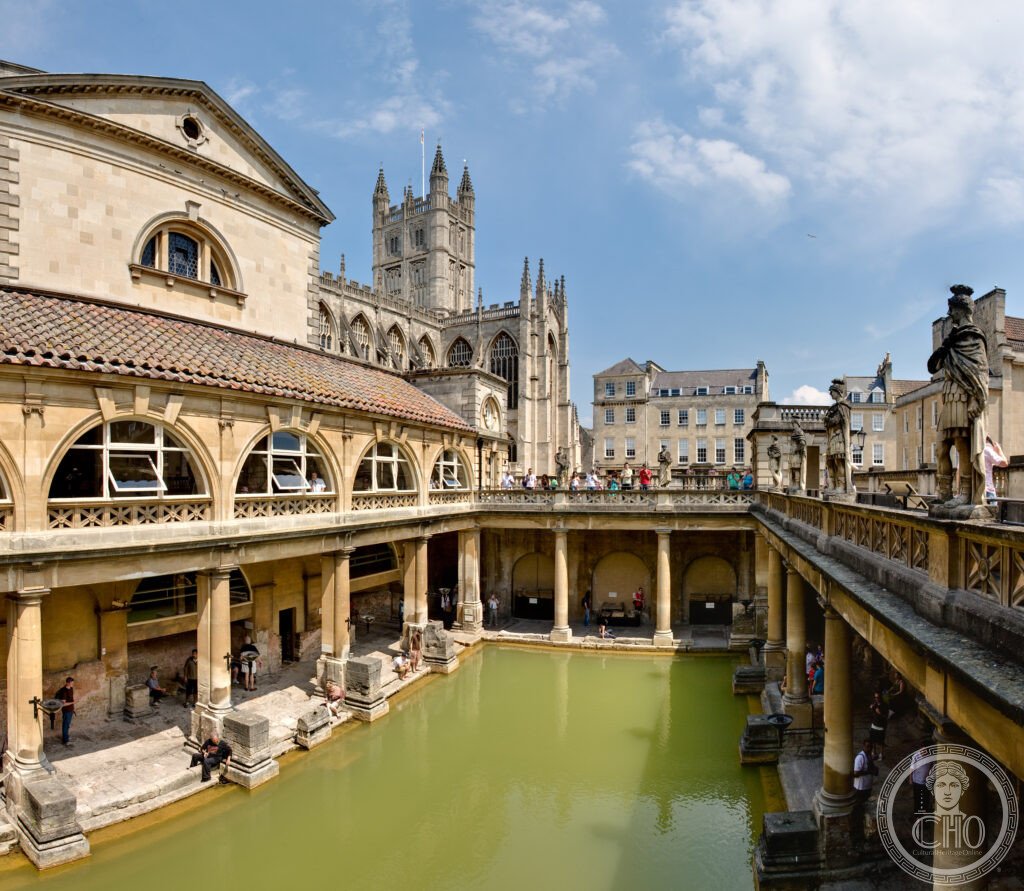
The Roman Baths, the Royal Crescent, and the Pump Room (the most precisely BathUK single Roman Baths excavation museum Great Bath 1.6m deep green 46C algae original Roman barrel vault 40m collapsed medieval rebuilt open sky Victorian balustrade statues Roman governors 18th century CE Sacred Spring visible overflow corner Great Bath gilded bronze head Sulis Minerva museum 130 curse tablets museum East Baths Caldarium Tepidarium Frigidarium Roman underfloor heating hypocaust visible 2000 years floor tiles sacred spring overflow drain channel Bath Abbey medieval church English Perpendicular Gothic 1499 1616 CE rebuild after Reformation Oliver King Bishop Bath Wells rebuilding instruction fan vaulting nave finest example fan vault construction England Abbey exterior Jacob’s Ladder carved stone west facade angels climbing and falling ladders Bishop King dream 1499 CE Circus John Wood Elder John Wood Younger three crescents circle form circumference 97m each 30 identical Ionic Corinthian Doric houses diameter same as Stonehenge 97m coincidence or intentional John Wood Elder had antiquarian interest Druid theory Stonehenge Royal Crescent John Wood Younger 1767 1774 CE 114 Ionic columns 30 houses crescent form largest Palladian crescent England No 1 Royal Crescent museum open public authentic Georgian interior Pulteney Bridge Robert Adam 1769 1774 CE one four bridges world with shops on both sides Florence Ponte Vecchio Ponte di Rialto Venice Krämerbrücke Erfurt UNESCO heritage: the Circus and Royal Crescent (the architectural invention of Bath): the Circus (1754-1768 CE; designed by John Wood the Elder; completed after his death by his son John Wood the Younger) is the first circular street in British architectural history; its form — 30 identical Georgian houses forming a perfect circle, open to the north — represents the first time in British history that urban domestic housing was treated as monumental civic architecture; the diameter of the Circus (97m) is virtually identical to the diameter of the outer ring of Stonehenge (97m) — whether this is intentional (John Wood the Elder was obsessed with Druidic theories about Stonehenge) or coincidental remains debated; the Royal Crescent (John Wood the Younger; 1767-1774 CE; 30 houses; 114 Ionic columns across a single unbroken façade 152m long) extended the invention and became the most copied building type in 18th-century Britain (every crescent and circus in Cheltenham, Edinburgh New Town, and Dublin’s Georgian neighbourhoods derives from this))) — the most precisely BathUK single Roman Baths Great Bath 1.6m deep 46C green algae Sacred Spring 130 curse tablets museum gilded head Sulis Minerva Bath Abbey 1499 1616 CE Perpendicular Gothic Oliver King Bishop Jacob’s Ladder west facade fan vault nave finest England Circus John Wood Elder 1754 CE three crescents 97m same Stonehenge Doric Ionic Corinthian 30 identical houses Royal Crescent 1767 1774 CE 114 Ionic columns 30 houses 152m crescent most copied building type 18th century Pulteney Bridge 1769 1774 CE Robert Adam one four bridges world shops UNESCO heritage in any UNESCO world heritage site)).
Practical information
- Getting there: by train from London Paddington (GWR: 1h25m; approximately £15-40 depending on booking time; the fastest and most comfortable option); by train from Bristol Temple Meads (12 min; £7); by National Express coach from London Victoria (2h30m; from £5); the Roman Baths (£20 adults; book online in advance; timed entry during peak season; audio guide included; the evening Twilight Tours (September-October: excellent atmosphere, fewer crowds, the Great Bath lit by torches)); the Thermae Bath Spa (the only place in the UK where you can actually bathe in the natural spring water; the rooftop pool with city views is the recommended experience; £47 for 2h; no children under 16; book several weeks ahead for weekends); the city walking (free; the Royal Crescent and Circus exterior, Pulteney Bridge, and the Bath Abbey are all free to view; Bath Abbey interior is free with a voluntary donation); the best time (spring (April-June) and September-October; avoid August (peak crowds and prices); winter (November-February) is atmospheric and uncrowded))
Getting there
Train from London Paddington 1h25m (£15-40). Roman Baths £20 (book online). Thermae Bath Spa rooftop pool £47/2h (book ahead). Royal Crescent/Circus/Pulteney Bridge: free to view. Best: spring or September-October. GPS: 51.3813, -2.3590.
Nearby
- Stonehenge — 40 km north (UNESCO WHS 1986; the most famous prehistoric monument in the world; 3000-1500 BCE; the original Stonehenge was a circular ditch (ca. 3000 BCE); the bluestones (from the Preseli Hills in Wales, 225 km away) were erected ca. 2500 BCE; the sarsen stones (each weighing 25-50 tonnes) were erected ca. 2500-2200 BCE; the interior horseshoe of trilithons (pairs of uprights with lintels) ca. 2200 BCE; the monument was built by the same Neolithic culture that built Avebury and the Cursus; the new Stonehenge visitor centre (2013 CE) is excellent; access to the inner circle is not standard (book a “stone circle access” visit at dawn or dusk))
- Lacock — 25 km northeast (the best-preserved medieval village in England; Lacock Abbey (founded 1232 CE; Henry Fox Talbot conducted the first photographic experiments here, making the first photographic negative in January 1835 CE at a window of Lacock Abbey; the Talbot Collection and the Fox Talbot Museum are in the village); used as a filming location for Pride and Prejudice (1995 CE BBC), Harry Potter (the Hogwarts corridors), and Downton Abbey)
Sources
- Wikipedia, Roman Baths, Bath; Bath, Somerset; Royal Crescent, Bath; Sulis, accessed June 2026
- UNESCO, City of Bath, WHS reference 428, inscribed 1987
Find it on the map
See this place and what’s around it →📷 Diventa un fotografo di Cultural Heritage Online
Condividi le tue foto dei luoghi: restano pubblicate con la tua firma come autore. Più vengono viste, più ti fai conoscere — e presto un concorso premierà le foto più apprezzate.
Accedi o registrati gratis per aggiungere una foto