
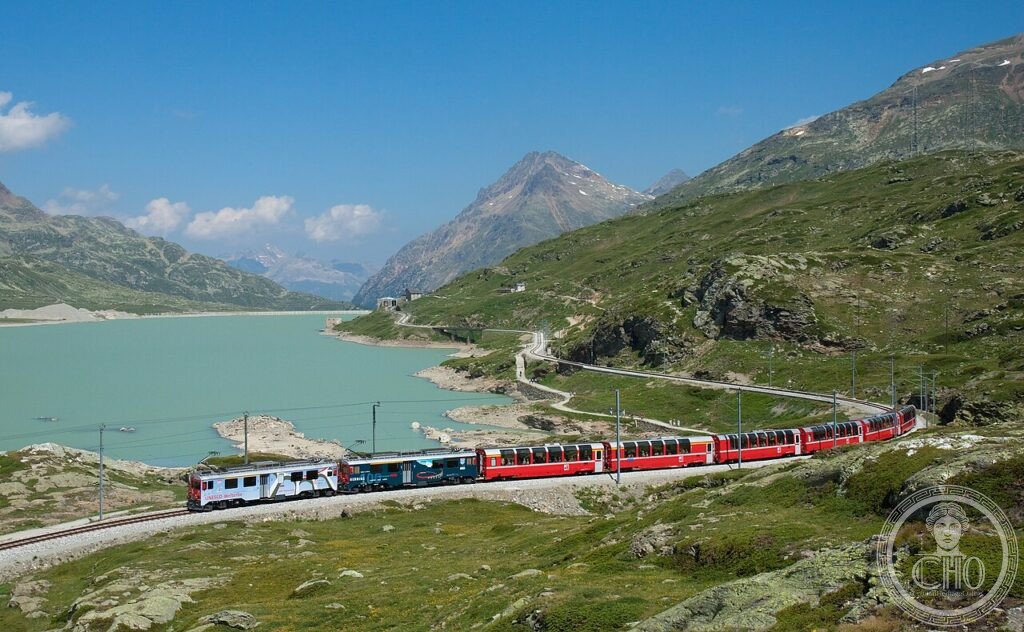
The southern terminus of the Bernina line, the highest transalpine railway in the world without a cog wheel, which climbs 1,800 metres in 61 kilometres from Tirano to St Moritz across one of the most engineered mountain landscapes in railway history — inscribed UNESCO in 2008.
At a glance
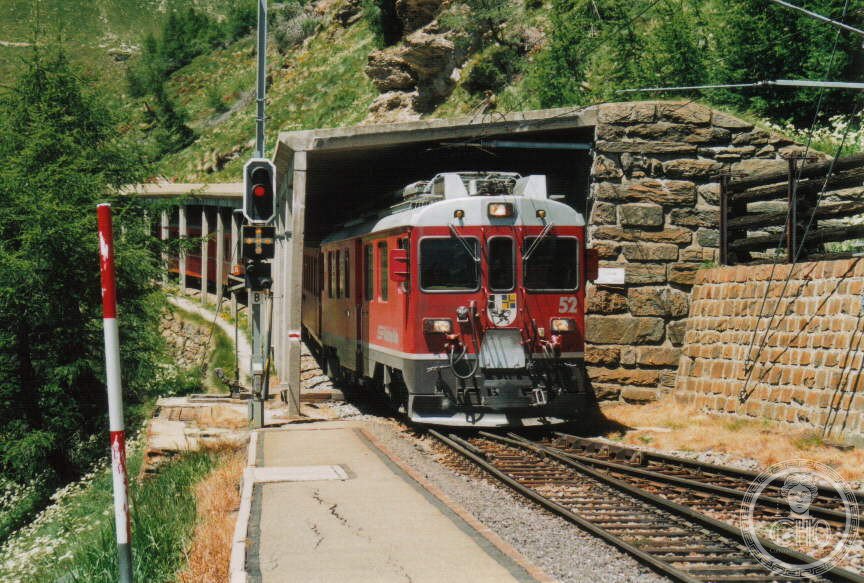
Tirano (altitude 429 m, Province of Sondrio) is the Italian end of the Bernina railway, the last of the great transalpine lines and the only one to cross the Alps without rack-and-pinion traction. From Tirano’s combined Rhaetian-railway and FS station, the narrow-gauge train climbs through Poschiavo, across the Lago Bianco viaduct at 2,253 metres, and descends to St Moritz and Chur in Switzerland — a 61-kilometre route inscribed as UNESCO World Heritage in 2008 together with the Albula line further north.
The Bernina line was built between 1906 and 1910 by the Bernina Bahn company and electrified from the start, a technical novelty that allowed operations above the snowline. The inscription recognises the line’s “masterful engineering” and its role as “a significant new step in transport technology at the dawn of the twentieth century.”
Key facts
- Construction: 1906–1910
- Operator: Rhaetian Railway (Rhätische Bahn, RhB)
- Route: Tirano (IT, 429 m) → Ospizio Bernina (2,253 m) → St Moritz / Chur (CH)
- Length: 61 km (Bernina section, Tirano to Pontresina)
- Maximum altitude: Ospizio Bernina, 2,253 m — highest transalpine railway without rack
- Gauge: Metre gauge (1,000 mm)
- UNESCO inscription: 2008, ref. 1276 — “Rhaetian Railway in the Albula / Bernina Landscapes”
- GPS (Tirano station): 46.2125, 10.1700 — Google Maps
History
The idea of a transalpine railway through the Bernina Pass predated the Gothard by decades, but the technical and financial challenges of a route above 2,000 metres without rack-and-pinion traction were enormous. The Bernina Bahn company was chartered in 1906; construction proceeded in two phases (Tirano to Poschiavo 1908, then over the pass to Pontresina 1910), using locally quarried stone for the viaducts and the steep switchback at Poschiavo to manage the gradient.
Electrification from the start — at a time when most mountain railways still used steam — distinguished the Bernina from its contemporaries and made year-round operation feasible. The line was absorbed into the Rhaetian Railway network in 1943. From the 1970s, the “Bernina Express” panoramic coach service was introduced, making the route one of the most popular scenic rail journeys in Europe.
The UNESCO inscription in 2008 (ref. 1276) covered both the Bernina line and the older Albula line (1904), recognising the whole as an “outstanding example of the influence of an innovative means of transport on the development of a cultural landscape.” The Bernina is the only transalpine railway crossing without a tunnel and without rack propulsion.
What you see
Departing Tirano, the train immediately enters the Italian-Swiss border zone, crossing the Poschiavino river on a circular viaduct — the Brusio spiral viaduct, 360-degree loop, grade 70‰ — the most photographed engineering feature on the line. The ascent through Poschiavo valley alternates between high stone viaducts and open terraced vineyard landscape before the treeline drops and the train emerges onto the high plateau of the Engadine.
At Ospizio Bernina (2,253 m), the train crosses between the Italian and Atlantic watersheds: the Lago Bianco and Lago Nero are dammed reservoirs on either side of the pass, their colours determined by mineral content. On the Swiss descent to St Moritz, the landscape shifts from the severe grey of the high alpine to the manicured resort valley of the Engadine, with pink-rendered hotel facades and an Art Nouveau spa town. The return from Tirano takes approximately 2 hours 20 minutes to St Moritz on the Bernina Express; the panoramic windows are not openable but the views are unobstructed.
Gallery
Practical information
- Train service: Bernina Express (panoramic, reservation required) and regular Rhaetian Railway services, several per day year-round.
- Reservation: Bernina Express requires reservation (SFr 14 supplement). Book via rhb.ch or trenit.it for Italian departures.
- Duration Tirano–St Moritz: ~2h20 (Bernina Express); ~2h45 (regional).
- Best season: December–February (snow panorama, but check pass conditions) or June–September (full operation, wildflowers at altitude). May and November: reduced service.
- Tirano station: Combined RhB (narrow gauge, platform 1) and Trenitalia FS (standard gauge, platforms 2-3) station. Bar at station.
Getting there
Tirano is 65 km north-east of Lecco on the SS38 (SS dello Stelvio), or 165 km from Milan via A4+A36+SS38 (2h30 by car). By train from Milan Centrale: Trenord direct to Tirano via Sondrio, 3h (no high-speed option). By train from Bergamo: change at Lecco or Sondrio, ~2h30. The Bernina Express from Chur or St Moritz arrives at Tirano as an international rail service; no customs formality.
Nearby
- Santuario della Madonna di Tirano — Renaissance basilica (1505), pilgrimage church at the RhB station entrance
- Bormio — Stelvio Pass, thermal baths, 22 km north
- Poschiavo (CH) — first Swiss stop, 19th-century Romansh village with Art Nouveau via Maistra
Sources
- UNESCO World Heritage Centre: whc.unesco.org/en/list/1276
- Wikipedia EN: Bernina railway line
- Rhätische Bahn (RhB): rhb.ch
- Bignami, Dario: La Ferrovia del Bernina, Tirano, 1997
Gallery
Find it on the map
See this place and what’s around it →📷 Become a Cultural Heritage Online photographer
Share your photos of places: they stay published under your name as the author. The more they're seen, the more you get noticed — and soon a contest will reward the most appreciated photos.
Log in or sign up free to add a photo