
Ferrara: Centro Storico e Delta del Po

Ferrara Castello Estense Este biciclette Addizione Erculea Biagio Rossetti UNESCO 1995
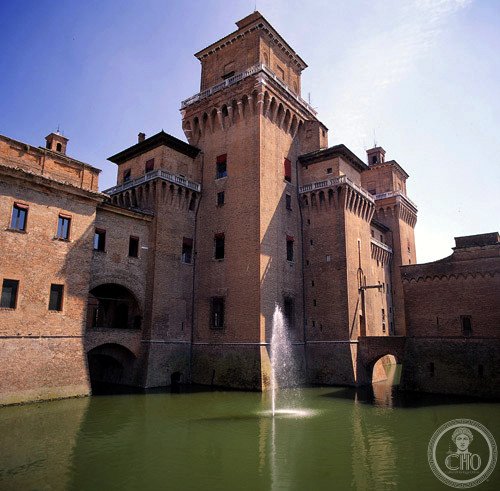
Castello Estense (Castello di San Michele), Ferrara, Emilia-Romagna, Italia. Il castello Estense (costruito 1385 CE su ordine di Nicolò II d’Este come risposta a una rivolta popolare (la sollevazione di 1385 CE: il popolo aveva ucciso a bastonate il tesoriere Tommasino da Tortona; Nicolò II ordinò la costruzione del castello come fortezza difensiva in mezzo alla città entro 24 ore dalla rivolta); le 4 torri angolari (la Torre dei Leoni a nord-est; la Torre di Santa Caterina a nord-ovest; la Torre di San Paolo a sud-ovest; la Torre Marchesana a sud-est; ogni torre misura 28 m × 8 m; le torri erano collegate al palazzo Estense adiacente da passaggi pensili); il fossato (30 m di larghezza; alimentato dal fiume Po di Volano; più volte prosciugato durante assedi; la funzione architettonica (il fossato del castello Estense non era solo difensivo: separava fisicamente la corte Estense dalla città, visualizzando il confine tra lo spazio del principe e lo spazio del popolo)). UNESCO World Heritage Site 1995/1999 (riferimento 733). Foto via Wikimedia Commons.
Ferrara, Emilia-Romagna, Italia · Signoria Este 1240–1598; Biagio Rossetti (Addizione Erculea 1492: il primo piano urbanistico moderno d’Europa); Ludovico Ariosto (Orlando Furioso 1516); Scuola Ferrarese (Cosmè Tura, Francesco del Cossa, Ercole de’ Roberti); Palazzo Schifanoja frescoes; UNESCO WHS 1995/1999 (rif. 733)

Ferrara: Centro Storico e Delta del Po

Ferrara (UNESCO 1995, Delta del Po aggiunto 1999) è la prima città pianificata del Rinascimento italiano — l’Addizione Erculea di Biagio Rossetti (1492 CE) ha raddoppiato la dimensione di Ferrara con un piano urbano con strade dritte, isolati regolari e giardini pensati prima di costruire, un metodo che sarà codificato teoricamente solo nel XVII secolo ma che qui fu realizzato con 150 anni di anticipo su qualsiasi altra città europea.

At a glance

Ferrara centro storico (the most precisely Ferrara zone Ferrara Emilia-Romagna Italy 44.8374 N 11.6191 E UNESCO WHS 1995/1999 reference 733: the Addizione Erculea (the specific plan: the Addizione Erculea (the “Herculean Addition”): the urban expansion of Ferrara commissioned by Ercole I d’Este (1431–1505 CE; Duke of Ferrara 1471–1505 CE) and designed by Biagio Rossetti (c.1447–1516 CE): (1) scale: the existing medieval Ferrara was approximately 40 hectares; the Addizione Erculea added approximately 80 hectares (doubling the urban area; the population increase from c.30,000 to c.100,000 was anticipated in the plan); (2) the street layout: the Addizione Erculea introduced straight boulevards (the Corso degli Ercole d’Este and the Via dei Prioni: both over 800 m long and 12–14 m wide; wider than any medieval Italian street and designed for wheeled traffic and cavalry); (3) the Quadrivio degli Angoli (the “Corner Crossing”): the intersection of Corso degli Ercolani and Via Voltapaletto: the 4 corner palaces (Palazzo Prosperi-Sacrati, Palazzo dei Diamanti (later the Pinacoteca Nazionale), Palazzo degli Angeli, and the Palazzo Turchi di Bagno) were designed by Rossetti as a coordinated ensemble (the first time in Europe that 4 independent private palace facades were designed by a single architect to form a coordinated urban space); the Palazzo dei Diamanti (Biagio Rossetti, c.1492–1503 CE): the most famous building of the Addizione Erculea: the facade (255 marble ashlars cut in diamond points: 8,500 diamonds total; the marble is the “Aurisina” limestone from the Trieste karst; the diamonds reflect light differently at different times of day (dawn: the points cast horizontal shadows; midday: the diamond faces gleam uniformly; evening: the points cast long vertical shadows)); the specific optical illusion (Rossetti cut the diamonds in 3 different sizes at the corners, middle, and base of the facade to compensate for the perspective distortion of a viewer at street level: the diamonds appear uniform in size from any point of view on the street — the first calculated optical correction of a building facade since Vitruvius described the technique in the 1st century BCE)).

Key facts

  • Il Salone dei Mesi nel Palazzo Schifanoja (1469–71 CE) e il ciclo astrologico-cortigiano più completo del Rinascimento italiano: the Palazzo Schifanoja frescoes (the Salone dei Mesi (the “Room of the Months”): the main hall of the Palazzo Schifanoja (the Este summer palace; Via Scandiana 23; open Tue–Sun 9:30 AM–6 PM; €8); the fresco programme (designed by court astrologer Pellegrino Prisciani; executed 1469–71 CE by a team of Ferrarese painters (attributed to: Cosmè Tura (March; July; possibly others); Francesco del Cossa (the March, April, and May panels; the most complete and best-preserved; signed in an inscribed letter to Ercole d’Este requesting higher pay: “the work I have done should be valued higher than that of the common shop painters”); Ercole de’ Roberti (various panels)); the 3-tier programme (each month panel has 3 horizontal tiers: (a) the upper tier: the classical myth assigned to the month (March = Minerva with weavers; April = Venus with lovers; May = Apollo with a chariot race); (b) the middle tier: the astrological decans (the 3 “decans” (10-day sections) of each zodiac month; each decan has a specific appearance and attribute (the decan figures are copied from Arabic astrological manuscripts (the “Picatrix” and the “Albumasar”) via Ferrarese Latin translations)); (c) the lower tier: the court of Ercole I d’Este in contemporary 1469 CE clothing (the triumph of the month: the Duke receives a delegation; hunts; plays chess; the specific identification: the figure in the March panel in the lower tier showing a man on horseback carrying a hawk (a falconer) on his wrist is identified by the heraldic device on his doublet as Ercole d’Este himself — the only contemporary portrait of the Duke in the entire cycle))
  • GPS (Piazza della Repubblica): 44.8374° N, 11.6191° E

History

Dagli Estensi a Rossetti a Ariosto al Ghetto e all’UNESCO 1995 (the most precisely Ferrara zone history: the Este signoria (1240–1598 CE: 358 years; the Este family (the house of Este: one of the oldest Italian noble families; origins traced to 10th-century CE Lombard nobility; the Ferrara branch established by Azzo II d’Este in 1196 CE; the Ferrara duchy officially created by Emperor Frederick III in 1471 CE as reward for Este loyalty); the humanist court (the Este court at Ferrara was the most important humanist court in 15th-century Italy after the Vatican: (a) Guarino Veronese (1374–1460 CE; the humanist schoolmaster engaged by Nicolò III d’Este to educate his sons); (b) Leon Battista Alberti (frequent visitor from 1438 CE; the “De re aedificatoria” was presented to Nicolò V at Ferrara); (c) Ludovico Ariosto (1474–1533 CE; the “Orlando Furioso” (1516 CE; expanded editions 1521 CE and 1532 CE): the most widely read narrative poem of the Italian Renaissance; the 46 cantos chronicle the adventures of the paladin Orlando and 200+ other characters in a complex narrative that entwines the Carolingian cycle with the Arthurian cycle and Greek mythology; the poem introduced the concept of the “romantic irony” that Schlegel later theorized)); the Jewish ghetto (1624–1859 CE: the Ghetto di Ferrara (Via Mazzini + Via Vignatagliata + Via Vittoria): the Jewish community of Ferrara was established before 1200 CE (the earliest document: a loan contract of 1227 CE between Jewish moneylenders and the Este court); the ghetto was established in 1624 CE by order of Cardinal Legate Jacopo Serra (the Papal Legate after the Este devolution of 1598 CE when Ferrara reverted to the Papal States); the ghetto was abolished by the French revolutionary forces in 1796 CE but reinstated 1800 CE; abolished definitively by the Risorgimento 1859 CE)); 1995 CE UNESCO inscription reference 733; extended to the Delta del Po 1999.

What you see

Il Castello Estense, il Palazzo dei Diamanti, il Palazzo Schifanoja (Mesi), il Duomo, e le biciclette di Ferrara (the most precisely Ferrara zone visit (1 full day on bicycle): the bicycle culture (Ferrara is the most bicycle-friendly city in Italy: 135 km of bike lanes on 44.9 km2 of city area (the density: 3 km of bike lanes per km2 of city; 10× the average Italian city); the bicycle modal share: 35% of all trips in Ferrara are by bicycle (the highest in Italy; comparable to Dutch cities); bicycle rental at the main station (Ferrara Stazione; €8/day at multiple rental shops on Via Rampari di San Benedetto); the recommended circuit (2–3 hours on bicycle): (1) Castello Estense (open Tue–Sun 9:30 AM–5:30 PM; €10; the dungeon (the “prigioni”): the cells where Ercole I d’Este imprisoned and beheaded his wife Parisina Malatesta and his son Ugo d’Este (1425 CE) for adultery (the episode inspired Byron’s poem “Parisina” (1816 CE))); (2) Duomo di Ferrara (Piazza della Cattedrale; the facade (the “Maestro Nicolò”, 1135 CE): the 3-lobed Romanesque rose window; the Porch of the Last Judgment (the scene of the damned pulled into the Beast’s mouth); (3) Palazzo Schifanoja (30 min on bicycle from the center; the Salone dei Mesi); (4) Palazzo dei Diamanti (Corso Ercole I d’Este 21; the Pinacoteca Nazionale: the 3rd and 4th floors house the Ferrarese school collection; open Tue–Sun 9:30 AM–7:30 PM; €10)); the Delta del Po (50 km east; accessible by bicycle from Ferrara via the Po Valley cycling route (EuroVelo 8; 50 km one-way; the flat terrain of the Po plain; the eel fishing of the Valli di Comacchio: the largest brackish lagoon in Italy; the Manifattura dei Marinati: the historical salting factory for eels (Via Agatopisto, Comacchio; open Apr–Sep; €5); the UNESCO extension covers 57,000 hectares of the Po Delta natural area).

Practical information

  • Noleggio bici a Ferrara e il percorso consigliato per scoprire l’Addizione Erculea in mezza giornata: il noleggio bici (in stazione: Girelli Bici (Via Rampari di San Benedetto 11; 0532/772190; €8/giorno; orario 8:30-19:30; prenotazione non richiesta ma consigliata in estate)); il percorso Addizione Erculea in bici (2 ore; km 7 totali; livello facile (pianura); Start: Stazione → Castello Estense (10 min) → Quadrivio degli Angoli (5 min) → Palazzo dei Diamanti (3 min) → Mura di Ferrara (le mura rinascimentali: 9 km di perimetro; percorribili in cima in bici; il panorama sul Delta del Po dalla Montagnola; 20 min) → Palazzo Schifanoja (10 min) → Centro (10 min); il migliore momento (la luce del tardo pomeriggio (16-18) illumina la facciata del Palazzo dei Diamanti a 45° e rende visibile la differenza di taglio dei 3 tipi di diamante — l’effetto ottico correttivo che Rossetti ha progettato))

Getting there

Trenitalia da Bologna (35 min, €7.50, ogni 30 min). Trenitalia da Venezia (1h20, €11.30, cambio Padova). Trenitalia da Ravenna (1h10, €6.80). GPS Castello Estense: 44.8374, 11.6191.

Nearby

  • Ravenna: Mosaici Paleocristiani (UNESCO 1996) — 70 km est (Trenitalia da Ferrara 1h10 €6.80; 8 edifici serie; San Vitale mosaici Giustiniano+Teodora; Galla Placidia; Dante tomba)
  • Comacchio e il Delta del Po (UNESCO 1999) — 50 km est (serial con Ferrara nella WHS rif. 733; le valli da pesca; i cavalli Camargue ferraresi; anguille affumicate (IGP); bus TPER da Ferrara 1h €4)

Sources

  • Wikipedia, Ferrara; Biagio Rossetti; Palazzo dei Diamanti; Salone dei Mesi, accessed June 2026
  • UNESCO, Ferrara, City of the Renaissance, and its Po Delta, WHS reference 733, inscribed 1995/1999
  • Rosenberg, Charles M. The Este Monuments and Urban Development in Renaissance Ferrara. Cambridge: Cambridge University Press, 1997 (the definitive study of the Addizione Erculea)

Hero image: Ferrara, Castello Estense, Emilia-Romagna, Italy, Wikimedia Commons. Editorial text © Cultural Heritage Online, 2026.

📷 Diventa un fotografo di Cultural Heritage Online

Condividi le tue foto dei luoghi: restano pubblicate con la tua firma come autore. Più vengono viste, più ti fai conoscere — e presto un concorso premierà le foto più apprezzate.

Accedi o registrati gratis per aggiungere una foto
📋 Copy & share on social
Scroll to Top