
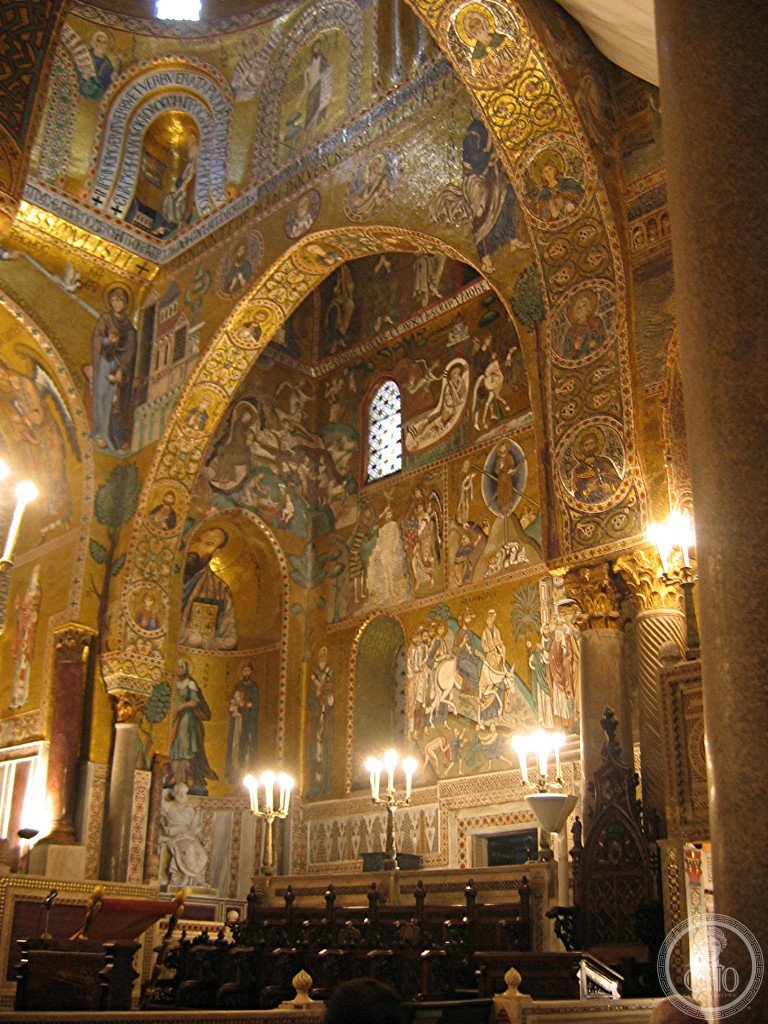
Inside the Palazzo dei Normanni, the Cappella Palatina brings together an Islamic muqarnas ceiling, Byzantine gold mosaics and a Norman basilica plan in a single unbroken space, built as a statement of Roger II’s multilingual, multi-faith kingdom.
At a glance
The Cappella Palatina stands within the Palazzo dei Normanni in Palermo, the royal chapel of the Norman kings of Sicily. It was built between 1130 and 1143 under Roger II, the first King of Sicily, and is held to be the only medieval building where Islamic, Byzantine Christian and Norman architectural traditions appear together without one style overriding another.
The chapel forms the principal component of the UNESCO World Heritage inscription covering Arab-Norman Palermo and the cathedral churches of Cefalù and Monreale, listed in 2015 under reference 1487.
Key facts
- Location: Palazzo dei Normanni, Piazza del Parlamento, Palermo, Sicily.
- Built: 1130–1143 CE, under Roger II, King of Sicily.
- Ceiling: a carved and painted cedar-wood muqarnas ceiling, the largest and best preserved of its kind outside the Islamic world, made by Fatimid Egyptian craftsmen.
- Mosaics: gold-glass Byzantine mosaics including a Christ Pantocrator in the apse, produced by workshops trained in the Constantinopolitan tradition.
- Recognition: UNESCO World Heritage Site since 2015 (reference 1487), as part of the Arab-Norman Palermo group.
- Nearby related site: La Martorana, built 1143 by George of Antioch, admiral to Roger II.
History
Palermo predates the Normans by many centuries, having been founded as Panormus by Phoenician settlers. Under Saracen rule, from 831 to 1072, the city became a major centre of the Islamic Emirate of Sicily, and much of the street pattern of the old city, including its narrow curved lanes and market streets such as Ballarò, Vucciria and Capo, descends from this period.
The Normans took Palermo in 1072 under Roger I, father of Roger II, following a five-year campaign. The conquest was marked by a policy of tolerance: the Muslim population was permitted to continue practising Islam, mosques were not immediately converted, and Arab administrators known as Kaid were kept in post. Roger II was crowned King of Sicily on Christmas Day 1130 by Pope Anacletus II, and it was under his rule, between 1130 and 1143, that the Cappella Palatina was built as the chapel of the royal palace.
Roger II’s court was famously trilingual, using Latin for the Church and law, Greek for Byzantine court ceremonial, and Arabic for science, poetry and administration. Among the scholars at his court was the geographer al-Idrisi, who compiled the Tabula Rogeriana in 1154, a world map oriented with south at the top in the Arabic convention and accompanied by a detailed geographical text.
The Swabian ruler Frederick II, born in 1194 and raised in Palermo, continued this cosmopolitan court culture, reputedly speaking six languages and sponsoring the translation of Arabic scientific texts into Latin. The Cappella Palatina and the wider group of Arab-Norman monuments in Palermo, Cefalù and Monreale were inscribed on the UNESCO World Heritage list in 2015.
What you see
The chapel follows a three-aisled basilica plan with round arches, the layout favoured by Norman church builders across Sicily and southern Italy. Above the nave and aisles runs the painted wooden muqarnas ceiling, its honeycomb of carved cells filled with scenes of hunting, music, banqueting and animals, along with inscriptions in Kufic Arabic that are mostly invocations and blessings for the king.
At the far end of the apse is a large gold-ground mosaic of Christ Pantocrator, considered the most important example of this subject in southern Italy; the figure’s eyes are positioned so as to appear to follow the viewer from any point in the chapel. The mosaic programme, covering a substantial area of gold glass, was produced by Byzantine-trained workshops and includes Old and New Testament scenes in the nave and images of Christ, angels and apostles in the presbytery.
The columns supporting the nave carry marble shafts of Euboean cipollino, reused from Roman spolia of the second century CE; the shafts survive intact, but their original Corinthian capitals have been replaced with medieval capitals carved with palmette designs. The floor is laid in opus sectile, an inlaid marble composition that includes porphyry, a purple-red stone imported from Egypt and no longer quarried since antiquity.
Within the wider Palazzo dei Normanni, the Sala di Re Ruggero, Roger II’s private audience chamber, carries its own mosaic decoration of hunting scenes with lions, deer, peacocks and centaurs. A short walk from the palace stands La Martorana, built in 1143 by George of Antioch, Roger II’s admiral and chief minister; its narthex contains a mosaic panel showing Roger II crowned by Christ, dressed in full Byzantine imperial regalia, with a Greek inscription naming him King of Sicily. It is thought to be the only surviving contemporary image of the king.
Practical information
- Access: the Cappella Palatina and the Sala di Re Ruggero are visited as part of the Palazzo dei Normanni circuit; opening times and admission arrangements should be checked with the palace’s official visitor information before travelling, as these can change.
- On site: a combined ticket typically covers the chapel, Roger’s Room and the Torre Pisana; current pricing should be confirmed through official channels.
- Viewing tips: visitors are advised to look up first at the muqarnas ceiling, then take in the Christ Pantocrator from the centre of the nave, and finish at the altar rail to view the opus sectile floor.
Getting there
The Palazzo dei Normanni stands in Piazza del Parlamento in central Palermo. La Martorana is a short walk away, around ten minutes on foot, making it easy to combine both sites in a single visit.
Nearby
- La Martorana — about ten minutes’ walk, a church of 1143 with a mosaic portrait of Roger II crowned by Christ.
- Palermo Cathedral — within the old city, begun in 1185, part of the same Arab-Norman UNESCO group.
- Ballarò, Vucciria and Capo markets — historic street markets in the old city, successors to the Saracen-era suqs.
Sources
- UNESCO
Find it on the map
See this place and what’s around it →Events here — now on & upcoming
- Anniversary: Ceres Discovered from Palermo's Royal Palace — January 1, 180101 Jan 2027See the event →
📷 Become a Cultural Heritage Online photographer
Share your photos of places: they stay published under your name as the author. The more they're seen, the more you get noticed — and soon a contest will reward the most appreciated photos.
Log in or sign up free to add a photoIs this page about you?
This page is read by travellers and heritage enthusiasts who find it on Google. Tell us how you are connected to this place and we will take it from there.