
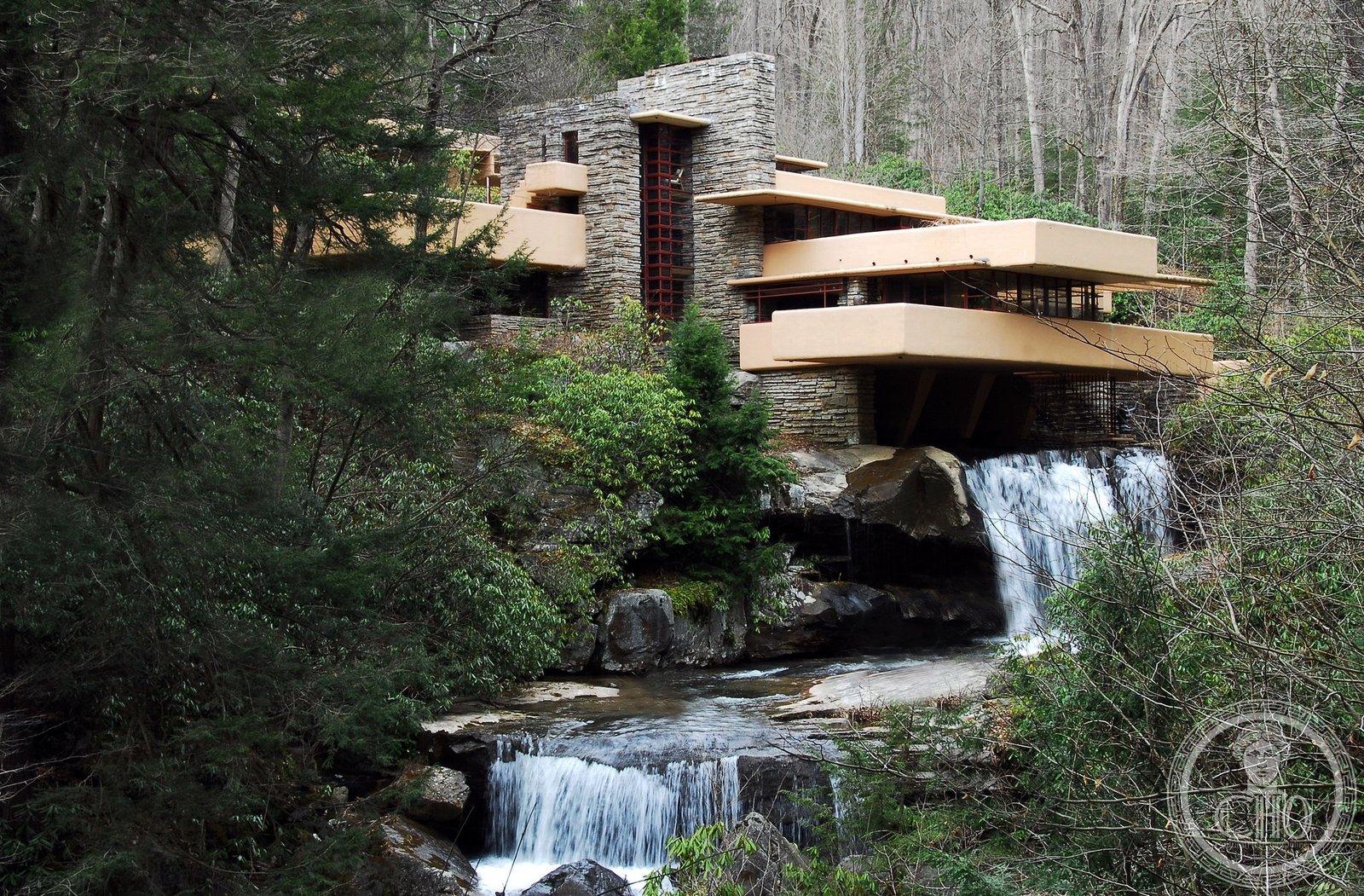
Frank Lloyd Wright’s masterwork rises from a waterfall on Bear Run stream, a weekend retreat that became a watershed moment in modern architecture.
At a glance
A three-story house museum built partly over a waterfall in Pennsylvania’s Laurel Highlands, Fallingwater exemplifies Wright’s organic architecture—structures in harmony with their natural setting. The Western Pennsylvania Conservancy operates the house and maintains 5,000 acres of surrounding woodland, preserving both building and landscape.
History
Edgar Kaufmann Sr., owner of Pittsburgh’s Kaufmann’s Department Store, had established a summer retreat at Bear Run by 1916. When employee use ceased, the Kaufmanns purchased the site in July 1933 and commissioned Wright to design their weekend home in 1934. Construction proved challenging: concrete cracked, terraces sagged, and structural problems emerged—issues that would resurface decades later. The family occupied the house by 1937. Wright subsequently designed a guest wing, completed in 1939. Their son, Edgar Kaufmann Jr., continued using the house after his parents’ deaths. The Western Pennsylvania Conservancy took over in 1963, opening it to tours in July 1964 and building a visitor center in 1979. Major renovation work in the late 1990s and early 2000s addressed sagging terraces, poor drainage, and other severe structural defects.
What you see
The house is constructed from locally quarried stone, reinforced concrete, steel, and plate glass. Its defining feature is three bold cantilevered terraces that extend outward from a central chimney without support at the far end—a daring structural gesture that brings living spaces directly over the waterfall. The first floor houses the main entrance, living room, kitchen, and two outdoor terraces. Four bedrooms and additional terraces occupy the upper stories. Wright designed much of the built-in furniture. Art, textiles, and Tiffany glass pieces are distributed throughout. A guest wing with carport and servants’ quarters sits above the main residence.
Cultural significance
By the 1960s, Fallingwater ranked among the world’s most discussed modern structures. It has inspired books, magazine features, films, and countless scholarly works. The house exemplifies Wright’s philosophy of organic architecture—design that grows from and responds to its landscape rather than imposing form upon it. It remains one of the most recognizable houses of the twentieth century.
Key facts
- Location: Mill Run, Pennsylvania, United States (39.90626°N, 79.46783°W)
- Designed by Frank Lloyd Wright, 1934
- Built 1935–1939
- Guest wing added 1939
- National Historic Landmark designation
- Part of “The 20th-Century Architecture of Frank Lloyd Wright” World Heritage Site (one of eight buildings)
- Operated as a house museum by the Western Pennsylvania Conservancy since 1963
Practical information & getting there
Fallingwater is located in Stewart Township in the Laurel Highlands, approximately 90 minutes southeast of Pittsburgh. The Western Pennsylvania Conservancy operates the site as a museum and welcomes visitors. Advance planning is recommended, as tours have limited capacity. For current hours, admission fees, and tour booking details, consult the official website or contact the visitor center.
Sources & resources
Find it on the map
See this place and what’s around it →📷 Become a Cultural Heritage Online photographer
Share your photos of places: they stay published under your name as the author. The more they're seen, the more you get noticed — and soon a contest will reward the most appreciated photos.
Log in or sign up free to add a photoIs this page about you?
This page is read by travellers and heritage enthusiasts who find it on Google. Tell us how you are connected to this place and we will take it from there.