
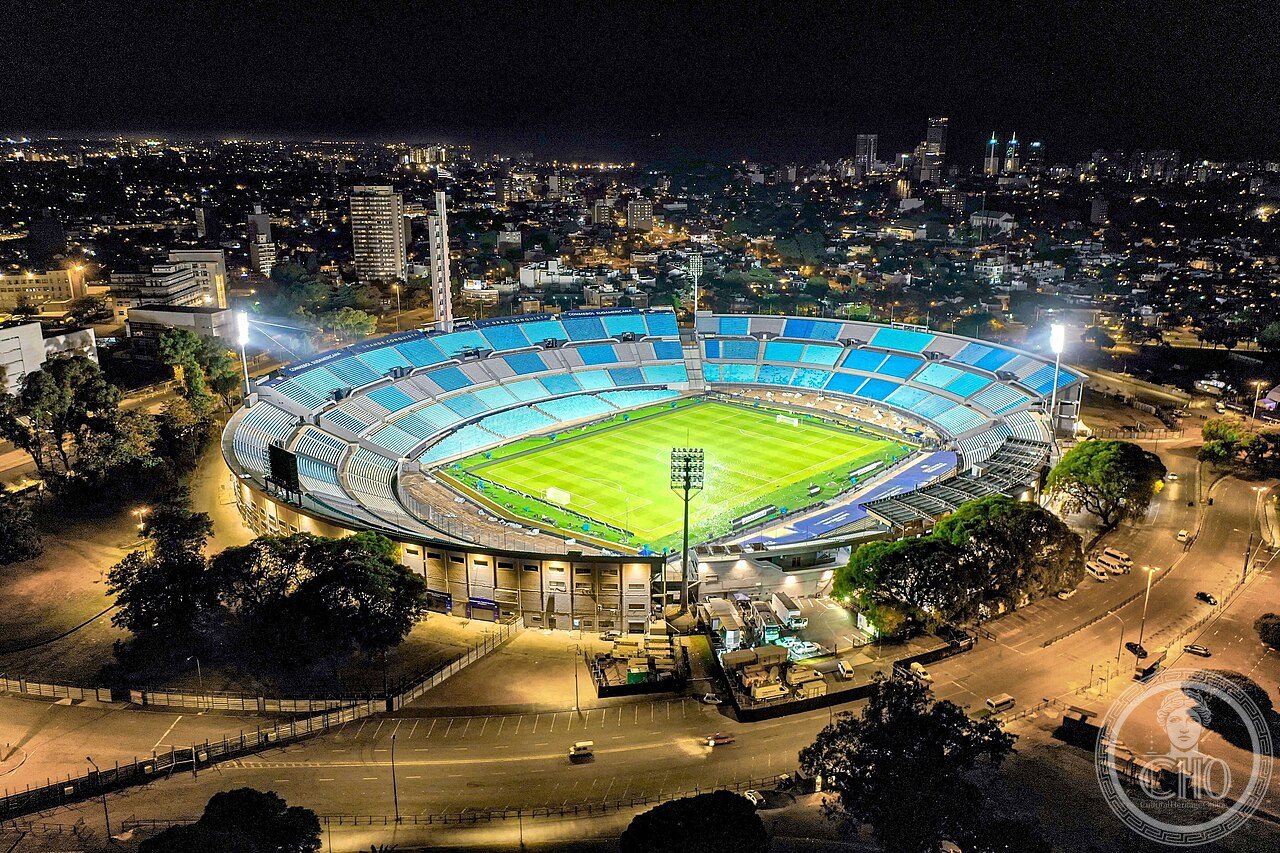
Built in just nine months to host the inaugural FIFA World Cup, the Estadio Centenario stands as one of the great feats of 20th-century sports architecture. Designed by Juan Scasso and completed in 1930, it was conceived not merely as a stadium but as a national monument — a celebration of the centenary of Uruguay’s constitution. Its iconic Torre de los Homenajes rises above a symmetrical Art Deco composition, watching over an arena that held 90,000 spectators for the world’s first global football championship. Uruguay defeated Argentina 4–2 in the final here on 30 July 1930. FIFA declared it a Football History Monument in 1983, one of only a handful of stadiums in the world to receive that designation. Still in active use for Uruguay national team matches, the Centenario bridges past and present: a living relic of the age when Uruguay was the world’s dominant footballing nation.
At a glance
- Type
- Stadium / Sports Monument
- Period
- 1930
- Style
- Rationalist / Art Deco
- Location
- Parque Batlle, Montevideo, Uruguay
- Coordinates
- 34.8937° S, 56.1524° W
- Architect(s)
- Juan Scasso
Overview
The Estadio Centenario occupies a prominent position in Parque Batlle, Montevideo’s principal public park. Its Art Deco tower has become an icon of Uruguayan national identity, recognized worldwide as the birthplace of the FIFA World Cup. The stadium’s design by Juan Scasso combined functionalist rationalism with monumental civic ambition, producing a structure of both technical and symbolic power. A museum of football inside documents the history of the 1930 tournament and Uruguay’s unmatched early dominance of world football.
History
Uruguay’s bid to host the first World Cup was tied explicitly to the centenary of its 1830 constitution. FIFA awarded the tournament on condition that Uruguay finance all visiting teams’ travel and accommodation — an extraordinary commitment for a small nation. Construction began in early 1930 and the stadium was ready in under nine months. The opening match was played on 18 July 1930, Uruguay’s national day. Uruguay won all their matches and defeated Argentina 4–2 in the final, watched by an estimated 68,000 spectators. In 1983, FIFA formally designated the stadium a Football History Monument, cementing its global heritage status.
Architecture & Design
Juan Scasso’s design is defined by the Torre de los Homenajes, a tall Art Deco observation tower at one end of the stadium from which the entire playing field and all four stands are visible. The main stands follow a rationalist geometry — clean lines, unadorned concrete, a functional efficiency that was modern for 1930. The facade combines symmetry with monumental scale, projecting civic pride through architectural restraint. The original capacity of 90,000 was later reduced for safety compliance; the stadium now holds approximately 60,235 spectators. Renovations have preserved the Art Deco tower and the overall character of the original design.
Cultural significance
The Estadio Centenario is where football became a global phenomenon. The 1930 World Cup transformed a European-dominated club sport into a genuinely international competition, and the Centenario was its stage. For Uruguay, the stadium represents the zenith of a period when this small nation of fewer than two million people was the planet’s footballing superpower — Olympic champions in 1924 and 1928, World Cup champions in 1930 and again in 1950. FIFA’s Football History Monument designation in 1983 confirmed its unique place in global sporting heritage.
Visiting today
The stadium is open for guided tours on non-match days. The Museum of Football inside documents the 1930 World Cup and Uruguay’s footballing history with photographs, trophies, and archival footage. Match days for Uruguay national team games are an immersive cultural experience — tickets are available through the Asociación Uruguaya de Fútbol. The tower observation platform offers panoramic views over Montevideo and Parque Batlle.
Getting there
The stadium is in Parque Batlle, approximately 4 km from Montevideo’s old city centre. City buses connect the park to the centre frequently; routes 104, 180, and 405 stop nearby. Taxis and ride-share apps are widely available from the city centre. The park is also accessible on foot or by bicycle from the Pocitos and Tres Cruces neighbourhoods.
Sources & resources
Find it on the map
See this place and what’s around it →Record researched and written by Luigi De Marchi for Cultural Heritage Online, 2026.
📷 Become a Cultural Heritage Online photographer
Share your photos of places: they stay published under your name as the author. The more they're seen, the more you get noticed — and soon a contest will reward the most appreciated photos.
Log in or sign up free to add a photoIs this page about you?
This page is read by travellers and heritage enthusiasts who find it on Google. Tell us how you are connected to this place and we will take it from there.