

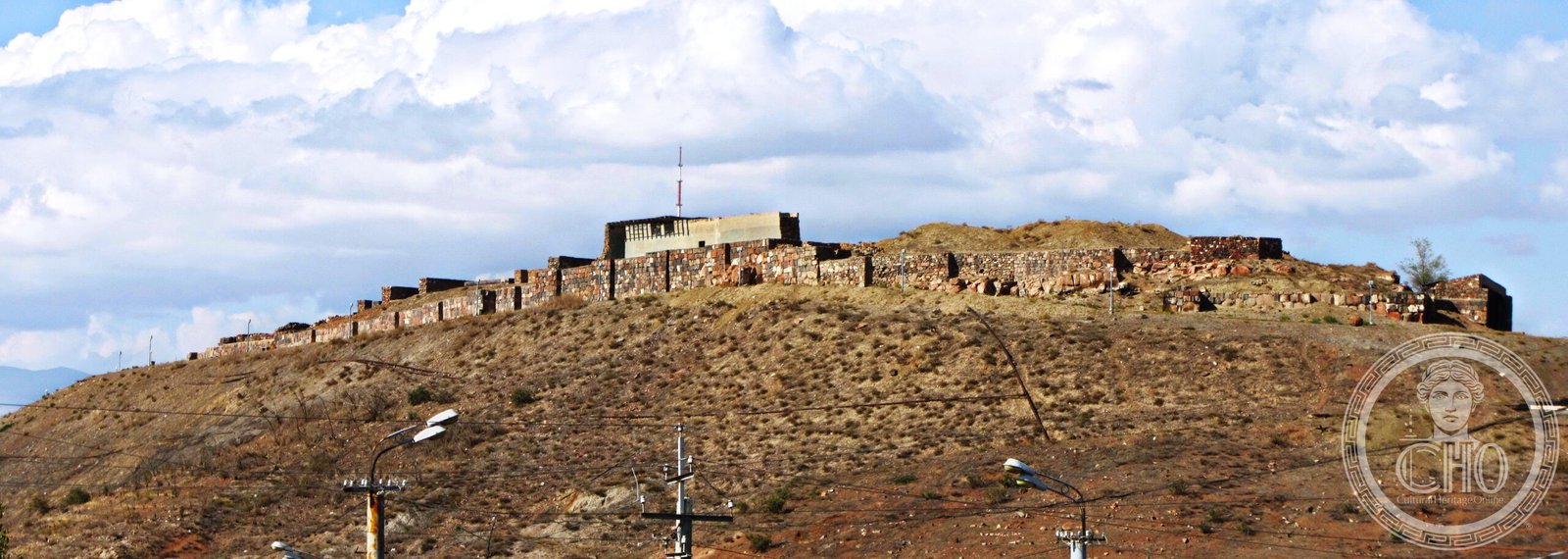
On Arin Berd hill within the modern suburbs of Yerevan, the ruins of the Urartian fortress of Erebuni preserve the founding monument of one of the oldest continuously inhabited cities in the world. Built in 782 BC by King Argishti I, the fortress gave the capital of modern Armenia its name through a 2,800-year chain of linguistic transformation: Erebuni → Erebouni → Yerevan.
At a glance
Erebuni was built as a northern military base and administrative centre of the Urartian Empire — the dominant Iron Age state of the ancient Near East from approximately 860 to 590 BC, centred on Lake Van in eastern Anatolia and controlling territories from the Caucasus to northern Mesopotamia. The site occupies a strategically commanding position on a hill approximately 60 metres above the Ararat Valley, overlooking the trade routes connecting Anatolia to the Caucasus. The site preserves the foundations and partially reconstructed walls of the palace complex, a temple to the Urartian god Khaldi, arsenals, and storerooms. The Erebuni Museum is built immediately adjacent to the excavation.
Key facts
- Location: Arin Berd hill, southern suburbs of Yerevan, Armenia
- Founded: 782 BC by Argishti I, King of Urartu
- Function: Military base, administrative centre, and royal residence of the Urartian Empire’s northern frontier
- Palace complex: Approximately 100 × 120 metres
- Temple: Most completely preserved Urartian temple ever excavated; original polychrome wall paintings partially in situ
- Founding inscription: Cuneiform inscription of Argishti I records founding, deportation of 6,600 men from Khate and Tsupan (modern Syria/SE Turkey)
- Name origin: Erebuni → Erebouni → Yerevan; the city has been continuously inhabited for over 2,800 years
History
The Urartian Empire (known as Urartu in Assyrian sources, Ararat in the Bible) was the most powerful state in the ancient Near East after Assyria during the 9th to 7th centuries BC. At its height it controlled a vast territory including modern eastern Turkey, Armenia, northwestern Iran, and parts of the South Caucasus. The empire was organised around a system of fortified administrative centres — large fortresses combining royal palace, temple, arsenal, and storage facilities — that served as nodes of political, military, and economic control. Erebuni was one of three major fortresses built by Argishti I in the Ararat Valley (the others: Argishtihinili and Armavir) to secure the fertile agricultural plain and its trade routes.
The founding cuneiform inscription, discovered in situ, records that Argishti I built Erebuni in his first regnal year and populated it by deporting 6,600 men from the lands of Khate and Tsupan — captive populations resettled as agricultural workers and craftsmen to develop the region. This practice of mass deportation and resettlement was a standard Urartian (and Assyrian) administrative tool. The fortress functioned as a military garrison and administrative centre for at least 150 years, with later modifications recorded in inscriptions of subsequent Urartian kings.
After the collapse of Urartu around 590 BC (attributed to pressure from the Median Empire and the Scythians), Erebuni continued to be occupied but lost its political significance. Settlement remained on and around the hill through the Achaemenid Persian period, the Hellenistic period under the Artaxiad Armenian kingdom, the Parthian and Sasanian periods, and the Islamic Abbasid period — a continuity of habitation that links the Urartian fortress of 782 BC directly to the modern capital of Armenia.
What you see today
The most remarkable surviving element of Erebuni is the Khaldi temple, the most completely preserved Urartian temple excavated anywhere. Urartian temples follow a distinctive plan: a single square cella on a raised platform with a columned portico, roofed with a distinctive upswept curved form. Fragments of the original polychrome wall paintings are still partially in situ on the interior walls — hunting scenes showing archers pursuing deer and ibex, geometric border decorations in red, blue, and white, and divine figures in a style that combines Urartian artistic conventions with clear Assyrian influence and local Caucasian elements. These paintings, dated to the 8th century BC, represent some of the oldest pictorial art surviving in situ in the Caucasus.
The palace complex foundations show the typical Urartian palace layout: a series of interconnected rooms around a central courtyard, with thick mudbrick walls on stone foundations. Partial reconstruction of walls to approximately 2–3 metres height gives a sense of the original scale. The panoramic view from the summit of Arin Berd hill across the Ararat Valley — with Mount Ararat visible in clear weather across the Turkish border — makes immediately legible why this particular hill was chosen: it commands one of the most strategically important vantage points in the entire Caucasus.
Practical information
- Address: Erebuni Fortress, 7 Erebuni Street, Yerevan 0085, Armenia
- Opening hours: Daily except Monday; approximately 10:00–17:00 (verify locally)
- Admission: Combined ticket for fortress + museum (modest fee); separate tickets available
- Museum: Erebuni Museum adjacent to the site houses the principal finds including the founding inscription
- Photography: Permitted throughout the site
Getting there
Erebuni Fortress is located approximately 8 km south of central Yerevan on Arin Berd hill. From central Yerevan, it can be reached by metro to Gortsaranain station followed by a short taxi ride, or directly by taxi from the city centre (approximately 15–20 minutes). The site is well-signposted from the main southern roads out of Yerevan. Yerevan Zvartnots International Airport is approximately 12 km northwest of the fortress.
Nearby
- Erebuni Museum — immediately adjacent, houses the founding inscription and principal finds
- Garni Temple — only surviving Greco-Roman temple in the South Caucasus, approximately 28 km east; 1st century AD Armenian royal temple
- Geghard Monastery — UNESCO World Heritage Site; partially rock-cut medieval Armenian monastery, approximately 40 km east
- Ararat Valley viewpoints — views of Mount Ararat (5,137 m) visible from the fortress hill on clear days
Sources
- Martirosyan, A.A. Argishtikhinili. Yerevan: Academy of Sciences, 1974. — Comparative Urartian fortress analysis
- Arutunian, N.V. Biainili (Urartu). Yerevan: Mitk, 1970. — Standard reference for Urartian history
- Zimansky, Paul. Ecology and Empire: The Structure of the Urartian State. Chicago: Oriental Institute, 1985.
- Wikipedia: Erebuni Fortress — en.wikipedia.org/wiki/Erebuni_Fortress
- Erebuni Museum official site — erebunimuseum.am
Find it on the map
See this place and what’s around it →📷 Become a Cultural Heritage Online photographer
Share your photos of places: they stay published under your name as the author. The more they're seen, the more you get noticed — and soon a contest will reward the most appreciated photos.
Log in or sign up free to add a photo