
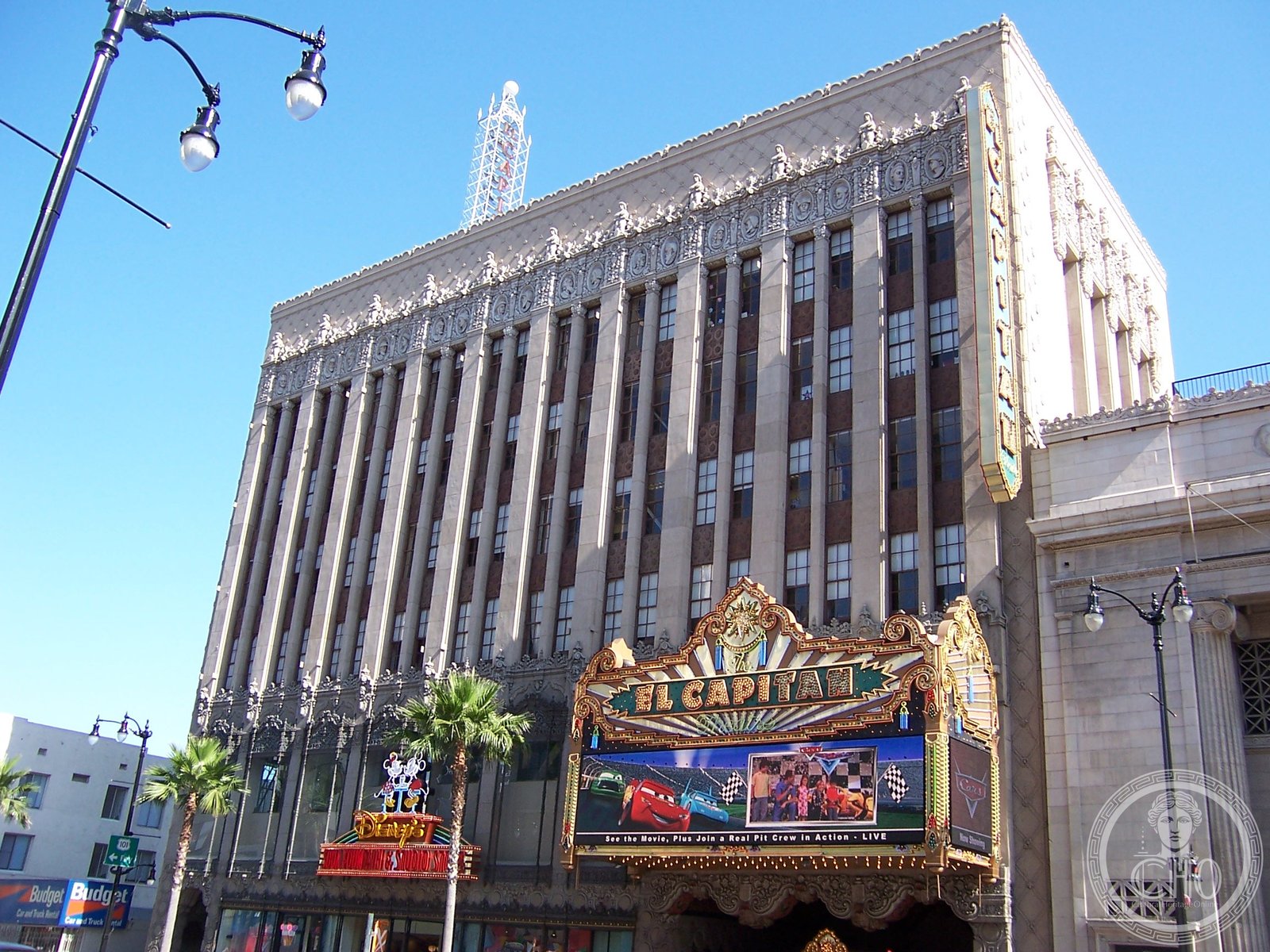
Opened on May 3, 1926 as a flagship legitimate theater on Hollywood Boulevard, the El Capitan is one of the most elaborately ornamented surviving 1920s entertainment palaces on the West Coast — a Spanish Colonial Revival interior of extraordinary richness that has operated continuously through the studio era, the multiplex age, and a complete restoration by The Walt Disney Company in 1991.
At a glance
The El Capitan Theatre at 6838 Hollywood Boulevard was built in 1926 for developer Charles E. Toberman, who was responsible for several of Hollywood’s most celebrated entertainment landmarks of the era. The architects were G. Albert Lansburgh and Stiles O. Clements, both of whose California theater practices spanned several decades and included major West Coast venues. The building opened as a legitimate theater for live productions; after closing in 1941, it reopened in 1942 as a Paramount Pictures cinema. Disney acquired and fully restored the building in 1991, reopening it as a premium first-run cinema for Disney films. It is a contributing property in the Hollywood Boulevard Commercial and Entertainment District on the National Register of Historic Places.
Key facts
- Address: 6838 Hollywood Boulevard, Hollywood, CA 90028
- Opened: May 3, 1926
- Architects: G. Albert Lansburgh and Stiles O. Clements
- Style: Spanish Colonial Revival / East Indian Baroque
- NRHP: Yes (contributing property, Hollywood Blvd Commercial and Entertainment District)
- Current operator: The Walt Disney Company (since 1991 restoration)
History
Hollywood in the mid-1920s was consolidating its identity as both a place and an idea: the center of the American film industry and a neighborhood that needed entertainment architecture to match that identity. The developer Charles Toberman had already commissioned Grauman’s Egyptian Theatre (1922) and was about to commission Grauman’s Chinese Theatre (1927); the El Capitan was the project between them, conceived not as a movie palace but as a legitimate theater for live productions in the Broadway manner. G. Albert Lansburgh and Stiles O. Clements — both of whom had designed major theaters across California — provided a building of considerable ornamental ambition.
The theater opened in 1926 with a program of live performances. The theater closed in 1941 and reopened the following year as the Hollywood Paramount Theatre under Paramount Pictures, which ran it as a cinema through the studio era’s productive middle years. By the 1980s the building had passed through several operators and declined to a state of disrepair common to the once-grand theaters of Hollywood Boulevard.
The restoration by Disney, announced in 1990, was comprehensive: the building was closed, stripped of later additions, and its Spanish Colonial Revival ornament restored to its 1926 condition, with a new interior design by Kevin Kidney and Jody Daily that recaptured the building’s original spirit. The reopening in 1991 coincided with the premiere of The Rocketeer, establishing a pattern of Disney first-run premieres at the venue that has continued through the decades since.
What you see
On Hollywood Boulevard the El Capitan presents a facade of sustained ornamental invention: the Spanish Colonial Revival vocabulary — pilasters, arched windows, terracotta reliefs, decorative towers — is applied with a density and specificity that makes the building immediately legible as of its era. The principal facade, organized around the entrance bay and rising to decorated towers, has the quality of a building that understood itself as a landmark from the moment of its construction.
The interior, restored to its 1926 design with the Disney-era refinements, continues the ornamental program with the particularity that interior theater design allows: columns, painted ceilings, decorative plasterwork, and the Wurlitzer organ that plays before performances, giving the El Capitan a ritual quality — organ, ornament, velvet — that distinguishes it from the experience of cinema in a contemporary multiplex.
Practical information
- Current programming: First-run Disney theatrical releases; special screenings and events
- Tickets: Available at the box office and online through Disney ticketing
- Organ performance: The Wurlitzer organ plays before screenings — arriving early is recommended
- Hollywood Walk of Fame: The theater fronts Hollywood Boulevard’s star-embedded sidewalk; the adjacent Dolby Theatre hosts the Academy Awards
Getting there
The El Capitan Theatre is at 6838 Hollywood Boulevard in Hollywood, adjacent to the TCL Chinese Theatre. Los Angeles International Airport (LAX) is 16 miles southwest; Hollywood/Highland Metro station (B Line/Red Line) is directly across the street. The Hollywood Walk of Fame and Dolby Theatre are within steps of the El Capitan. Street parking is limited; the Hollywood & Highland parking structure is immediately adjacent.
Nearby
- TCL Chinese Theatre (1927) — the Grauman’s Chinese Theatre complex, adjacent on Hollywood Boulevard; celebrity cement block forecourt
- Dolby Theatre — home of the Academy Awards, in the Hollywood & Highland complex
- Hollywood Museum — 1,200 exhibits on the history of Hollywood in the original Max Factor Building (1935), two blocks east
Sources
- Wikipedia, “El Capitan Theatre” — architect, opening date, history, Disney restoration
- National Register of Historic Places — Hollywood Boulevard Commercial and Entertainment District
- Los Angeles Conservancy — theater documentation
- Disney press materials — 1991 restoration documentation
Find it on the map
See this place and what’s around it →Record researched and written by Luigi De Marchi for Cultural Heritage Online, 2026.
📷 Become a Cultural Heritage Online photographer
Share your photos of places: they stay published under your name as the author. The more they're seen, the more you get noticed — and soon a contest will reward the most appreciated photos.
Log in or sign up free to add a photoIs this page about you?
This page is read by travellers and heritage enthusiasts who find it on Google. Tell us how you are connected to this place and we will take it from there.