
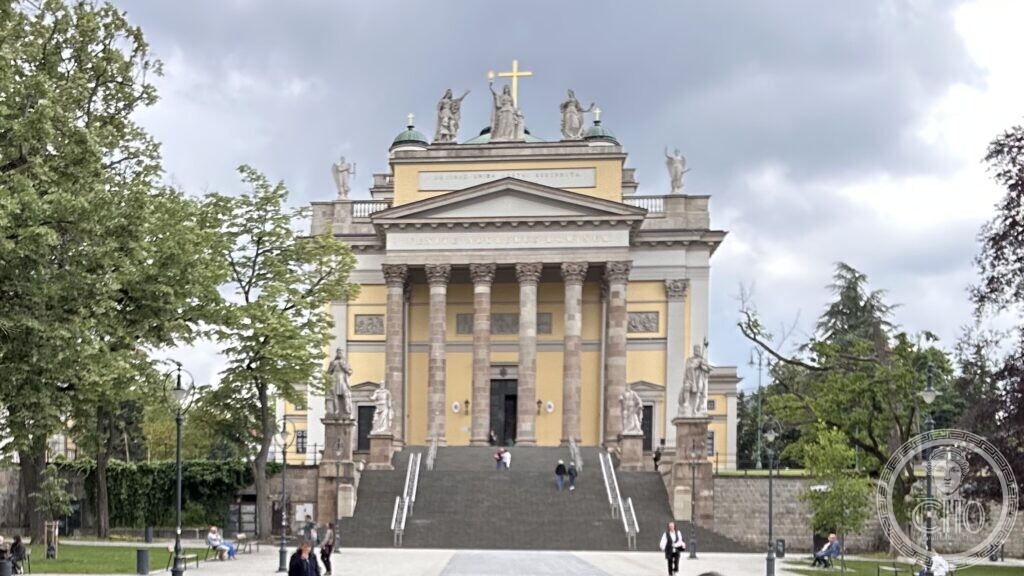
Eger, Hungary · built 1831–1836 · consecrated 6 May 1837
At a glance
In 1827 János László Pyrker came to Eger as archbishop. He was a patron of the arts on a scale that later enriched Hungary’s public collections, and within four years he had a new cathedral going up on the slope above the town. József Hild designed it, the masons finished it in 1836, and it was consecrated on 6 May 1837. For the statues on the front Pyrker sent to Venice for a young sculptor, Marco Casagrande. The result is a neoclassical church 93 metres long and 53 metres wide, reached by a flight of steps wide enough for a procession, and the second or third largest in the country depending on who is counting.
Key facts
- Address: Pyrker János tér 1, 3300 Eger
- 1827 — János László Pyrker appointed Archbishop of Eger
- 1831–1836 — built to designs by József Hild
- 6 May 1837 — consecrated
- 93 metres long, 53 metres wide
- Façade statues — Saints Stephen and Ladislaus, the apostles Peter and Paul — carved by the Venetian sculptor Marco Casagrande
- 1864 — organ built by Ludwig Mooser of Salzburg; rebuilt and enlarged in 1912 by the Angster works of Pécs. It is the second largest instrument in Hungary
- Seat of the Archdiocese of Eger, raised from a bishopric to an archbishopric in 1804
- In the crypt, under a red marble slab, an urn holding Pyrker’s heart; his body was buried elsewhere, by his own wish
- Coordinates: 47.89940, 20.37317
What you see
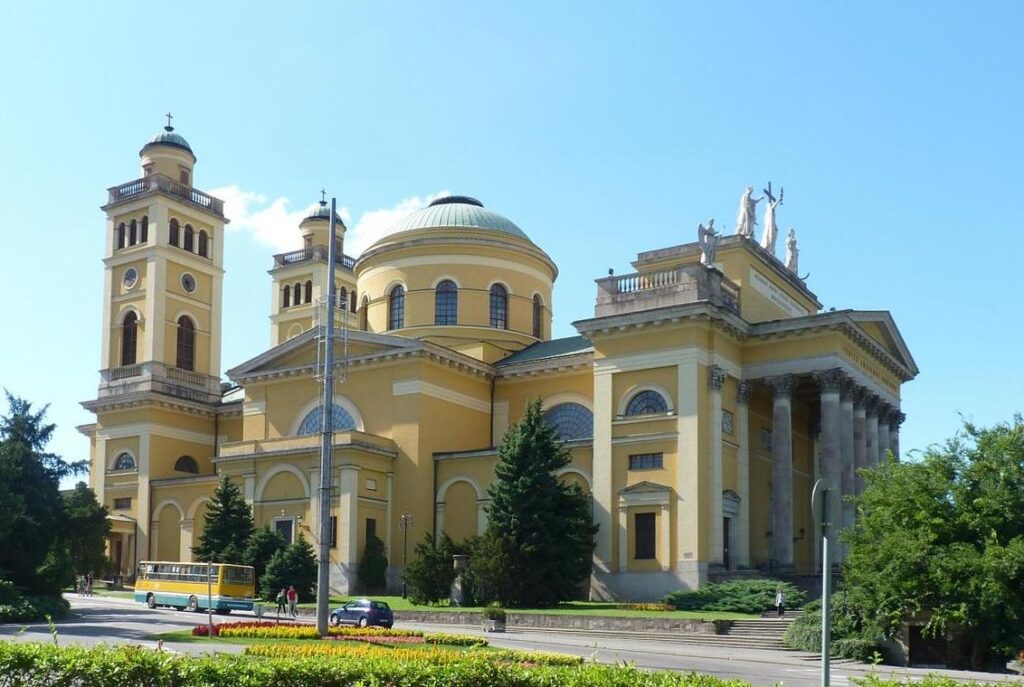
The front is a portico of Corinthian columns under a pediment, set against a tall yellow block, and the whole thing stands at the top of a broad grey stair that runs the width of the building. Casagrande’s saints stand at the foot of the stair on their own pedestals and again along the balustrade above the cornice, so that the figures climb with you. Behind the pediment rises a second storey, yellow and inscribed, carrying three more statues against the sky, and behind that the green copper of the dome and its two smaller companions. Across the entablature runs a line of Latin, venite adoremus Dominum — come, let us adore the Lord — which the cathedral’s parish has taken as its motto.
Inside, the plan is a three-nave basilica with a transept, and the dome opens over the crossing. The organ is at the west end: Mooser built it in 1864 with three manuals, the Rieger works later gave it a Barker lever and pneumatic slider action, and in 1912 the Angster factory of Pécs rebuilt it again, adding string and reed stops and taking Mooser’s reeds out.
A disagreement worth recording
The basilica’s own website calls it «hazánk második legnagyobb temploma», the second largest church in the country. A local history account of the consecration calls it «az ország harmadik legnagyobb temploma», the third. Both statements are in print and we have not been able to reconcile them; the usual ranking puts Esztergom first and then argues about Budapest. We record the disagreement rather than choosing a side.
Photographs

Practical information
- An active cathedral: it is open for worship, and admission to the church is free
- The Lyceum stands across the square; the Archbishop’s Palace is two minutes up Széchenyi István utca, and Eger Castle a short walk beyond
Sources
- Egri Bazilika, the cathedral’s own site (bazilikaeger.hu) and its parish site (eger-bazilika.plebania.hu) — Pyrker as builder, Hild as architect, the rank among Hungarian churches, the urn in the crypt, the organ as the second largest in the country
- Egri Sztorik — account of the consecration: 6 May 1837, built 1831–1836, 93 by 53 metres, Casagrande’s statues, and the third-largest ranking
- Az egri bazilika orgonája — Mooser 1864, the Rieger intervention, the Angster rebuilding of 1912
- OpenStreetMap — address and building footprint, Pyrker János tér 1
Find it on the map
See this place and what’s around it →📷 Become a Cultural Heritage Online photographer
Share your photos of places: they stay published under your name as the author. The more they're seen, the more you get noticed — and soon a contest will reward the most appreciated photos.
Log in or sign up free to add a photo