
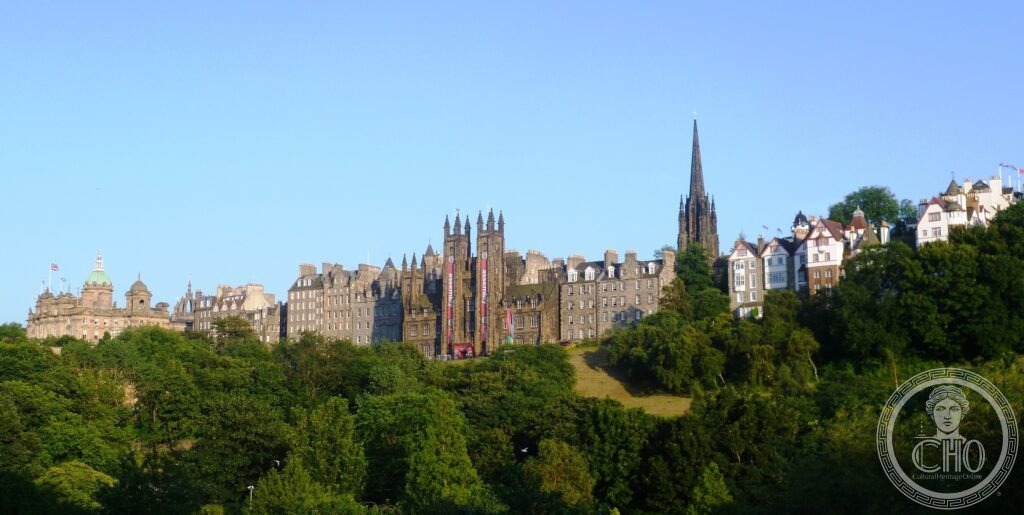
Edinburgh Old Town and New Town
The most dramatically sited capital city in the British Isles and a place where a medieval volcanic fortress, a Calvinist Protestant revolution, the Scottish Enlightenment, and the Georgian city-planning movement all left their marks within walking distance of each other — Edinburgh, perched on a ridge of ancient volcanic rock above the Firth of Forth, is one of the most complete dual-heritage cities in the world and the host of the largest annual arts festival on the planet.
At a glance
Edinburgh (UNESCO WHS 1995 as “Old and New Towns of Edinburgh” — the most architecturally contrasted single UNESCO WHS inscription in Britain: the inscription covers both the medieval Old Town (built organically from the 12th century; the most stratified medieval streetscape in Scotland) and the Georgian New Town (planned from 1766; the finest planned Georgian urban ensemble in the world — and historically the most precisely timed European city expansion: the New Town was built on strictly geometrical lines while the Old Town was decaying; it was the most consequential single act of urban renewal in Scottish history, led by architect James Craig and later by Robert Adam (the most internationally influential Scottish architect of the 18th century)); the contrasts (the most architecturally varied single UNESCO inscription in Britain: within 500 m you can walk from a 14th-century medieval tenement to a 1790s neo-classical terrace — the most compressed architectural history in any British city); the capital (Edinburgh is the capital of Scotland and the seat of the Scottish Parliament (since 1999 — the most consequential single act of devolution in British constitutional history).
Key facts
- Edinburgh Castle — the most besieged fortress in Britain: the most militarily contested single building in Scottish history — the Castle (26 sieges in recorded history — the most besieged single fortress in Britain (the most frequently cited military statistic in Scottish castle history); built on the volcanic plug of Castle Rock (the most geologically distinctive single castle foundation in any European capital city: the 350-million-year-old basalt plug of an extinct volcano; the castle was probably occupied since the Iron Age — the most continuously occupied volcanic rock in European settlement history); the Scottish Crown Jewels (the most ancient royal regalia in the British Isles: the Scottish Honours of the Three Kingdoms (the Crown, the Sceptre, and the Sword of State) were last used for Charles II’s coronation at Scone in 1651 and were subsequently hidden in a stone chest in the castle for 111 years — the most precisely hidden single royal regalia cache in British history; rediscovered by Sir Walter Scott in 1818 — the most consequentially literary single heritage discovery in Scottish history (Scott was the most influential single person in the 19th-century public rediscovery of Scottish heritage))); the Stone of Destiny (the most politically significant single stone in the history of Scotland: the sandstone block on which Scottish kings were crowned from at least 843 CE; taken to Westminster Abbey by Edward I of England in 1296 (the most consequential single act of cultural plunder in Scottish history); returned to Edinburgh Castle in 1996 (700 years after removal — the most precisely timed single heritage repatriation in the history of the UK))
- The Old Town and the closes: the most atmospheric medieval streetscape in Britain — the Royal Mile (described in hero caption; the most atmospherically historical single street in Scotland: the closes (the most distinctive single feature of the Edinburgh Old Town: approximately 100 closes (narrow alleyways leading off the Royal Mile) survive — the most densely surviving medieval alleyway network in any British city; each close is named after a historical occupant or event; the most famous: Mary King’s Close (the most visited single underground heritage site in Scotland: a 17th-century close sealed beneath the Royal Mile from the 1750s — the most precisely preserved single piece of medieval Edinburgh street archaeology; now open as a museum; the most atmospheric underground experience in any British heritage city))); the tenements (the most vertically ambitious medieval domestic buildings in Europe: the Old Town tenements of the 16th–17th century reached up to 14 storeys — the tallest inhabited buildings in the pre-modern world until the 19th century; the most frequently cited “world’s first skyscrapers” in any Scottish heritage publication; the most densely populated medieval city per acre in Europe at the time); the Edinburgh Festival (the most important single reason Edinburgh appears in more international heritage tourism itineraries in August than any other month: the Edinburgh International Festival (1947) and the Edinburgh Festival Fringe (the largest arts festival in the world: 3,500+ events; 50,000+ performances; 300+ venues in August 2026 — the most events in any single annual arts festival in the world))
- The Scottish Enlightenment: the most intellectually productive single city in 18th-century Europe — the Scottish Enlightenment (the most intellectually consequential single urban intellectual movement in the British Isles: Edinburgh in 1740–1800 produced more major European thinkers per capita than any other city in the world (the most densely productive single urban intellectual environment in 18th-century Europe): David Hume (the most radical sceptical philosopher in the British Empiricist tradition — the most cited single Scottish philosopher in modern analytic philosophy); Adam Smith (the most influential single economist in Western history: The Wealth of Nations (1776) — the most frequently cited single book in the history of economic theory; the most read book by economists who have never read it — the most accurately described relationship between a book and its reputation in economic history); James Watt (the most consequentially improved single machine in the history of the Industrial Revolution: the steam engine condensing chamber improvement (1765) — the most precisely dated single invention that changed the direction of world economic history); Joseph Black (the most important single Scottish scientist of the 18th century: discoverer of carbon dioxide and the theory of latent heat))
- Heritage: UNESCO World Heritage Site, Old and New Towns of Edinburgh, inscribed 1995
- GPS: 55.9496° N, -3.1886° E
History
Medieval Edinburgh (the most religiously turbulent single Scottish city: the Reformation (1560) — John Knox preached the most inflammatory single sermon in Scottish church history at St Giles’ Cathedral on 11 July 1559 — the most precisely dated single speech in the Scottish Reformation (Knox’s sermon against Mary of Guise initiated the final phase of the Protestant revolution in Scotland); Mary Queen of Scots (the most tragic single Scottish royal: Queen of Scotland (1542–1567), Queen Consort of France (1559–1560), imprisoned (1568) and executed (1587) by her cousin Elizabeth I of England — the most internationally contested single royal execution in 16th-century Europe; Mary lived at the Palace of Holyroodhouse (described in Practical section); the most precise single emotional landmark of her reign: the Holyrood private chambers where Rizzio was stabbed 56 times in front of the pregnant Mary (the most violently consequential single domestic incident in Scottish royal history))); the Georgian New Town (the Craig Plan 1766: the most precisely geometric single extension plan in Scottish urban history; built on land to the north of the Old Town over the drained Nor’ Loch (the most ambitious single land-reclamation project in Edinburgh’s history: the valley between the Old Town and the New Town was drained to provide the site for Princes Street Gardens and the New Town foundations; UNESCO WHS 1995.
What you see
The Edinburgh visit (the essential sequence: Edinburgh Castle (1h 30min: the Crown Jewels; the Stone of Destiny; the Great Hall; the view across the city — the finest single panoramic view from any castle in Britain); the Royal Mile walk (1h 30min from Castle to Holyroodhouse: the closes (10 min each into the most atmospheric medieval lanes in Scotland); St Giles’ Cathedral (the most historically resonant single church interior in Edinburgh: the Thistle Chapel — the finest piece of neo-Gothic craft woodcarving in Scotland); the Palace of Holyroodhouse (the royal palace at the foot of the Royal Mile; the most personally atmosphere-saturated single royal interior in Scotland: the private chambers of Mary Queen of Scots (the ceiling and wall paintings in the inner chamber — the most precisely dated 16th-century royal domestic interior in Scotland)); the New Town (Princes Street Gardens (the most atmospherically positioned public park in any European capital: below the castle rock, flanked by the Scott Monument (the second-tallest monument to a writer in the world (after the Burns Monument in Alloway); the George Street and Charlotte Square Georgian architecture).
Practical information
- Getting there: Edinburgh Airport (EDI; 12 km west; the most frequently used Scottish airport for international arrivals: direct flights from 100+ destinations; the Edinburgh Trams (the most recently constructed tramway in Scotland: opened 2014; extended 2023; the Airport–City Centre journey (25 min; the most cost-effective single airport-to-centre public transport in Scotland: £7.50 single fare — the cheapest major UK airport-to-city public transport)); by train from London (the East Coast Main Line (Kings Cross–Edinburgh Waverley: 4h 17min by Avanti Azuma LNER — the most scenic long-distance railway journey in the British Isles: the Northumberland coast + Holy Island (Lindisfarne) visible from the train); by train from Glasgow (50 min ScotRail — the most travelled inter-city rail route in Scotland: 10+ departures per hour at peak time))
- St Andrews and the Scottish golf coast: the birthplace of golf and the finest university town in Scotland — St Andrews (55 km north-east; 1h 15min drive or 1h 30min bus; the Old Course of St Andrews (the most historically significant single golf course in the world: the most precisely dated birthplace of the rules of golf (1754 — the most precisely dated single codification of the rules of any ball sport in Scotland)); the Cathedral Ruins (the most dramatically ruined medieval ecclesiastical complex in Scotland: the St Andrews Cathedral (1158–1318; the largest medieval building ever built in Scotland; destroyed in the Reformation; the most evocatively ruined single sacred site in Scotland — the ruin of the largest building in the country as a direct result of a religious revolution); the university (founded 1413 — the oldest university in Scotland and the third oldest in the British Isles after Oxford and Cambridge))
- The Highlands and the Isle of Skye: the most dramatic landscape in the British Isles — the Scottish Highlands (3h drive north from Edinburgh; the most spacious wilderness in Britain: the Cairngorms National Park (the largest national park in the UK by area: 4,528 km²); the Great Glen (Loch Ness: the most evocatively famous loch in Scotland; the Loch Ness Monster (the most commercially successful single cryptid in the history of tourism: the monster legend generates approximately £41 million per year in Loch Ness-related tourism — the most precisely monetised single myth in UK tourism)); the Isle of Skye (5h drive north-west; the most photogenic island in Scotland: the Cuillin Mountains (the finest technical rock-climbing ridgeline in the British Isles; the most dramatic mountain silhouette in any Scottish island); the Fairy Pools; the Old Man of Storr; the Quiraing — the most photographed landslide landscape in Scotland))
Getting there
Edinburgh Airport (EDI): tram to city centre 25 min (£7.50). Train from London Kings Cross 4h 17min (LNER). From Glasgow 50 min. Waverley Station in city centre. Edinburgh Festival: August (book accommodation 6+ months in advance). GPS: 55.9496, -3.1886.
Nearby
- Stirling Castle and the Battlefield of Bannockburn — 55 km north-west (1h train from Edinburgh); the finest single Scottish battlefield memorial and the most architecturally imposing castle on a basalt crag outside Edinburgh — Stirling (the Stirling Castle (the second most historically important castle in Scotland after Edinburgh; overlooking the Carse of Stirling from a 75-m basalt crag; the most architecturally complete Renaissance Scottish royal palace: the Great Hall (1501–1503) and the Palace (1538–1542) are the finest 16th-century secular buildings in Scotland); Bannockburn (2 km south; the battlefield where Robert the Bruce defeated Edward II’s English army on 24 June 1314 — the most decisive single military victory in Scottish independence history; the most emotionally significant single date in Scottish national consciousness: the basis of the Declaration of Arbroath (1320) — the most eloquently worded single declaration of national independence in European medieval history))
- St Andrews and the Old Course — 55 km north-east (1h 30min bus); birthplace of golf — described in Practical section
- The Rosslyn Chapel and the Borders — 10 km south of Edinburgh (20 min by bus; the most popular single day trip from Edinburgh since 2003): the Rosslyn Chapel (the Collegiate Church of St Matthew; 1456–1484; the most extensively stone-carved single small church in Scotland: every surface of the interior is carved — the most densely carved small chapel interior in northern Britain; the Apprentice Pillar (the most intricately carved single column in any Gothic chapel in Scotland — named after the legend of the apprentice who carved it so beautifully that the master mason killed him in jealousy; the Veil of the Temple (the hanging stone canopy over the Apprentice Pillar — the most technically ambitious single free-hanging stone carving in any British chapel); famous as the Da Vinci Code “Holy Grail” location (the most commercially consequential single fictional attribution to a real Scottish building: the 2003 Dan Brown novel and 2006 film increased visitor numbers from 30,000 to 176,000 per year — the most dramatically tourism-boosted single Scottish heritage site by a work of fiction))
Sources
- Wikipedia, Edinburgh; Edinburgh Castle; Royal Mile; Scottish Enlightenment; Edinburgh Festival Fringe, accessed June 2026
- UNESCO, Old and New Towns of Edinburgh, WHS reference 728, inscribed 1995
- Arthur Herman, The Scottish Enlightenment: The Scots’ Invention of the Modern World, Fourth Estate, 2001
Find it on the map
See this place and what’s around it →📷 Diventa un fotografo di Cultural Heritage Online
Condividi le tue foto dei luoghi: restano pubblicate con la tua firma come autore. Più vengono viste, più ti fai conoscere — e presto un concorso premierà le foto più apprezzate.
Accedi o registrati gratis per aggiungere una foto