
,_10th_Street,_Omaha,_NE.jpg)
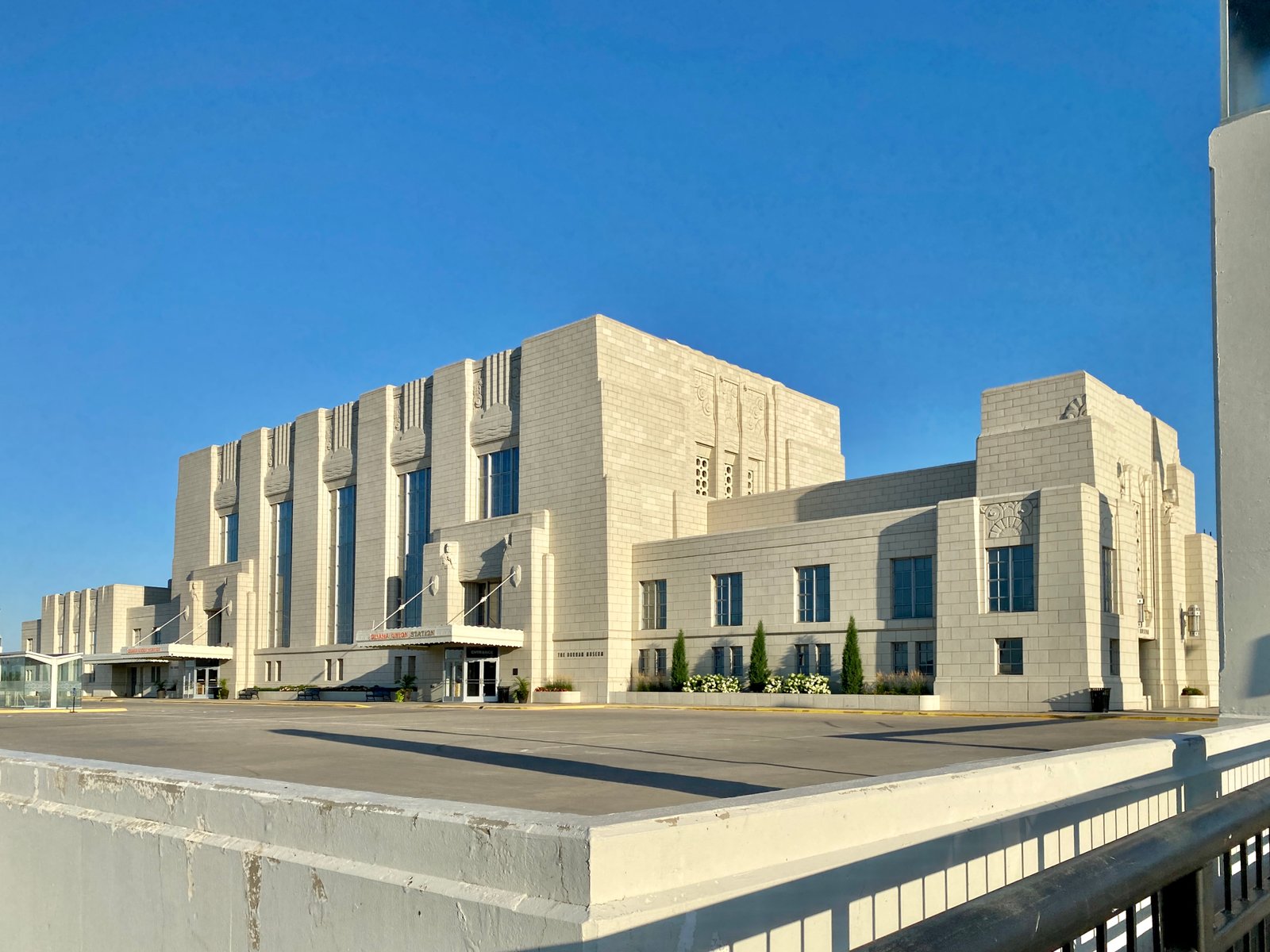
The former Omaha Union Station (1931) is one of the most intact Art Deco railroad terminals in the United States — a building that processed millions of wartime travellers through its marble halls and now houses Omaha’s principal history museum.
At a glance
The Durham Museum occupies the former Omaha Union Station at 801 South 10th Street, a few blocks south of downtown and within walking distance of the Old Market district. The station opened on January 1, 1931, built to replace an earlier terminal and designed to serve the Union Pacific, Burlington, and Northwestern railroads that converged at Omaha. The main waiting hall — its floor in pink marble, its ceiling soaring to coffered vaults — remains the finest interior space in the building, and stands essentially as the railroads left it when the station closed in 1971. The Durham Museum opened in this building in 1975.
Key facts
- Opened: January 1, 1931 (as Omaha Union Station)
- Style: Art Deco
- Railroads served: Union Pacific, Burlington Route, Chicago & North Western
- Station closed: 1971
- Museum opened: 1975 (as Western Heritage Museum; renamed Durham Museum 1998)
- Address: 801 South 10th Street, Omaha, NE 68108
- National Historic Landmark: 1975
History
Omaha’s strategic position on the Missouri River and its role as the eastern terminus of the transcontinental Union Pacific Railroad made it one of the most important rail junctions in the United States. The 1931 station replaced an earlier Victorian terminal and was designed to accommodate the volume of long-distance passenger traffic that Omaha handled — a volume that would peak during the Second World War, when the station processed millions of military personnel moving through the Midwest.
The Second World War years were the station’s most intense: photographs from the period show the main waiting hall crowded with servicemen and women sleeping on the marble floors, writing letters home at the long wooden benches that still stand in the room. The Red Cross maintained a canteen in the building throughout the war. After 1945, passenger volumes declined rapidly as automotive travel and commercial aviation captured the long-distance market. The station closed to rail traffic in 1971 and the building was saved from demolition by a preservation campaign that led to its conversion as a history museum.
The Western Heritage Museum opened in 1975 and was renamed the Durham Museum in 1998 following a major gift from the Durham family of Omaha. A significant restoration project in the 1990s stabilised the building fabric and restored the main hall to its original appearance. The museum’s collection focuses on Great Plains and American West history, with particularly strong holdings on the railroad era and the pioneer migration.
What you see
The exterior presents a compact Art Deco composition in Indiana limestone: a central entrance pavilion with a recessed portal flanked by horizontal wing blocks, shallow carved ornament at the cornice level, and the characteristic setback massing of late-1920s institutional architecture. The scale is civic — not the monumental grandeur of a metropolitan terminus like Cincinnati or Los Angeles, but the considered dignity of a regional hub that processed several hundred trains a day.
The main waiting hall is the emotional core of the building. pink marble covers the floor in large slabs; the walls rise through successive bands of darker stone to the coffered vault ceiling, which carries painted decoration in blue and gold. The original wooden benches are in place. The room is approximately two stories high, and the Art Deco light fixtures — which survive in the original installation — cast an amber light across the marble that makes the hall look like a period film set at any hour of the day.
Practical information
- Hours: Tuesday–Saturday 10am–5pm, Sunday noon–5pm; closed Monday
- Admission: General admission charged; members free
- Allow: 2–3 hours for the museum collection and the architectural spaces
- Note: The main waiting hall and the restored soda fountain counter are accessible without entering the paid collection areas
Getting there
The Durham Museum is at 801 South 10th Street in downtown Omaha, approximately 0.5 miles south of the Old Market district along 10th Street. Surface parking is available adjacent to the building. METRO bus service connects the museum to downtown and midtown. Omaha Eppley Airfield (OMA) is approximately 10 miles north via I-480.
Nearby
- Old Market district — Omaha’s Victorian warehouse quarter with galleries, restaurants, and shops, 0.5 miles north
- Joslyn Art Museum (1931) — the city’s other great Art Deco monument, 1.5 miles northwest in midtown; see CHO place card
- Bob Kerrey Pedestrian Bridge — suspension footbridge spanning the Missouri River to Council Bluffs, Iowa, 0.5 miles east
Sources
- National Park Service, National Historic Landmark nomination, Omaha Union Station (1975)
- Durham Museum — official building and collection history (durhammuseum.org)
- Union Pacific Railroad historical archives
- Nebraska State Historical Society documentation
Find it on the map
See this place and what’s around it →📷 Become a Cultural Heritage Online photographer
Share your photos of places: they stay published under your name as the author. The more they're seen, the more you get noticed — and soon a contest will reward the most appreciated photos.
Log in or sign up free to add a photoIs this page about you?
This page is read by travellers and heritage enthusiasts who find it on Google. Tell us how you are connected to this place and we will take it from there.