
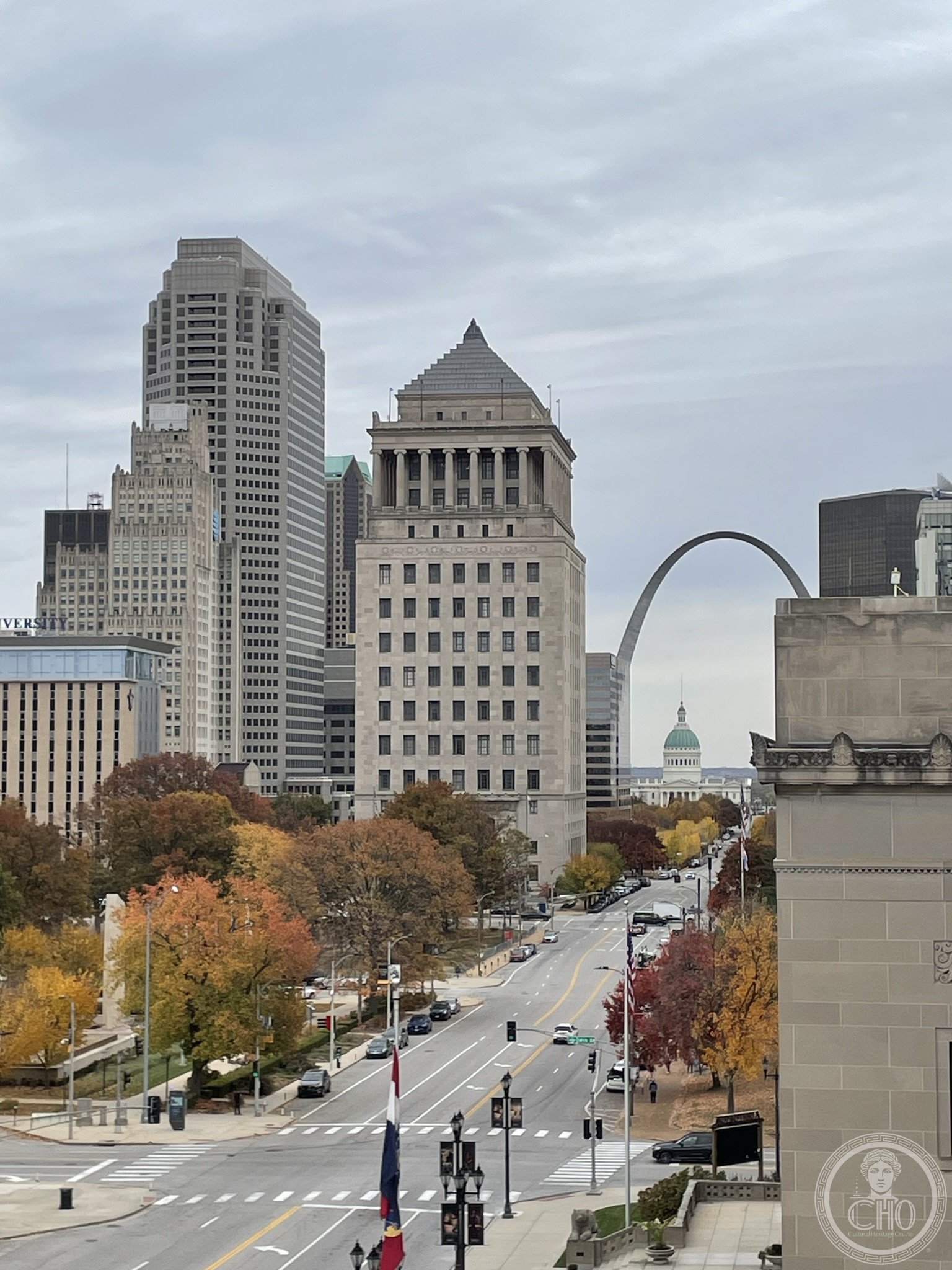
A working courthouse that borrowed its crown from one of the Seven Wonders of the Ancient World.
At a glance
Completed in 1930, the Civil Courts Building rises through a tiered Art Deco shaft before culminating in one of the most unexpected skyline flourishes in American civic architecture: a stepped pyramid modelled on the ancient Mausoleum at Halicarnassus. The building houses the Missouri Circuit Court and has been in continuous use since opening day. Finished as the Great Depression tightened its grip on the national economy, it represents a moment of institutional resolve — a city choosing to build grandly rather than defer. Its silhouette, visible across downtown St. Louis, remains exactly as the designers intended: a landmark that earns attention by earning its height.
Key facts
- Location: 10 N. Tucker Blvd, St. Louis, Missouri
- Completed: 1930
- Style: Art Deco with stepped pyramid crown
- Crown reference: Mausoleum at Halicarnassus (one of the Seven Wonders)
- Function: Missouri Circuit Court (active courthouse)
- Status: National Register of Historic Places
History
St. Louis in the 1920s was investing heavily in civic infrastructure, aiming to consolidate court functions that had long been dispersed across an ageing collection of downtown buildings. The Civil Courts Building was conceived as the centrepiece of a planned civic precinct, designed to house the Missouri Circuit Court and related judicial offices in a single structure capable of expressing the authority of the law in stone. Construction began in 1929 and the building was occupied in 1930, at a moment when the financial climate had changed dramatically from the optimism of the commission.
The decision to crown an Art Deco tower with a replica of the Mausoleum at Halicarnassus was unusual by American standards, where courthouse design typically looked to Greek temples or Roman domes. The choice of one of the ancient world’s great funerary monuments as the finishing element of a courthouse had a certain logic: permanence, authority, and the weight of civilisation reaching across centuries. The building has never left service. Generations of lawyers, litigants, and judges have passed under its stepped crown, and the Missouri courts still use it today.
What you see
The lower floors present a restrained late Art Deco vocabulary: smooth-faced stone, broad arched window openings set within shallow rectangular bays, and minimal surface ornament that lets the profile do the speaking. Above the main cornice, the tower steps back in a series of setbacks that narrow the silhouette gradually before the stepped pyramid crown takes over. The crown is finished in pale stone that glows almost white at midday and warm ochre at dusk, anchoring the building’s profile against the St. Louis skyline from considerable distance.
Inside, the public corridors retain their original marble cladding and bronze hardware — a material honesty that the building’s exterior promises and delivers. The courtrooms remain in active legal use; visitors exploring the public halls pass genuine proceedings behind closed doors, and the building’s scale — wide enough to be institutional, tall enough to be monumental — communicates exactly what it was built to convey.
Practical information
- Hours: public corridors accessible Monday–Friday, approximately 8 am–5 pm
- Entry: security screening at entrance; cameras permitted in public areas; no photography in active courtrooms
- Time needed: 30–45 minutes for exterior and public corridors
- Accessibility: ground-level accessible entrance available
Getting there
The Civil Courts Building is at 10 N. Tucker Blvd in central St. Louis, roughly three blocks north of the MetroLink Convention Center station (Red and Blue lines). On foot from the Gateway Arch grounds, the walk west along Market Street takes approximately fifteen minutes, passing through the civic centre precinct. Street parking is available on surrounding blocks, though downtown St. Louis is most easily navigated by light rail.
Nearby
- Wainwright Building (1891) — Louis Sullivan’s proto-skyscraper, three blocks northeast
- Old Post Office (1884) — Romanesque Revival landmark, two blocks east
- Gateway Arch and Museum (1965) — the city’s iconic riverfront monument, fifteen minutes on foot
Sources
- National Register of Historic Places nomination file, Civil Courts Building, St. Louis, Missouri
- Missouri Courts, building and historical records
- St. Louis Public Library / Missouri History Museum collections
Find it on the map
See this place and what’s around it →📷 Become a Cultural Heritage Online photographer
Share your photos of places: they stay published under your name as the author. The more they're seen, the more you get noticed — and soon a contest will reward the most appreciated photos.
Log in or sign up free to add a photoIs this page about you?
This page is read by travellers and heritage enthusiasts who find it on Google. Tell us how you are connected to this place and we will take it from there.