
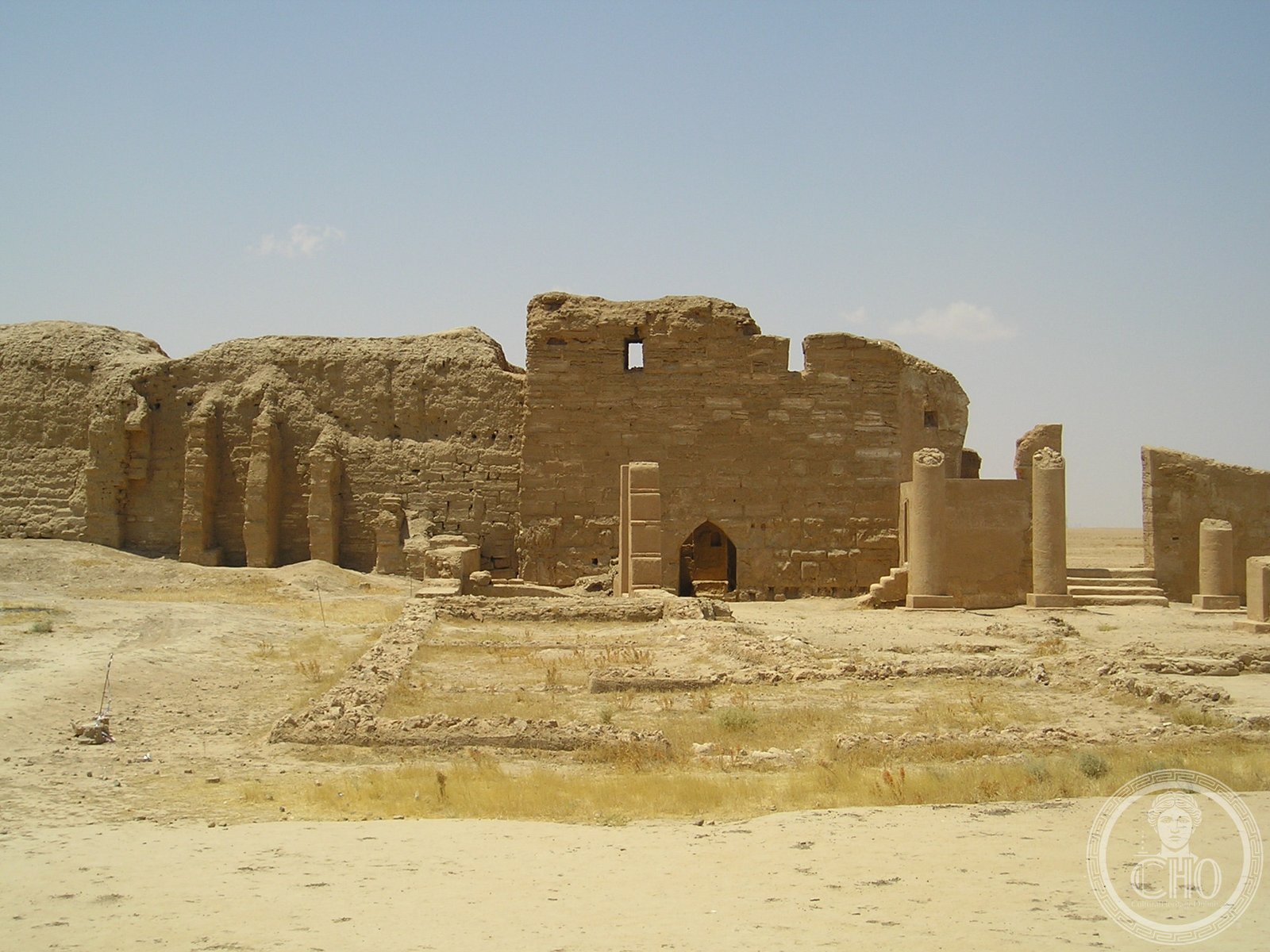
Founded by one of Alexander the Great’s generals on the middle Euphrates, Dura-Europos was a Silk Road frontier city that changed hands between Seleucids, Parthians, and Romans before being buried under desert sand after a Persian siege in 256 AD — preserving the oldest known Christian church and the oldest surviving synagogue with figurative wall paintings.
At a glance
Called the “Pompeii of the Syrian Desert”, Dura-Europos was accidentally rediscovered in 1920 when British cavalry digging a foxhole broke into a buried room with painted walls. The site yielded a synagogue (c. 244 AD) with walls entirely covered in Old Testament narrative paintings, a house-church (c. 232–256 AD) that is the oldest known purpose-adapted Christian building in the world, and at least 16 temples serving Roman, Greek, Palmyrene, Mithraic, and Zoroastrian cults simultaneously. The site is now under severe threat from looting linked to the Syrian Civil War.
Key facts
- Founded: c. 303 BC by Seleucus I Nicator, one of Alexander’s generals
- Destroyed: 256 AD, besieged and sacked by Shapur I of Persia
- Rediscovered: 1920, by British cavalry; systematic excavations 1928–1937 (Yale University & French Academy)
- The synagogue: c. 244 AD — the best-preserved ancient synagogue in the world, walls entirely covered in figurative narrative paintings
- The house-church: c. 232–256 AD — the oldest known purpose-adapted Christian church anywhere in the world
- Organic preservation: Desert burial preserved papyrus scrolls, textiles, wooden objects, and leather goods
- Status: UNESCO-classified as severely threatened; illegal excavations documented by satellite imagery since 2011
History
Dura-Europos was founded around 303 BC by Seleucus I Nicator, one of the generals who divided Alexander the Great’s empire. Positioned on a high plateau above the Euphrates, controlling a strategic river crossing, it served as a Macedonian military colony — its name combining the Greek Europos (the Seleucid dynasty’s home city in Macedonia) with the Semitic word dura, meaning fortress.
The Parthians captured it around 114 BC and it became a thriving Silk Road commercial city, absorbing Greek, Semitic, and Iranian cultural influences simultaneously. Rome seized it in 165 AD and established a major garrison. For roughly a century the city was a Roman military stronghold, housing auxiliaries from across the empire and trading with Palmyra and the Parthian successor states.
The end came in 256 AD when Shapur I of the Sassanid Persian Empire besieged the city. The Roman garrison buried their valuables, blocked the towers with rubble, and evacuated. The western portion of the city was buried under desert sand and remained undisturbed for over 1,600 years.
In 1920, a British cavalry unit digging a fortification trench accidentally broke through the roof of a buried room and revealed painted walls. Systematic excavations from 1928 to 1937 by Yale University and the French Academy of Inscriptions and Belles-Lettres uncovered one of the richest archaeological finds of the twentieth century.
What you see
The site occupies a 70-hectare plateau bounded by the Euphrates cliffs on one side and massive mudbrick defensive walls on three sides. The central street grid of a Hellenistic city is still legible. Key structures include:
- The Dura Synagogue (Block L7): A house converted into a synagogue expanded around 244 AD. Its assembly hall walls were covered floor-to-ceiling in figurative paintings of Hebrew Bible scenes — Moses and the Exodus, Ezekiel’s vision, the story of Esther. These directly challenged the assumption that ancient Judaism was aniconographic. The original paintings are preserved in the National Museum of Damascus.
- The Christian house-church (Block M8): The oldest known purpose-adapted Christian church — a domestic house converted for Christian use around 232 AD. It contained a baptistery with painted walls showing a Good Shepherd and women at a tomb. The paintings are now in the Yale University Art Gallery.
- 16+ temples: Roman military shrines, a Palmyrene temple to Bel and Iarhibol, a Mithraic mithraeum, a temple of the Gadde (Semitic city deities), and a Zoroastrian fire temple — all functioning simultaneously in a city of roughly 6,000 people.
- Military finds: Papyri, weapons, and a unique lamellar horse-armour (clibanarius barding) — the only surviving example of this type from antiquity.
Practical information
Dura-Europos is located near the town of Salhiye in the Deir ez-Zor Governorate of eastern Syria. The site is not accessible to visitors due to the ongoing Syrian Civil War. Most original finds are held at the Yale University Art Gallery (New Haven, Connecticut) and the National Museum of Damascus.
Getting there
In normal conditions, Dura-Europos is reached via the Euphrates highway from Deir ez-Zor city (approximately 90 km to the west). The site is not currently accessible due to the conflict. Monitor government travel advisories for Syria before planning any visit.
Nearby
- Mari (Tell Hariri) — Major Bronze Age palace city on the Euphrates, approximately 120 km south; also threatened by looting
- Deir ez-Zor Archaeological Museum — Held important finds from the Euphrates valley; severely damaged during the war
- Palmyra (Tadmor) — Roman and Palmyrene trading city, 200 km west; key partner in Dura’s commercial network; also severely damaged
Sources
- Rostovtzeff, M. I. et al. The Excavations at Dura-Europos: Preliminary Reports. Yale University Press, 1929–1952.
- Kraeling, C. H. The Synagogue. Yale University Press, 1956.
- Kraeling, C. H. The Christian Building. Augustin, 1967.
- James, Simon. The Arms and Armour and other Military Equipment. British Museum Press, 2004.
- UNESCO / ASOR Cultural Heritage Initiatives. Satellite damage assessment reports, 2014–2019.
Find it on the map
See this place and what’s around it →📷 Become a Cultural Heritage Online photographer
Share your photos of places: they stay published under your name as the author. The more they're seen, the more you get noticed — and soon a contest will reward the most appreciated photos.
Log in or sign up free to add a photo