
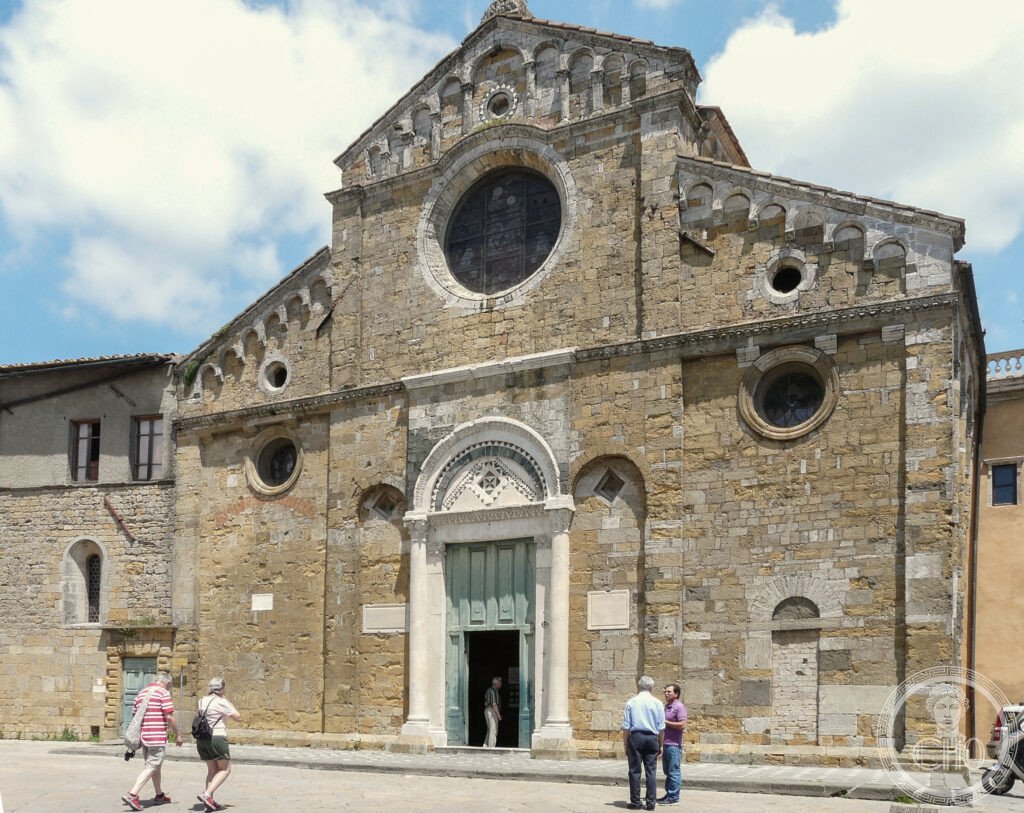
Rebuilt after the earthquake of 1117 and consecrated in 1120, the cathedral of Volterra holds in its left aisle a thirteenth-century wooden group among the most intense in Tuscan Romanesque sculpture.
At a glance
The Cathedral of Santa Maria Assunta stands on Piazza San Giovanni, the religious heart of the Etruscan hill town of Volterra in Tuscany. A church on this site dates back to the 9th century; the present building was rebuilt after the earthquake of 1117 and consecrated in 1120 by Pope Callixtus II. The cathedral was enlarged in the second half of the 13th century, when a Romanesque-Pisan facade replaced the earlier front, and its interior was substantially reworked in the 16th century under Bishop Guido Serguidi, then restored again in 1842-43. Pope Pius XII raised it to the rank of minor basilica in 1957. It remains the mother church of the Diocese of Volterra.
Key facts
- Consecration: 20 May 1120, by Pope Callixtus II, after the earlier church on the site was destroyed in the 1117 earthquake.
- Facade: Romanesque-Pisan front from the 13th-century enlargement, its portal incorporating spolia reused from the Roman theatre of Volterra.
- Deposition group: a polychrome wooden sculpture group of the Deposition from the Cross, carved in the 13th century, kept in a side chapel.
- Ciborium: marble ciborium by Mino da Fiesole, 1471.
- Coffered ceiling: gilded wooden ceiling of 1580-1584, designed by Francesco Capriani.
- Bell tower: rectangular campanile raised in 1493, pierced by twelve mullioned (bifora) windows.
- Minor basilica: title conferred by Pope Pius XII in November 1957.
History
A church dedicated to Santa Maria already stood on the site of Piazza San Giovanni in the 9th century. It was destroyed, along with much of the town, by the earthquake of 1117, and rebuilt in the years that followed; the new cathedral was consecrated on 20 May 1120 by Pope Callixtus II, a ceremony that also marked the town reasserting its civic and episcopal identity after the disaster.
The building reached roughly its present form in the second half of the 13th century, when the cathedral was enlarged and given its Romanesque-Pisan facade, a phase traditionally associated with the workshop of Nicola Pisano. The interior underwent a major transformation in the 16th century commissioned by Bishop Guido Serguidi, who introduced the black-and-white banded walls typical of Tuscan Romanesque churches along with the gilded coffered ceiling completed by Francesco Capriani between 1580 and 1584. A further restoration followed in 1842-43.
Through these successive campaigns the cathedral accumulated works spanning several centuries: the 13th-century Deposition group, Mino da Fiesole’s 1471 marble ciborium, and Mariotto Albertinelli’s Annunciation of 1497. In November 1957 Pope Pius XII elevated the church to the rank of minor basilica, formal recognition of its role as the seat of the Diocese of Volterra.
What you see
The plan is a Latin cross with three naves separated by twenty-two granite columns, their capitals ranging from Romanesque originals to later reworkings, beneath the black-and-white striped walls introduced in the 16th-century renovation. Overhead, the coffered ceiling gilded and carved with saints between 1580 and 1584 caps a nave and colonnade that still read as unmistakably Romanesque despite the later Baroque-era overlay.
In the left nave stands the pulpit, reassembled from carved 12th-century panels, close to the chapel holding the five-figure wooden Deposition group of the 13th century: hollowed, painted limewood figures whose stark, angular gestures place them among the most expressive examples of Romanesque wood sculpture in Tuscany. Near the high altar, Mino da Fiesole’s marble ciborium of 1471 stands not far from Mariotto Albertinelli’s Annunciation of 1497, while the sacristy and side chapels preserve reliquaries associated with the town’s patron saints, Ottaviano and Ugo.
Practical information
- Opening hours: generally 10:00-18:00 (last entry 17:30) on weekdays; Sundays and holidays from around midday, with variations for religious services — check locally before visiting.
- Admission: entry to the cathedral itself is free; a combined ticket (around €8) covering the adjoining Baptistery and the diocesan exhibition spaces includes an audioguide and is valid for two days.
- Time needed: 20-30 minutes for the nave and chapels.
Getting there
Volterra sits on a hilltop in inland Tuscany and has no station of its own; the nearest railhead is Saline di Volterra-Pomarance on the Cecina-Volterra line, from which local bus 780 covers the roughly 21-minute run up to town. Travellers coming from Pisa or Florence typically combine a train to Pontedera or Cecina with a connecting bus. Pisa International Airport, about 65 km away, is the closest airport, followed by Florence. By car, Volterra is reached via the SR68 regional road; the cathedral stands on Piazza San Giovanni in the historic centre (43.401787, 10.858996), a short walk from the town’s car parks.
Nearby
- Battistero di San Giovanni — the octagonal Romanesque baptistery facing the cathedral across the same piazza, built in the 13th century.
- Teatro Romano di Volterra — a well-preserved Roman theatre of the 1st century BC, on the northern edge of the historic centre.
- Palazzo dei Priori — begun in 1208 and considered the oldest town hall in Tuscany, a few steps from the cathedral on the main square.
- Pinacoteca Comunale — housed in Palazzo Minucci Solaini, with works by Rosso Fiorentino, Luca Signorelli and Domenico Ghirlandaio.
Sources
- “Duomo di Volterra”, Italian Wikipedia (consulted July 2026).
- “Volterra Cathedral”, English Wikipedia (consulted July 2026).
- “Cattedrale e Battistero”, Volterra Tur — official tourism consortium of Volterra (volterratur.it).
- “Roman Theatre and Palazzo dei Priori”, Visit Tuscany — official regional tourist board (visittuscany.com).
Find it on the map
See this place and what’s around it →📷 Become a Cultural Heritage Online photographer
Share your photos of places: they stay published under your name as the author. The more they're seen, the more you get noticed — and soon a contest will reward the most appreciated photos.
Log in or sign up free to add a photoIs this page about you?
This page is read by travellers and heritage enthusiasts who find it on Google. Tell us how you are connected to this place and we will take it from there.