
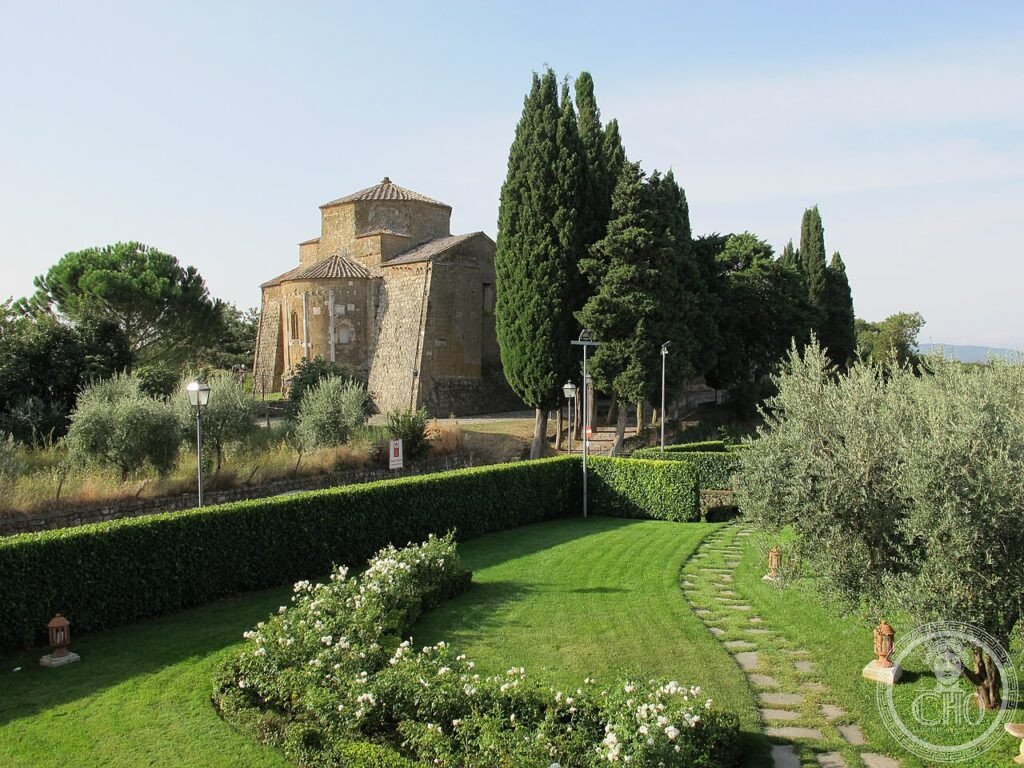
Among the tufa houses of a village now almost empty, the cathedral of Sovana holds a travertine ciborium without equal in Tuscany and the memory of Hildebrand, the local monk who became Pope Gregory VII.
At a glance
The Cathedral of Saints Peter and Paul stands in Sovana, a small stone village that is a frazione of the comune of Sorano, in the province of Grosseto. Raised to a bishop’s seat in the 5th century and rebuilt mainly between the 11th and 13th centuries, the building preserves a tufa crypt from its earliest phase alongside mature Romanesque stonework shaped by Lombard workshops. Since 1986 it has served as co-cathedral of the diocese of Pitigliano-Sovana-Orbetello. Local tradition and Tuscany’s regional tourism board link its growth to Ildebrando di Sovana, the town-born monk who became Pope Gregory VII, and to the Aldobrandeschi family who ruled the area. Modest in scale next to Tuscany’s great urban cathedrals, it holds one of the region’s most unusual liturgical furnishings: a monumental travertine ciborium with no equal elsewhere in Tuscany.
Key facts
- Dedication: Saints Peter and Paul (Santi Pietro e Paolo)
- Status: co-cathedral of the Diocese of Pitigliano-Sovana-Orbetello since 1986
- Earliest phase: crypt dated to the 8th-9th century, first documented in a 1061 bull of Pope Nicholas II
- Main construction: Romanesque rebuilding largely completed by 1248
- Style: “second-generation” Romanesque with Lombard influence and elements transitional toward Gothic
- Relic: the crypt holds remains traditionally attributed to Saint Mamiliano, bishop of Palermo
- Local figure: linked to Ildebrando di Sovana, later Pope Gregory VII (c. 1015-1085)
History
Sovana became a bishop’s seat in the 5th century, part of the early Christianization of the Maremma hill country. The oldest fabric still standing is the crypt, cut and vaulted in local tufa stone in the 8th or 9th century; the church built above it is first documented in a bull issued by Pope Nicholas II in 1061, by which point Sovana was already a fortified seat of the Aldobrandeschi family. Tradition attributes the crypt’s principal relics to Saint Mamiliano, a bishop of Palermo venerated locally after his death.
The building took its present Romanesque form mainly across the 11th to 13th centuries, with work continuing into 1248. This period coincided with the peak of Aldobrandeschi power and with the pontificate of Gregory VII, born Ildebrando in or near Sovana around 1015-1020 according to Visit Tuscany, the region’s official tourism authority; a rock-cut Etruscan tomb on the edge of the town still carries his name. The reconstruction drew on formulas from Lombard Romanesque architecture while already showing details that point toward Gothic forms, a transitional mix visible in the capitals and portal.
Sovana’s political and demographic decline from the 16th century onward left the cathedral largely untouched by later rebuilding, which is why its Romanesque core survives with comparatively little overlay. The 1986 reorganization of Tuscan dioceses merged Sovana with Pitigliano and Orbetello, and the building has held co-cathedral status ever since, still used for worship and open to visitors as part of the diocesan museum circuit.
What you see
The exterior mixes travertine and the local grey-gold tufa, with a Romanesque portal and, in the apse zone, sculpted fragments clearly reused from an earlier building phase or salvaged from elsewhere on the site. The plan is a basilica with three naves separated by columns and pilasters carrying arched vaults; the capitals are the building’s best-known feature, carved with geometric and foliate patterns, animals, human faces, and Old Testament scenes, work generally dated to the 12th century.
Inside, the travertine ciborium over the altar is described by regional sources as unique in Tuscany for its scale and completeness, raised on marble pilasters with geometric inlay. A 15th-century travertine baptismal font stands nearby. The tufa crypt beneath the presbytery, low-vaulted and dim, is the most tangible link to the 8th-9th century church. On the summer solstice, light is reported to enter through the apse window and travel the length of the nave, an alignment several local and tourism sources treat as intentional rather than coincidental.
Practical information
- Opening hours: daily 10:00-13:00 and 14:30-19:00; reduced winter hours (weekends only, until 17:30) from 7 January to 14 February
- Tickets (from 1 January 2026): full adult €2.50; children 8-10 €2.00; groups of 20+ €2.00 per person; free for under-8s, residents and diocesan groups
- Combined ticket: €7.50 covers both the cathedral and the Palazzo Orsini Museum in Pitigliano, usable on different days
- Time needed: 20-30 minutes
Getting there
Sovana sits in the hill country of southern Tuscany’s Maremma, reached by car via the SR74 Maremmana and local roads through Sorano and Pitigliano; it has no train station of its own, with Orbetello, Chiusi and Orvieto the nearest stops, each roughly 60 km away, from where a car, taxi or local bus (line 18P) covers the final stretch. The cathedral stands at 42.656251, 11.641646, on the eastern edge of the historic village.
Nearby
- Necropoli etrusca di Sovana — the rock-cut Etruscan necropolis on the village’s edge, including the Tomba Ildebranda named for Gregory VII, part of the Città del Tufo archaeological park
- Pitigliano — the larger tufa town whose Palazzo Orsini Museum shares a combined ticket with the cathedral
- Sorano — the seat of the comune, built around its own Aldobrandeschi-Orsini fortress
Sources
- Wikipedia (Italian): “Concattedrale dei Santi Pietro e Paolo (Sovana)”
- Wikipedia (English): “Sovana Cathedral”
- Visit Tuscany, official regional tourism board: “Co-cathedral of Saints Peter and Paul in Sovana”
- Palazzo Orsini Museum, Pitigliano (diocesan museum system): “Orari e biglietti Sovana”
- Wikidata, Q3045563 (“Sovana Cathedral”)
Find it on the map
See this place and what’s around it →📷 Become a Cultural Heritage Online photographer
Share your photos of places: they stay published under your name as the author. The more they're seen, the more you get noticed — and soon a contest will reward the most appreciated photos.
Log in or sign up free to add a photoIs this page about you?
This page is read by travellers and heritage enthusiasts who find it on Google. Tell us how you are connected to this place and we will take it from there.