
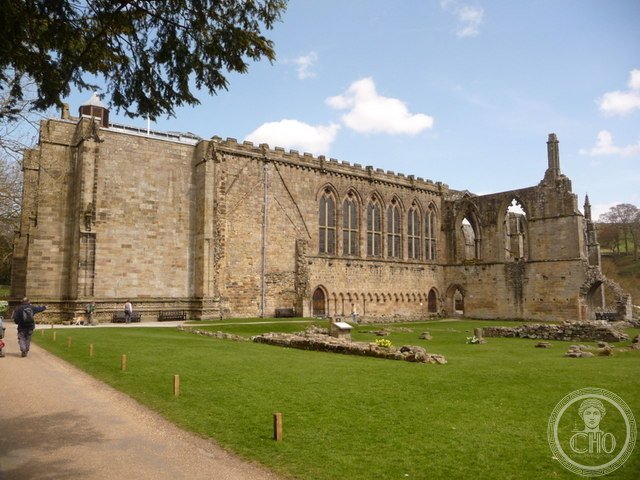
On the river Wharfe the Augustinian canons built a priory that Henry VIII let fall partly into ruin: for almost five centuries the western nave has gone on being a living church, beside the choir left in ruins.
At a glance
Bolton Priory sits in a bend of the River Wharfe in the Yorkshire Dales, on an estate still owned by the Duke of Devonshire’s Chatsworth Settlement. Founded for Augustinian canons in 1154, it is unusual among English monastic ruins because it was never fully abandoned: at the Dissolution the local community was allowed to keep the nave as its parish church, while the choir, transepts, and cloister were left to decay. The result is a single site that is both a working church, still holding regular Sunday worship, and a genuine ruin open to the public, set within a wider estate of woodland and riverside walks.
Key facts
- Order: Augustinian canons, founded 1154 (community traced to an earlier house at Embsay from around 1120)
- Founder: Lady Alice de Rumilly of Skipton Castle, who granted the land
- Status: partial ruin (choir, transepts, cloister) + partial working parish church (nave), Grade I listed
- Dissolved: January 1540, under Henry VIII
- Dedication: the surviving church is the Priory Church of St Mary and St Cuthbert
- Unfinished tower: a west-front tower begun in 1520 was left half-built at the Dissolution
- Setting: Bolton Abbey Estate, Yorkshire Dales, owned by the Chatsworth Settlement (Duke of Devonshire)
History
Augustinian canons first settled nearby at Embsay around 1120. In 1154 Lady Alice de Rumilly of Skipton Castle granted them land beside the River Wharfe, and the community relocated to build Bolton Priory on the new site. Over the following century the canons built a substantial cruciform church and claustral ranges, funded in part by the wool trade and by estates across Wharfedale. In the early 14th century the priory suffered raids linked to Scottish incursions into northern England, and rebuilding continued intermittently for decades afterwards.
By the early 16th century the priory was ambitious enough to begin a new west-front tower, started in 1520, intended to give the church a grander approach. It had reached only half its planned height when Henry VIII’s Dissolution of the Monasteries reached Bolton in January 1540 and the community was suppressed. What happened next set Bolton apart from most dissolved English priories: Prior Richard Moone negotiated directly with Thomas Cromwell, arguing that the local township of Bolton had no other parish church and depended on the priory nave for worship. Cromwell agreed, and the western nave was walled off from the rest of the building and handed to the parish, while the choir, transepts, chapter house, and domestic ranges were stripped of lead and left to fall into ruin.
The parish church has been maintained and altered ever since, including major 19th-century restoration work that added new windows, among them designs associated with A. W. N. Pugin, and further repairs under the architect George Edmund Street. A serious structural crisis in the late 1970s led to a major restoration campaign in the 1980s under Canon Maurice Slaughter, which stabilised the roof and fabric and revived the congregation. The estate around the ruins passed by inheritance to the Clifford family and later to the Dukes of Devonshire, whose Chatsworth Settlement still owns and manages Bolton Abbey today.
What you see
Approaching from the estate side, visitors first meet the unfinished west tower: a squared, buttressed base rising to roughly half its intended height, its masonry left rough where construction stopped in 1540. Beyond it, the surviving nave, now the parish church, keeps its Norman and Early English arcades and its late-medieval roof, furnished for regular worship with pews, an organ, and 19th-century stained glass. A plain stone wall, built at the Dissolution to separate the working church from the doomed eastern arm, still marks the line between “living” and “ruined” Bolton.
Step through or around that wall and the character changes completely: the roofless choir, crossing, and transepts stand open to the sky, their arcades and window tracery silhouetted against the wooded valley side, with grassed-over footings marking the vanished chapter house and cloister. The whole complex sits almost at the water’s edge, and the classic view — ruined east end reflected in the slow-moving Wharfe, with the famous stepping stones just downstream — is one of the most photographed monastic settings in the north of England.
Practical information
- The priory ruins and parish church are on the Bolton Abbey Estate and can be visited without a ticket; the estate itself is open every day of the year
- A parking charge applies at the estate’s car parks (Bolton Abbey, Riverside, Strid Wood, and Barden Bridge); current rates are set by the estate and checked in advance
- The working church (the nave) holds regular Sunday services and is not open for tourist visits during worship
- Allow 30-45 minutes for the ruins and church, longer if combining with a riverside walk to the stepping stones or Strid Wood
Getting there
Bolton Abbey lies in Wharfedale, about 6 miles (10 km) north of Skipton, which has the nearest railway station on the Leeds-to-Settle-and-Carlisle line and connections to Leeds and Bradford. Leeds Bradford Airport is roughly 45 minutes away by car. Drivers can reach the estate directly off the B6160, with dedicated car parks at the Bolton Abbey and Riverside entrances; the priory ruins are a short walk from the main village car park. GPS: 53.983787, -1.888184.
Nearby
- Barden Tower — a ruined 15th-century hunting lodge of the Cliffords, a few miles upriver on the same estate
- Skipton Castle — one of England’s best-preserved medieval castles, seat of the de Rumilly and later Clifford family who endowed Bolton Priory
- Strid Wood — ancient woodland along the Wharfe, part of the Bolton Abbey Estate, with waymarked riverside trails
Sources
- Wikipedia, “Bolton Abbey” and “Bolton Priory”
- Bolton Abbey Estate, official history pages, boltonabbey.com
- Priory Church of Bolton Abbey (parish), boltonpriory.org.uk, “About/History”
Find it on the map
See this place and what’s around it →📷 Become a Cultural Heritage Online photographer
Share your photos of places: they stay published under your name as the author. The more they're seen, the more you get noticed — and soon a contest will reward the most appreciated photos.
Log in or sign up free to add a photoIs this page about you?
This page is read by travellers and heritage enthusiasts who find it on Google. Tell us how you are connected to this place and we will take it from there.