
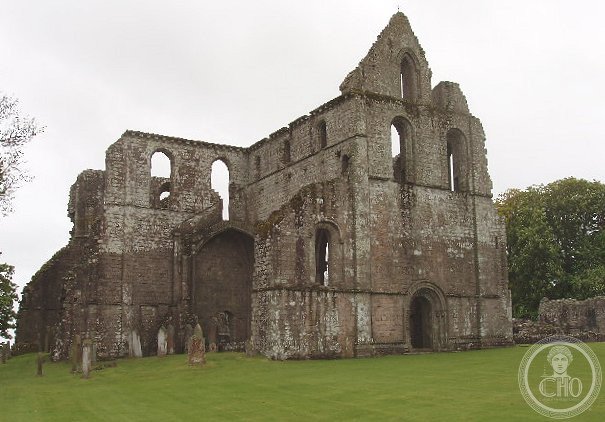
Among the Gothic ruins of a Cistercian abbey founded in the twelfth century, a fleeing queen spent her last night in Scotland before her exile in England.
At a glance
Dundrennan Abbey is a ruined Cistercian monastery in Dumfries and Galloway, in south-west Scotland, founded in 1142. It is best known for two things: the quality of its early Gothic architecture, considered among the finest to survive from Scotland’s thirteen medieval Cistercian houses, and its role in the final chapter of Mary, Queen of Scots’ life north of the border. On 15 May 1568, after her defeat at the Battle of Langside, the queen spent her last night on Scottish soil within these walls before crossing the Solway Firth into what would become permanent English captivity. Today the abbey survives as a substantial ruin under the care of Historic Environment Scotland, its transepts and chapter house still legible against the Galloway skyline.
Key facts
- Founded: 1142, by Fergus, Lord of Galloway, with the support of King David I of Scotland
- Order: Cistercian, colonised by monks from Rievaulx Abbey in Yorkshire
- Occupied: continuously for roughly 400 years until the Reformation
- Architecture: early Gothic transept and chapter house, unusual three-storey elevation with blind and open arcading
- Royal episode: Mary, Queen of Scots’ last night in Scotland, 15 May 1568
- Crown transfer: abbey lands passed to the Crown in 1587 after the Reformation
- Managed by: Historic Environment Scotland, as a scheduled monument
History
Dundrennan Abbey was founded in 1142 by Fergus, Lord of Galloway, with backing from King David I, part of a wave of Cistercian foundations that reshaped monastic Scotland in the twelfth century. The first community of white-robed monks came from Rievaulx Abbey in North Yorkshire, bringing with them the strict Cistercian rule of manual labour, silence and architectural austerity. For roughly four centuries the abbey functioned as a working religious house, its monks farming the surrounding Galloway land and maintaining the round of daily offices in a church built to the standard Cistercian cross-shaped plan, though unusually elaborated with a three-storey internal elevation of blind and open arcades.
The abbey’s best-documented moment arrived in 1568, at the very end of its monastic life. Mary, Queen of Scots, fleeing after her defeat at the Battle of Langside, was received at Dundrennan on 15 May and spent her final night in Scotland within its precinct. From nearby Port Mary she crossed the Solway Firth to Workington in Cumbria, stepping onto English soil and into the custody that would end, nineteen years later, at Fotheringhay. The Reformation had already begun to dissolve the community’s religious purpose, and by 1587 the abbey’s lands were formally transferred to the Crown; the buildings were subsequently stripped and, for a period, put to use sheltering livestock, accelerating their decay.
Archaeological excavation in the 1990s, funded by the predecessor body to Historic Environment Scotland, uncovered the south-east corner of the cloister, revealing a warming house, novices’ quarters, drainage channels and latrine structures, and establishing five distinct phases of construction spanning roughly 1170 to 1600. That work confirmed Dundrennan as one of the most thoroughly understood Cistercian sites in Scotland, even in ruin.
What you see
What survives at Dundrennan today is concentrated in the transepts and the chapter house, generally regarded as the finest early Gothic fabric among Scotland’s thirteen Cistercian abbeys. The transept walls rise through three distinct storeys — arcade, gallery and clerestory — an elevation more commonly associated with major Gothic cathedrals than with the deliberately plain Cistercian house-style, and it is this ambition, executed in silvery-grey sandstone, that gives the ruin its visual weight. Blind arcading alternates with open arches punched through to let light fall across the empty nave, and carved capitals, some still crisply cut, mark the transition from Romanesque massing to Gothic verticality.
The chapter house, where the community would have gathered daily for readings and monastic business, retains its footprint clearly enough to read the room’s original proportions, while excavated foundations to the south-east trace the domestic ranges — warming house, dormitory undercroft, latrine block — that once supported the monks’ daily routine. Little of the nave’s full height survives, but the fragments that do, set against open grass and the wooded valley of the Abbey Burn, give an unusually direct sense of a Cistercian house built for permanence rather than display, right up until the moment history intervened.
Practical information
- Opening hours: daily, 10:00–16:30, 1 April – 30 September (closed 1 October – 31 March); last entry 30 minutes before closing
- Tickets: adult £6.00, child (7–15) £3.50, concession £4.50; Historic Environment Scotland members free
- Time needed: allow 45–60 minutes to see the transepts, chapter house and excavated cloister range
Getting there
Dundrennan Abbey sits in the village of Dundrennan, on the A711 about 8 km south-east of Kirkcudbright and 10 km south-west of Castle Douglas, in Dumfries and Galloway. There is no direct rail link; the nearest mainline station is Dumfries, roughly 40 km away, from which the site is reached by car or local bus toward Kirkcudbright. By road, it is about a 25-minute drive from Dumfries via the A75 and A711. The nearest airports are Glasgow Prestwick and Glasgow International, both around a two-hour drive. GPS: 54.806874, -3.947952.
Nearby
- Sweetheart Abbey, New Abbey — another Cistercian ruin founded from Dundrennan’s sister house, about 25 km north
- Glenluce Abbey, near Stranraer — the third Galloway Cistercian foundation linked to Dundrennan’s monastic network
- Threave Castle, near Castle Douglas — 14th-century island stronghold of the Black Douglases
- MacLellan’s Castle, Kirkcudbright — a late-16th-century town residence on the River Dee
Sources
- Historic Environment Scotland, “Dundrennan Abbey: History”, historicenvironment.scot
- Historic Environment Scotland, “Dundrennan Abbey: Prices and Opening Times”, historicenvironment.scot
- Wikipedia, “Dundrennan Abbey”
- Undiscovered Scotland, “Dundrennan Abbey Feature Page”
Find it on the map
See this place and what’s around it →📷 Become a Cultural Heritage Online photographer
Share your photos of places: they stay published under your name as the author. The more they're seen, the more you get noticed — and soon a contest will reward the most appreciated photos.
Log in or sign up free to add a photo