
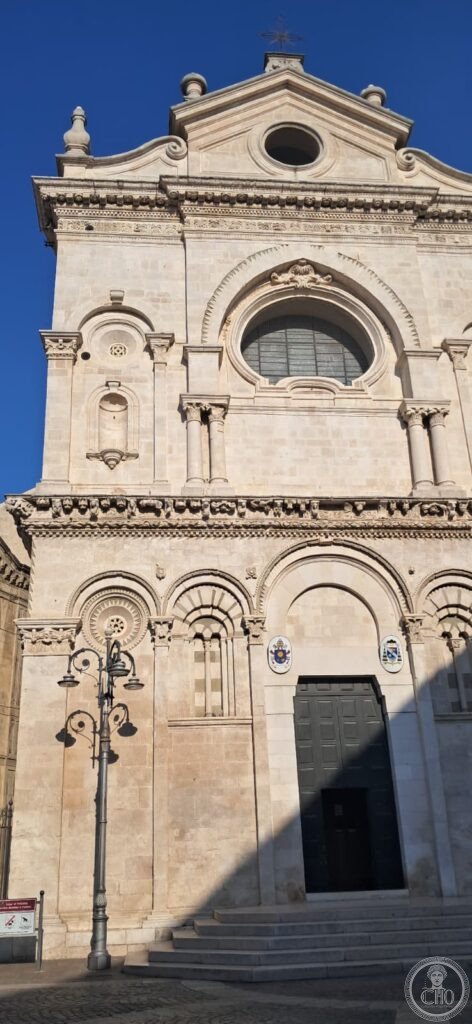
Beneath the plain of the Tavoliere, the crypt commissioned by Robert Guiscard still holds the Iconavetere, the wooden icon to which the city of Foggia owes its name and its origin.
At a glance
The Cathedral of Foggia, dedicated to the Assumption of the Virgin and popularly known as Santa Maria Icona Vetere, stands on the site of an earlier structure commissioned by Robert Guiscard in 1081, whose crypt survives beneath the present church. The larger building above it was raised in 1172 under William II of Sicily in the Apulian Romanesque style, with a facade whose lower register still shows Pisan-influenced stonework. A powerful earthquake in 1731 badly damaged the upper structure, and the reconstruction that followed gave the cathedral its present Baroque bell tower and much of its interior decoration, leaving a building that reads, front to back, as two centuries of Puglia’s architectural history layered on top of one another. The cathedral has been the seat of the Archdiocese of Foggia-Bovino since the dioceses of Foggia and Bovino were merged in 1986.
Key facts
- Earliest structure: crypt commissioned by Robert Guiscard in 1081 to house the Icona Vetere, still accessible beneath the present church
- Main church: built from 1172 under King William II of Sicily, in Apulian Romanesque style with Pisan facade influences
- 1731 earthquake: severely damaged the upper facade and interior, rebuilt in Baroque style, including the current bell tower
- Bell tower: four-storey Baroque campanile roughly 50 metres tall, added after the 18th-century reconstruction
- Icona Vetere: an ancient wooden panel of the Madonna enthroned with Child, known locally as the Madonna dei Sette Veli (Madonna of the Seven Veils), venerated in its own chapel beside the presbytery behind a bronze grille and a late 17th-century marble altar
- Status: minor basilica since 1806; became the cathedral of the newly created Diocese of Foggia in 1855; declared a national monument in 1940
History
According to local tradition, the origins of Foggia itself are tied to the discovery of the Icona Vetere, an ancient icon of the Virgin said to have surfaced from marshland near the settlement in the eleventh century, wrapped in cloth as if hidden from destruction. The devotion that grew around the image shaped the young town’s identity long before it had a cathedral to match, and Robert Guiscard’s 1081 foundation was built specifically to give the icon a permanent home, in what is now the church’s crypt, known as the Succorpo.
Ninety years later, William II of Sicily ordered a larger collegiate church built directly over that crypt, completed by 1172 in the restrained, Pisan-inflected Romanesque style typical of Puglia’s Norman-era cathedrals: dressed stone, blind arcading, and a sober main portal. The building served for centuries as a collegiate church rather than a cathedral, since Foggia belonged ecclesiastically to the diocese of Troia until the nineteenth century.
The 1731 earthquake, one of the most destructive to strike the Capitanata region, tore through the upper facade and much of the interior, and the reconstruction that followed reshaped the building in the Baroque taste of the period, adding the current bell tower and stucco-decorated dome over the Latin-cross nave. Recognition followed the rebuilding: Pope Pius VII granted the church minor basilica status in 1806, and when the Diocese of Foggia was created in 1855, this building became its cathedral. It was raised to an archdiocese in 1979 and merged with the neighbouring Diocese of Bovino in 1986 to form the present Archdiocese of Foggia-Bovino.
What you see
The lower facade is the clearest surviving Romanesque element: an ornate stone cornice carved with figures and animals, attributed to the sculptor Bartolomeo da Foggia, frames a sequence of blind arches decorated with two-light windows (bifore) and small round oculi around the main portal, while the side Portal of San Martino preserves further medieval carving. Above this register, the Baroque rebuilding after 1731 added a taller, more ornamented upper facade and the freestanding bell tower, so the building’s silhouette shifts noticeably from austere Romanesque base to exuberant eighteenth-century crown.
Inside, the Latin-cross plan opens into a nave covered by a stucco-decorated dome, itself a product of the post-earthquake rebuilding, while the real historical anchor of the church lies below: the medieval crypt, with capitals carved in a style close to that of other Capitanata Romanesque churches, and the adjoining chapel of the Icona Vetere, where the venerated panel sits behind a bronze grille beneath a marble altar dated to the late seventeenth century.
Practical information
- Opening hours: generally open to visitors Monday to Saturday, approximately 7:00-13:00 and 16:00-19:00, with adjusted hours on Sundays around Mass times; confirm with the Archdiocese of Foggia-Bovino before visiting
- Tickets: free entry to the church and the Icona Vetere chapel
- Time needed: about 30-45 minutes, including the crypt
Getting there
Foggia is a main stop on the Adriatic railway line linking Bari, Bologna and Rome, with the cathedral about a 15-minute walk from Foggia Centrale station through the historic centre. Foggia’s Gino Lisa Airport handles domestic flights, and Bari Karol Wojtyła Airport, roughly an hour away by car via the A14, is the main international gateway for the area. By car, Foggia sits on the A14 motorway and the SS16. GPS: 41.4635° N, 15.5439° E.
Nearby
- Cattedrale di Lucera — about 20 km west; the Gothic-Angevin cathedral built by Charles II of Anjou over the site of Lucera’s former Saracen settlement
- Cathedral of Santa Maria Assunta, Troia — roughly 20 km southwest; the Romanesque cathedral Foggia’s own church answered to ecclesiastically before 1855
- Fortezza svevo-angioina and Roman Amphitheatre, Lucera — Frederick II’s hilltop fortress and the region’s Roman-era amphitheatre, both a short drive from Foggia
Sources
- Wikipedia — “Cattedrale di Foggia” (it.wikipedia.org) and “Foggia Cathedral” (en.wikipedia.org)
- Catalogo dei Beni Culturali, Ministero della Cultura — “Chiesa Cattedrale di Foggia” (catalogo.cultura.gov.it)
- Archdiocese of Foggia-Bovino — parish and Mass-time information (diocesifoggiabovino.it)
Find it on the map
See this place and what’s around it →📷 Become a Cultural Heritage Online photographer
Share your photos of places: they stay published under your name as the author. The more they're seen, the more you get noticed — and soon a contest will reward the most appreciated photos.
Log in or sign up free to add a photoIs this page about you?
This page is read by travellers and heritage enthusiasts who find it on Google. Tell us how you are connected to this place and we will take it from there.