

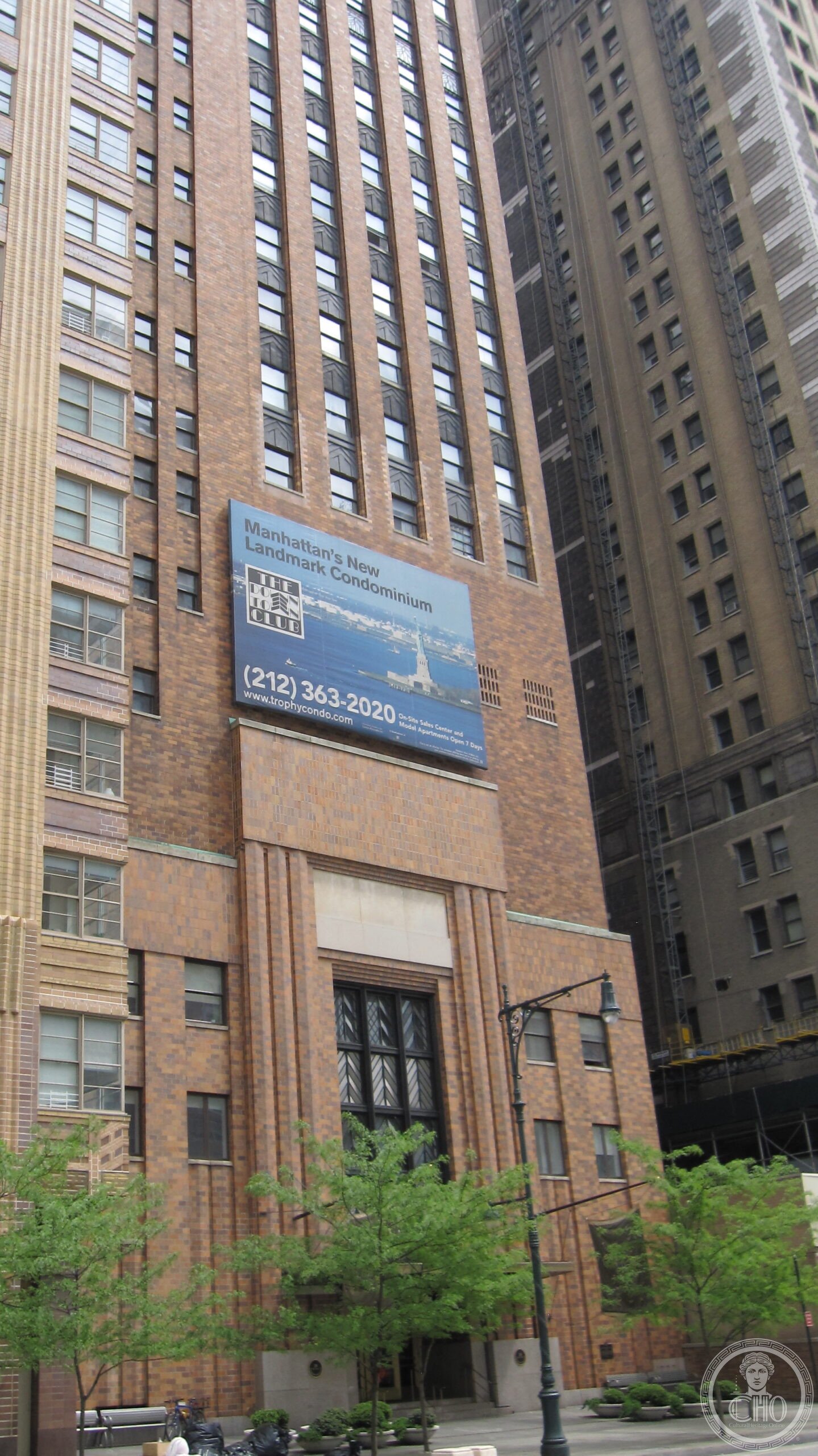
An Art Deco tower that stacked a complete urban athletic world thirty-five floors above Lower Manhattan — and became one of architecture’s most dissected essays on the improbable logic of the New York skyscraper.
At a glance
The Downtown Athletic Club opened in 1930 at 19 West Street, a block from Battery Park and the southern tip of Manhattan. Designed by the firm Starrett & Van Vleck, the 35-story tower was conceived as a vertical campus for sports and sociability: boxing rings, a swimming pool, a golf driving range, handball courts, and a gymnasium were distributed across its upper floors, each sport at a different elevation above the city. The building became famous decades after its construction when architect Rem Koolhaas used its cross-section as the central exhibit in his 1978 manifesto Delirious New York, reading the Athletic Club as proof that the skyscraper had freed urban life from the constraints of the ground plane. The Heisman Trophy, college football’s highest individual honor, was first awarded here in 1935.
Key facts
- Completed: 1930
- Architect: Starrett & Van Vleck
- Address: 19 West Street, Lower Manhattan, New York, NY 10004
- Height: approximately 35 stories
- Style: Art Deco
- Historic designation: National Register of Historic Places (New York City Landmarks)
- First Heisman Trophy ceremony: December 9, 1935
History
Starrett & Van Vleck — the firm responsible for Lord & Taylor on Fifth Avenue and Saks Fifth Avenue — brought a retailer’s understanding of vertical circulation to the Downtown Athletic Club commission. The building’s clients were the businessmen of Lower Manhattan’s financial district, a world that still ran on face-to-face trading, long lunches, and physical proximity. The Athletic Club was designed to provide everything those men needed without leaving the financial district: a gym before the opening bell, a boxing match after it, a swim on the way back uptown.
The Heisman Trophy connection came in 1935 when the Downtown Athletic Club established the award to honor college football’s outstanding player. The first trophy went to Jay Berwanger of the University of Chicago. The Downtown Athletic Club administered the award until 2002, when the club closed — the last of the private athletic clubs that had once made the skyscraper a complete civic world.
Rem Koolhaas’s 1978 reading of the building elevated it from a curiosity to an architectural argument. His cross-section showed a different program on every floor — the golf driving range on the third, the pool twelve floors above that, the boxing ring near the roof — as evidence that the Manhattan skyscraper had not merely added stories to an existing building type but invented an entirely new one: a vertical city-block that could contain whatever its owners needed, stacked in any order that suited the structural frame.
What you see
The West Street facade reads as a narrow tower of orange-red brick with Gothic-inflected limestone tracery at the upper setbacks — a treatment common in 1930 Manhattan, when the Gothic and the modern had not yet fully separated. The building steps back in profile as it rises, following the 1916 zoning envelope that shaped most Art Deco towers below Midtown. The lobby, when accessible, retains its original Art Deco metalwork: elevator surrounds in bronze with stylized geometric ornament, a marble floor with inlaid pattern, and lighting fixtures in the period manner.
From the street the building’s most legible feature is the contrast between the relatively slender tower — typical for the financial district block it occupies — and the variety of window sizes that betray the unusual internal program. A gymnasium requires a different window rhythm than a bedroom; a swimming pool has different glazing needs than an office. That variety, visible from the sidewalk, is the architectural record of Koolhaas’s reading: a building whose exterior says “normal tower” while its interior proposes something else entirely.
Practical information
- Access: Converted to residential; lobby not publicly accessible
- Best time to visit: Exterior viewable any time; photograph from the West Street sidewalk or Battery Park promenade
- Nearest subway: 1 train to Rector Street; R/W to Whitehall Street; 4/5 to Bowling Green
- Time needed: 20–30 minutes for exterior photography; combine with Battery Park waterfront walk
Getting there
19 West Street stands on the western edge of Lower Manhattan, facing Battery Park across West Street. The nearest subway stations are Rector Street (1 train), Whitehall Street (R, W), and Bowling Green (4, 5). JFK Airport is approximately 45 minutes by A train to Howard Beach, then AirTrain; LaGuardia is 30–40 minutes by taxi or express bus. The Staten Island Ferry terminal at Whitehall Street is two blocks north.
Nearby
- One Wall Street / Irving Trust Building (1931) — Gothic-Art Deco tower three blocks northeast; stunning mosaic banking hall interior
- Woolworth Building (1913) — Cass Gilbert’s Gothic commercial cathedral, six blocks north on Broadway
- Battery Park — waterfront park at the southern tip of Manhattan, one block west; views to Ellis Island and the Statue of Liberty
- Museum of Jewish Heritage — Battery Park City, ten-minute walk northwest
Sources
- Rem Koolhaas, Delirious New York: A Retroactive Manifesto for Manhattan (1978), Oxford University Press
- New York City Landmarks Preservation Commission designation report
- National Register of Historic Places, Battery Park–Bowling Green district documentation
- Heisman Trophy Trust, official history, heisman.com
Find it on the map
See this place and what’s around it →📷 Become a Cultural Heritage Online photographer
Share your photos of places: they stay published under your name as the author. The more they're seen, the more you get noticed — and soon a contest will reward the most appreciated photos.
Log in or sign up free to add a photoIs this page about you?
This page is read by travellers and heritage enthusiasts who find it on Google. Tell us how you are connected to this place and we will take it from there.