
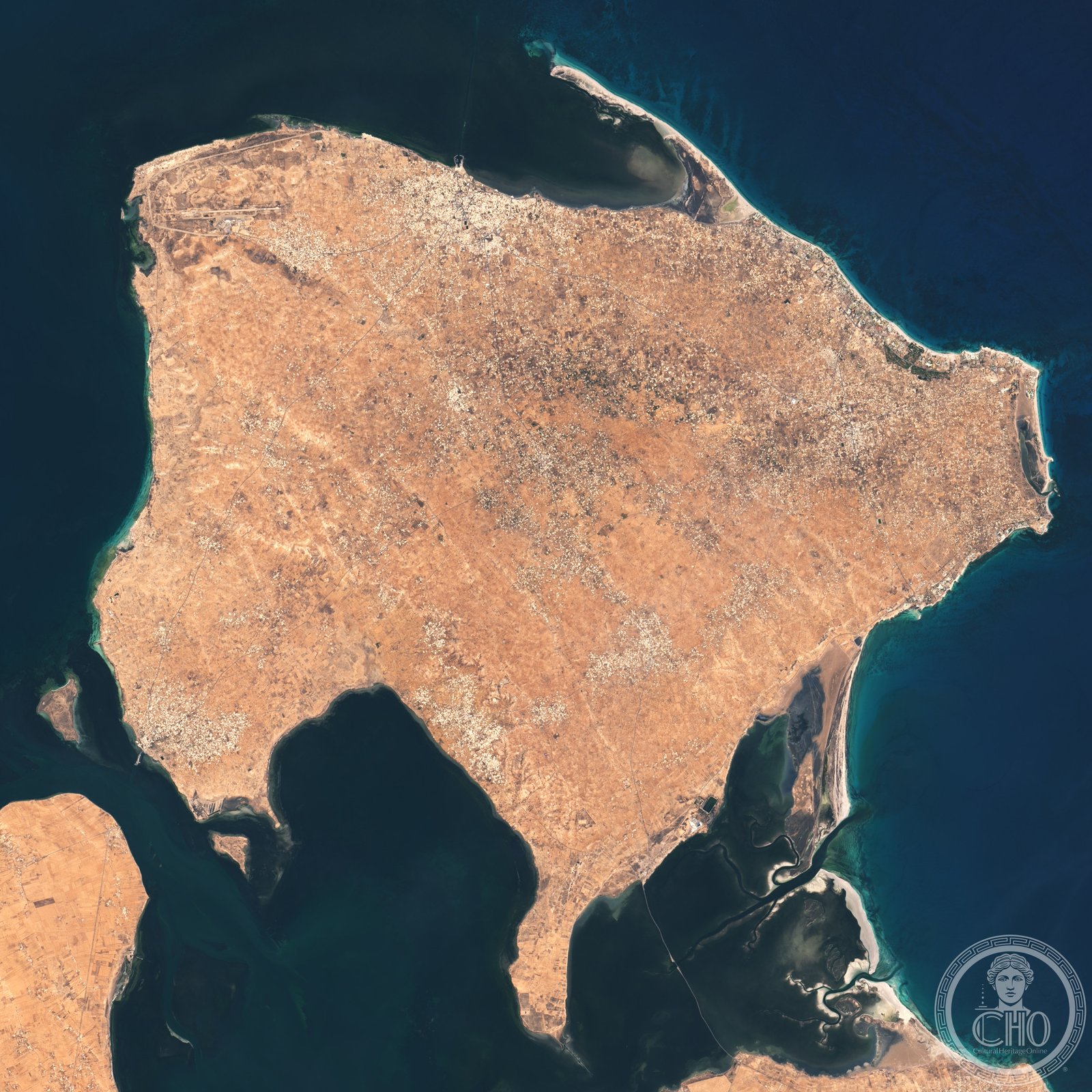
Djerba: Testimony of a Settlement Pattern in an Island
For three thousand years, no conqueror has erased Djerba — Berbers, Phoenicians, Romans, Jews, Arabs, and Ottomans each added a layer to the same ancient landscape. A UNESCO World Heritage Site since 2023, inscribed not for any single building but for an entire living island civilization.
At a glance
Djerba is the largest island of North Africa, lying off the southeastern coast of Tunisia in the Gulf of Gabès. Its UNESCO World Heritage inscription in 2023 recognizes something rare: not a palace, a cathedral, or an archaeological site, but an entire settlement system — 3,000 years of continuous human occupation expressed in a landscape of dispersed farmsteads, over 200 small mosques, olive groves, and two exceptional cultural anchors: the El Ghriba Synagogue, among the oldest in the world, and the Borj Ghazi Mustapha Ottoman fort. The island has no traditional city centre. Its people have always lived scattered across the land in farmstead-compounds (menzel), each with its own mosque — a spatial pattern unchanged since Antiquity.
Key facts
- UNESCO inscription: 2023 (World Heritage List)
- Location: Gulf of Gabès, southeastern Tunisia
- Island area: 514 km²
- Continuous occupation: approximately 3,000 years
- El Ghriba Synagogue: possibly the oldest synagogue in Africa; present building dates to 1920
- Borj Ghazi Mustapha: Ottoman fort, 16th century CE
- Number of mosques: over 200 (menzel mosques, each serving a farmstead cluster)
- Coordinates: 33.8750°N, 10.8500°E (Erriadh / El Ghriba Synagogue)
History
Djerba’s oldest layers are Berber. The island’s indigenous inhabitants built the dispersed farmstead pattern — the menzel system — that has defined Djerba ever since. Phoenician traders established a presence from around the 8th century BCE; the Romans called it Meninx and exploited its famous garum (fish sauce) industry and textile workshops. A tradition identifies Djerba with the land of the Lotus-Eaters in Homer’s Odyssey — a story that tells you more about the island’s reputation for disarming hospitality than about any historical fact.
Jewish communities arrived on Djerba in waves: one tradition places the first settlement after the destruction of the First Temple of Jerusalem in 586 BCE; another after the Second Temple’s fall in 70 CE (the El Ghriba Synagogue supposedly contains stones from the Second Temple). What is certain is that by the medieval period, Djerba had an ancient and distinctive Jewish community — the Kohanim of Hara Kbira — speaking Judeo-Berber and maintaining traditions that predated Talmudic standardization.
Arab conquest in the 7th century CE brought Islam and Arabic to the island without erasing its prior character. The Ibadi sect — a branch of Islam neither Sunni nor Shia, older than both — took root in Djerba and survives there today. The Ibadi tradition explains many of the island’s 200+ small mosques: Ibadi communities built small, plain mosques for each farmstead cluster rather than large congregational ones, generating the dispersed landscape that UNESCO inscribed.
The Normans briefly held Djerba in the 12th century. The Ottomans consolidated control in the 16th century and built the Borj Ghazi Mustapha fort at Houmt Souk. Under Ottoman and later French colonial rule, Djerba’s cosmopolitan character — Berber, Jewish, Arab, Ottoman — persisted, making it exceptional among Mediterranean islands.
Mass tourism arrived in the late 20th century but has been concentrated on the northern beach zone, leaving the island’s interior landscape largely intact. UNESCO’s 2023 inscription was a recognition of this survival.
What you see
The island has no single focal monument. Its heritage is the landscape itself: white-washed farmstead-compounds (menzel) scattered across flat terrain between olive groves and palm gardens, each associated with a small plain mosque. The mosques are deliberately austere — whitewashed cubes with minimal ornament, reflecting Ibadi theology’s rejection of ostentation. Their minarets (where present) are square, not round.
The village of Erriadh — formerly called Hara Sghira, the small quarter — is the Jewish quarter of Djerba, home to the El Ghriba Synagogue. The present building (1920) has an ornate interior of blue and white Tunisian tiles, carved wooden ark, and silver lamps — a remarkable contrast to its plain whitewashed exterior. Every spring, Jewish pilgrims from Israel, France, and across the diaspora converge on El Ghriba for the Lag BaOmer pilgrimage.
The Borj Ghazi Mustapha in Houmt Souk is a well-preserved 16th-century Ottoman fort on the harbour. The nearby Musée de Guellala displays the island’s distinctive pottery tradition — unglazed terracotta vessels whose forms have changed little since Antiquity.
Erriadh is also known for a striking contemporary intervention: the Djerbahood street art project (2014), which brought over 150 artists from 30 countries to paint the village walls — a provocative juxtaposition of ancient layers and global contemporary art in a UNESCO-inscribed setting.
Practical information
- El Ghriba Synagogue: open daily except Saturday; modest dress required; entry fee; best visited outside the spring pilgrimage period if crowds are unwanted
- Borj Ghazi Mustapha: open daily; Houmt Souk harbour; no entry fee for exterior
- Djerbahood murals: self-guided walking tour through Erriadh village
- Guellala Museum: southern coast of the island; pottery and island ethnography
- Best season: March–May and September–November; summers are very hot
Getting there
Djerba–Zarzis International Airport (DJE) serves the island with direct flights from France, Germany, Italy, and the UK. The island is also accessible by ferry from Jorf on the mainland (the crossing takes approximately 15 minutes and runs continuously). Houmt Souk is the main town and the island’s transport hub. A hire car or scooter is strongly recommended for exploring the interior landscape: the dispersed menzel pattern makes public transport inadequate for cultural visits.
Nearby
The mainland Tunisian south offers extraordinary complementary sites. Tataouine (the name that inspired George Lucas’s Tatooine) is 100 km from the ferry landing, surrounded by ksar (fortified Berber granary villages) including the spectacular Ksar Ouled Soltane. Matmata, famous for its troglodyte cave dwellings, is 90 km north. The Saharan oasis of Douz and the Grand Erg Oriental are accessible from here.
Sources
- UNESCO World Heritage Committee, Djerba: Testimony of a Settlement Pattern in an Island, inscription 2023, Decision 45 COM 8B.16
- Institut National du Patrimoine (Tunisia), nomination dossier for Djerba, 2023
- Nelly Amri, L’Ibadisme en Ifriqiya, research on Ibadi communities in Tunisia
- Wikipedia, Djerba (accessed 2026)
Find it on the map
See this place and what’s around it →📷 Diventa un fotografo di Cultural Heritage Online
Condividi le tue foto dei luoghi: restano pubblicate con la tua firma come autore. Più vengono viste, più ti fai conoscere — e presto un concorso premierà le foto più apprezzate.
Accedi o registrati gratis per aggiungere una foto