

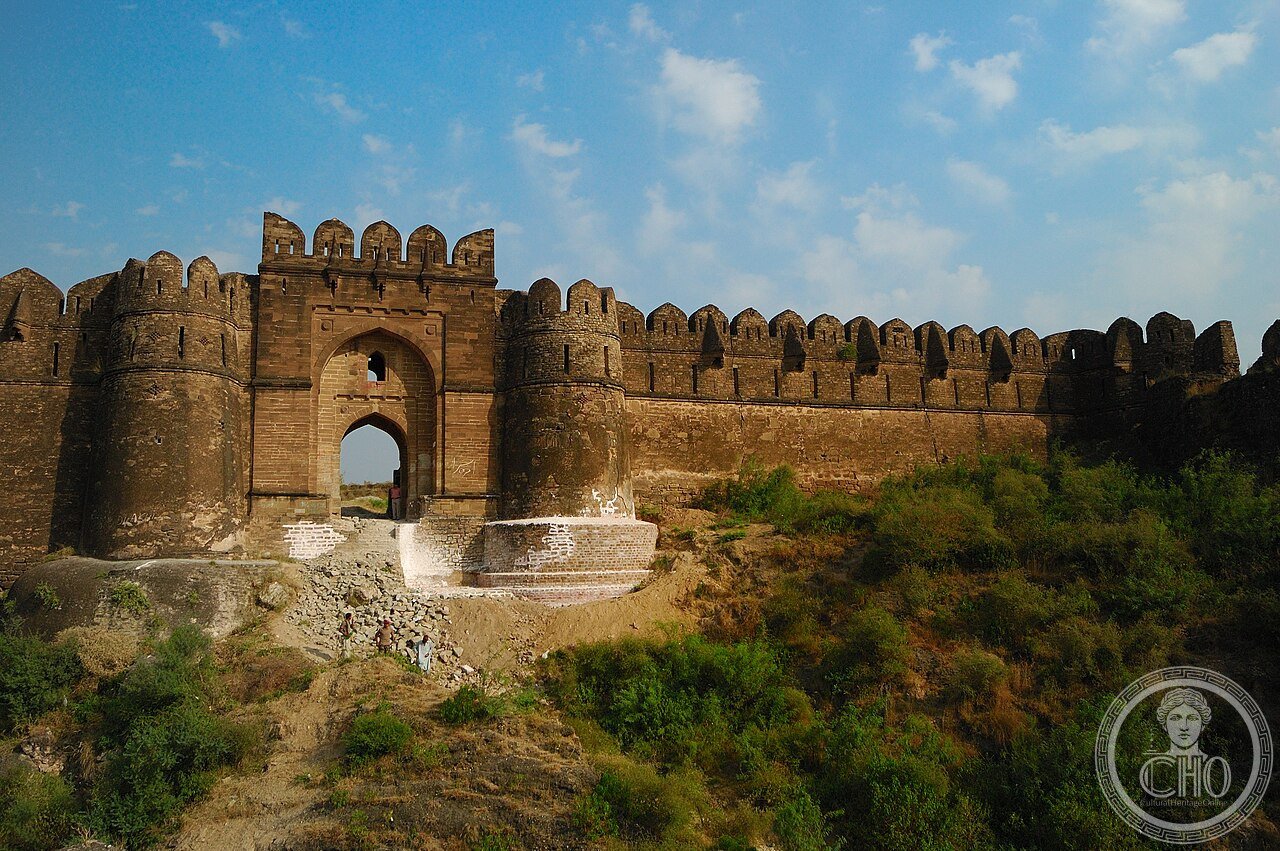
The largest fort ever built in the Indian subcontinent — a 4-kilometre perimeter wall with 68 bastions and 12 massive gates, raised in seven years by the Afghan emperor Sher Shah Suri to control the Punjab routes that a Mughal counterinvasion would need.
At a glance
Rohtas Fort stands in the salt-range hills of Punjab province, approximately 18 kilometres from the city of Jhelum on the Grand Trunk Road. With a perimeter wall of approximately 4 kilometres enclosing an area of 43 square kilometres, pierced by 12 gates and equipped with 68 bastions, it is the single largest fortress ever constructed on the Indian subcontinent. Built between 1541 and approximately 1548 CE to subdue the Gakhar tribe of the Potohar plateau — who remained loyal to the exiled Mughal emperor Humayun — it was so massive and well-sited that the Gakhars never mounted a significant challenge. Inscribed as a UNESCO World Heritage Site in 1997 under criteria II and IV.
Key facts
- Built: 1541–c. 1548 CE by Sher Shah Suri
- Dynasty: Suri Empire (Afghan rulers of North India, 1540–1555)
- Scale: Perimeter wall ~4 km; enclosed area ~43 sq km; 68 bastions; 12 gates
- Tallest gates: Sher Shah Darwaza and Langar Khani Gate, each ~20 m high
- Purpose: Military suppression of Gakhar tribe; control of Punjab–Kashmir routes
- UNESCO WHS: 1997, criteria II and IV
- Location: Near Dina, Jhelum District, Punjab Province, Pakistan
History
In 1540 CE, Sher Shah Suri defeated Humayun at the Battle of Kanauj and drove the Mughal emperor into a fifteen-year exile. His five-year reign was one of the most effective in South Asian history: he reorganised the revenue system, introduced the rupee as a standardised currency, created a postal relay network, and extended and repaired the Grand Trunk Road from Kabul to Bengal — reforms so effective that the Mughal emperors who eventually reconquered the subcontinent adopted them wholesale.
Rohtas was built as a permanent military base to overawe and suppress the Gakhars, who controlled the mountain routes between Punjab, Kashmir, and Afghanistan and remained loyal to the exiled Humayun. Positioned on a rocky promontory overlooking the Kahan River, with cliffs protecting two sides and the massive wall covering the remaining approaches, the fort was designed not to be taken by storm.
After Humayun reconquered Delhi in 1555, the fort passed to Mughal control. Akbar used it as a base during his consolidation of Punjab, and his general Raja Man Singh governed Punjab from the fort in the 1580s. After Mughal decline it passed through various local rulers before coming under British control in the 19th century. The walls and all 12 gates are largely intact today, along with the Shahi Mosque, the haveli of Raja Man Singh, and a functioning stepped well (baoli).
What you see
The overwhelming first impression is scale: the perimeter wall, 10–18 metres high and in places 12 metres thick, runs for 4 kilometres across rocky terrain, reinforced by 68 bastions of varying form. The construction is in coursed rubble masonry with dressed stone facing, designed to resist artillery.
The 12 gates are the architectural highlights. Sher Shah Darwaza, the main gate on the southern approach, stands approximately 20 metres high with flanking octagonal towers and a Persian inscription naming Sher Shah. Langar Khani Gate on the western side bears the remains of a carved elephant facade. Kabuli Gate, facing north toward Kabul, is the most intact and was the ceremonial entrance for armies approaching from Afghanistan.
Inside the walls, the Shahi Mosque survives in good condition, built in dressed stone showing the Suri synthesis of Afghan and Punjabi architectural traditions. The haveli of Raja Man Singh preserves frescoed interiors and carved stone detail.
Practical information
- Access: Open to visitors; basic facilities only
- Best time: October to March (Punjab winters); summers are extremely hot
- Time needed: Half day minimum for main gates; full day for the perimeter walk
- Physical demand: Moderate; terrain is rocky and uneven
- Photography: Outstanding; gates are best in early morning or late afternoon light
- Base: Jhelum city (18 km) or Dina town (5 km) for accommodation
Getting there
The fort is near Dina in Jhelum District. From Jhelum city (18 km), take the Grand Trunk Road (N-5) westward to Dina; the fort is signposted from there. From Rawalpindi/Islamabad (120 km northeast), use the M-2 Motorway to the Dina interchange. The nearest railway station is Jhelum, on the Lahore–Rawalpindi line. From Lahore the drive is approximately 200 km (3 hours via M-2).
Nearby
- Jhelum city — 18 km; base town; site of the ancient Battle of the Hydaspes (Alexander vs. Porus, 326 BCE)
- Tilla Jogian — ~40 km southwest; sacred Hindu mountain monastery, ancient Shaiva pilgrimage destination
- Katas Raj Temples — ~60 km west; Hindu sacred lake complex with ruins spanning multiple historical periods
- Taxila — ~80 km northeast; UNESCO WHS, the greatest Gandharan archaeological complex in Pakistan
- Rawalpindi / Islamabad — ~120 km northeast; national capital region with national museums
Sources
- UNESCO World Heritage List: Rohtas Fort — WHC List 586
- Wikipedia: Rohtas Fort
- Pakistan Archaeology Department, Jhelum District records
Find it on the map
See this place and what’s around it →📷 Become a Cultural Heritage Online photographer
Share your photos of places: they stay published under your name as the author. The more they're seen, the more you get noticed — and soon a contest will reward the most appreciated photos.
Log in or sign up free to add a photo