

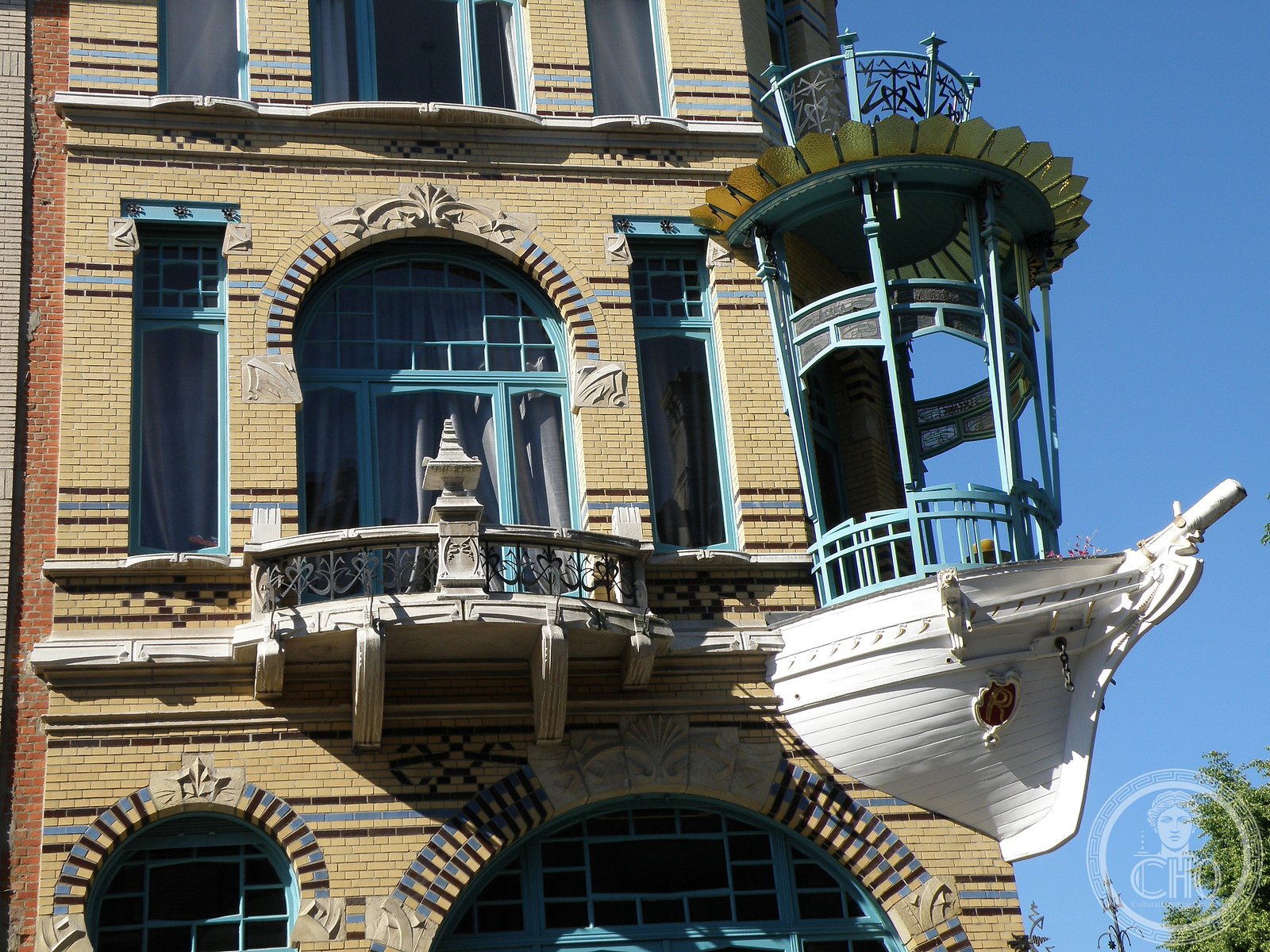
A house named for the five continents, dreamed up by a port city at the height of its trading wealth.
At a glance
De Vijf Werelddelen — the House of the Five Continents — stands on the Schildersstraat in the museum quarter of southern Antwerp, the city’s “Zuid”. It was finished in 1901 to designs by Frans Smet-Verhas, one of the principal architects to work in Art Nouveau in Antwerp. Eccentric and exuberant, the house is one of his two most famous buildings, and it carries the maritime, world-spanning imagination of a port that was then growing rich on global trade. The name itself — the five continents — reads as a merchant city’s view of the world, set into a facade.
Key facts
- Architect: Frans Smet-Verhas
- Finished: 1901
- Style: Art Nouveau
- Location: Schildersstraat, Antwerp Zuid (museum quarter)
- Status: one of Smet-Verhas’s two most famous works
- Theme: a maritime, world-spanning iconography
History
By 1900 Antwerp was one of the great ports of Europe, and its new wealth showed in the houses its citizens built. Frans Smet-Verhas, born in 1851, had begun in eclectic and Flemish Renaissance-revival styles before turning, around 1900, to the new Art Nouveau.
De Vijf Werelddelen, completed in 1901, was one of the results, in the developing quarter south of the Royal Museum of Fine Arts. A few years later, in 1905, the same architect built another celebrated house in the city, the House of the Battle of Waterloo.
The two remain his best-known works, and De Vijf Werelddelen is one of the landmarks of Antwerp’s turn-of-the-century architecture.
What you see
The facade is tall, narrow and frankly theatrical, an Art Nouveau composition that breaks from the calm brick fronts around it with curving lines, sculptural relief and a restless, ornamental surface. It is the work of an architect who used the style for drama rather than restraint.
The house belongs to a moment when Antwerp’s architects competed to give private townhouses the presence of small monuments. Smet-Verhas answered with a building meant to be looked at, its decoration carrying the seafaring, far-horizon theme of its name.
Practical information
- The house is private; the facade is seen from the street.
- It sits in the gallery-and-antiques quarter near the Royal Museum of Fine Arts (KMSKA).
- Time needed: a short stop on an Antwerp Art Nouveau walk.
Getting there
The Schildersstraat is in the Zuid district of Antwerp, a short walk or tram ride south of the centre, beside the Royal Museum of Fine Arts.
Nearby
- The Royal Museum of Fine Arts Antwerp (KMSKA).
- The Art Nouveau townhouses of the Zurenborg district.
- The galleries and cafés of the Zuid.
Sources
- Wikipedia (EN), “Frans Smet-Verhas”.
- Flemish heritage inventory (inventaris.onroerenderfgoed.be).
Find it on the map
See this place and what’s around it →Record researched and written by Luigi De Marchi for Cultural Heritage Online, 2026.
📷 Become a Cultural Heritage Online photographer
Share your photos of places: they stay published under your name as the author. The more they're seen, the more you get noticed — and soon a contest will reward the most appreciated photos.
Log in or sign up free to add a photoIs this page about you?
This page is read by travellers and heritage enthusiasts who find it on Google. Tell us how you are connected to this place and we will take it from there.