
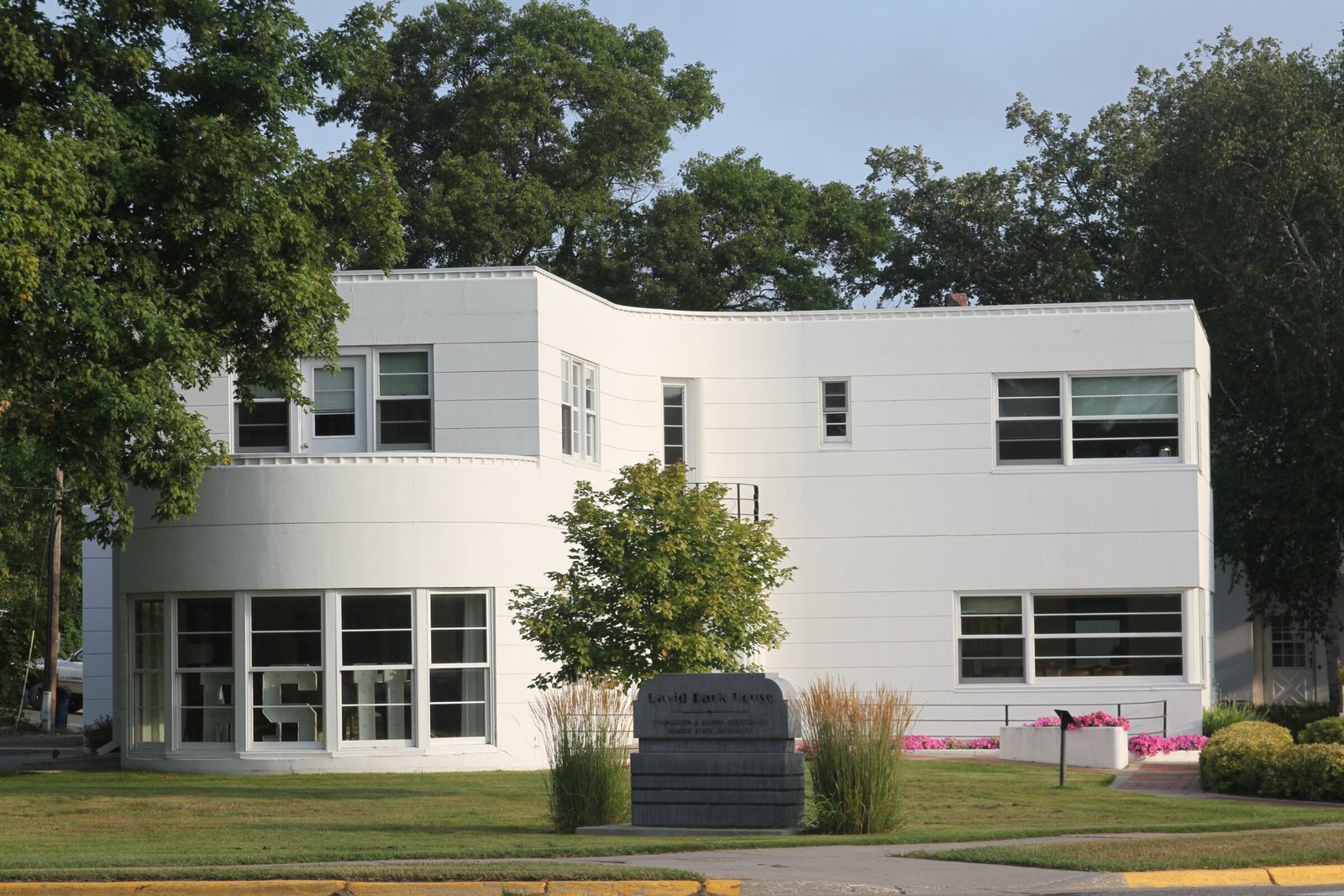
A creamery owner in northern Minnesota built himself a poured-concrete house shaped like a piano when viewed from above — one of the state’s few genuine examples of residential Streamline Moderne.
At a glance
David Park, who purchased the Koors Brothers Creamery in 1926 and rebuilt it as the David Park Creamery, commissioned architect Edward K. Mahlum to design this house in Bemidji, built in 1936-1937 by contractor Adolph C. Nasvick. Wikipedia’s National Register documentation calls it one of Minnesota’s few outstanding examples of residential Streamline Moderne architecture, built of poured concrete — an unusual construction choice for a northern Minnesota home of the period.
Key facts
- Built: 1936-1937
- Architect: Edward K. Mahlum
- Builder: Adolph C. Nasvick
- Style: Streamline Moderne
- Materials: Poured concrete; three-story brass-railed curved staircase
- Address: 1501 Birchmont Drive, Bemidji, Minnesota
- Heritage: NRHP #88000566 (May 16, 1988)
- Current use: Offices of the Bemidji State University Alumni & Foundation (since 1992)
History
David Park built his creamery business into one of the notable local industries of Bemidji, a small city on Lake Bemidji in Minnesota’s north woods, after buying the Koors Brothers Creamery in 1926. His house, built a decade later, translated the streamlined, modern imagery of Art Deco-era industrial design into a private residence at a moment when few homes in the region attempted anything beyond conventional wood-frame construction.
The house left private hands and passed to Bemidji State University, which has used the building as offices for its Alumni & Foundation operations since 1992 — a second life as an institutional building that has kept the house maintained and occupied rather than left to decline. The National Register of Historic Places listed it in 1988, recognizing its rarity as a Minnesota example of the style.
What you see
The house is built of poured concrete, an unusual and expensive choice for a 1930s Minnesota residence, giving its curved walls and streamlined massing a solidity rarely seen in wood-frame Streamline Moderne houses elsewhere. Viewed from above, the plan reads as piano-shaped, and inside, a three-story curved staircase with brass railings carries the streamlined design language from the exterior straight through the building’s core.
Practical information
- Status: Occupied office building (Bemidji State University Alumni & Foundation)
- Best view: From Birchmont Drive, taking in the curved massing
- Photography: Exterior photographable from the public street; interior visits by arrangement with the Foundation office
Getting there
The house stands on Birchmont Drive in Bemidji, Minnesota, on the shore of Lake Bemidji near the Bemidji State University campus. Bemidji Regional Airport is about 3 miles from downtown.
Nearby
- Bemidji State University campus — immediately adjacent
- Lake Bemidji — shoreline near Birchmont Drive
- Paul Bunyan and Babe the Blue Ox statues, downtown Bemidji — a short drive away
Sources
- Wikipedia: David Park House
- National Register of Historic Places, NRHP #88000566 (May 16, 1988)
Find it on the map
See this place and what’s around it →Record researched and written by Luigi De Marchi for Cultural Heritage Online, 2026.
📷 Become a Cultural Heritage Online photographer
Share your photos of places: they stay published under your name as the author. The more they're seen, the more you get noticed — and soon a contest will reward the most appreciated photos.
Log in or sign up free to add a photoIs this page about you?
This page is read by travellers and heritage enthusiasts who find it on Google. Tell us how you are connected to this place and we will take it from there.