

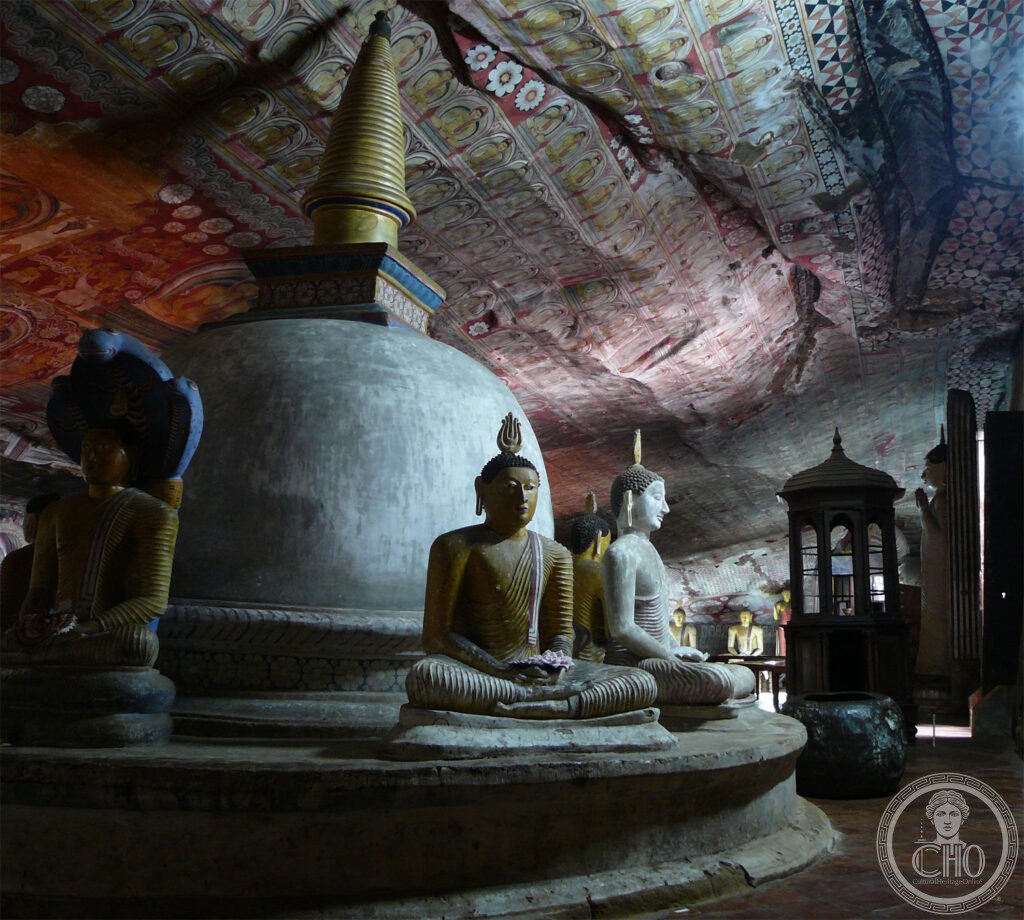
The finest Buddhist cave shrine complex in South Asia — five cave-temples carved into a 160-metre granite massif above the Sri Lankan plain, whose ceilings and walls are covered with 2,100 square metres of Buddhist painting (the largest surviving body of Sri Lankan cave art), and whose interiors contain 157 ancient Buddha statues; a place of uninterrupted pilgrimage for 2,000 years, from the time of King Vattagamani Abhaya who took refuge here during the first century BC to the present day.
At a glance
The Golden Temple of Dambulla (Sinhalese: ෂක්ඔ සක්වුඹය, Ran Giri Dambulla Rajamaha Viharaya) is a Buddhist cave-temple complex in Dambulla, North Central Province, Sri Lanka, approximately 148 km north of Colombo. The complex consists of five cave-shrines (Caves I–V) cut into a large granite rock face rising 160 metres above the surrounding plain; the caves date from the 1st century BC (the earliest paintings) through the 18th century Kandyan period (the most recent renovations of the cave interiors). The entire internal surface of the five caves is covered with Buddhist paintings (2,100 m²) and 157 Buddha statues and other sculptural images, many of them gilt. The site is the most important pilgrimage site in Sri Lanka after Kandy; it is visited by approximately one million pilgrims annually. UNESCO inscribed the Golden Temple of Dambulla in 1991.
Key facts
- The five caves: Cave I (Devaraja Lena, “Cave of the Divine King”) is the largest cave, 9 metres high; it contains a 15-metre reclining Buddha in the parinirvana position, the pose of death and final liberation, flanked by statues of the Hindu gods Vishnu and Ananda, the Buddha’s attendant, with ceiling paintings in good condition. Cave II (Maharaja Lena, “Cave of the Great Kings”) is the largest and most elaborate, with 52 statues including a large seated Buddha and standing Buddhas, and the most complete paintings. Cave III (Maha Alut Viharaya, “Great New Temple”) was added in the 18th century under the Kandyan kings. Cave IV is the Pachima Viharaya, “Western Temple”. Cave V (Devana Alut Viharaya, “Second New Temple”) is the most recently added cave, 19th century.
- The paintings: the 2,100 m² of paintings on the ceilings and walls of the five caves represent the most comprehensive surviving body of Sri Lankan Buddhist cave art; the earliest paintings date from the 1st century BC (Cave II); the most recent are Kandyan-period (18th century, Cave III); the predominant style is the Kandyan school — rich colours, fluid outlines, flattened perspective; the subjects are Jataka tales (the 550 previous lives of the Buddha), events from the Buddha’s life, portraits of the Kandyan kings, and narrative scenes from Sri Lankan history; the paintings were restored in the 1930s (not always faithfully to the originals) and are currently being conservation-documented.
- King Vattagamani Abhaya (89–77 BC): the tradition that the cave shrines were first established as a refuge for King Vattagamani Abhaya during his 14-year exile (when the Chola kings of South India temporarily occupied Anuradhapura) is the foundation legend of the site; after recovering his throne, the king dedicated the caves to the Buddhist Sangha and adorned them with paintings and sculptures — a pattern that all subsequent rulers of Sri Lanka have followed (the caves function as a register of the gratitude of kings to the Buddha).
- The Golden Temple at the base: the modern Golden Temple (the large cave-temple building with a golden exterior at the base of the rock, not the ancient cave-shrines at the top) was built in 1938 and renovated in 2000; it has a museum of the cave-art history (ground floor) and a golden-painted exterior that is the most photographed element of Dambulla from a distance; entry tickets to the ancient caves (at the top of the rock) are sold at the base; the climb to the cave-shrines is approximately 30 minutes on foot (350 steep stone steps).
- Heritage: UNESCO World Heritage Site, Golden Temple of Dambulla, inscribed 1991.
- GPS: 7.8567° N, 80.6493° E.
History
The caves of Dambulla have been inhabited by Buddhist monks since at least the 3rd century BC; the construction of painted shrine-caves here follows a pattern of Buddhist rock-cut architecture found across South Asia (Ajanta, Ellora, Bhaja) but the Dambulla complex is unusual in remaining a continuously active place of Buddhist practice from its earliest phase to the present. The caves were expanded and renovated by every major Sri Lankan royal dynasty: the early Anuradhapura kings (1st century BC–10th century AD) established the cave shrines; the Polonnaruwa kings added the Cave of the Great Kings (Cave II); the Gampola kings refurbished the site in the 14th century; and the Kandyan kings undertook the most extensive renovation in the 18th century, adding new caves (Cave III) and repainting the earlier cave interiors.
The cave shrines narrowly survived the Portuguese conquest of Sri Lanka’s lowlands in the 16th century; the Portuguese Catholic missionaries destroyed several Buddhist temples on the coast, but their reach did not extend to Dambulla in the highland interior. The British colonial period (1815–1948) brought Western scholars to the site: the paintings were documented in detail by W.H. Siddons (1874) and subsequently by Ananda Coomaraswamy (the seminal Sri Lankan art historian) in his Medieval Sinhalese Art (1908). The UNESCO inscription in 1991 was followed by a conservation assessment that identified the 1930s restorations as problematic (they overpainted some of the original paint layers with synthetic pigments); conservation work is ongoing.
What you see
The climb to the cave shrines (350 stone steps cut into the rock face, 30 minutes, shaded in part) passes through a colony of toque macaques (wild monkeys who have been present at the site for at least 500 years and are described in 16th-century chronicles); the final section of the approach gives a wide view of the Sri Lankan plain to the north, with Sigiriya Rock visible 17 km away. The cave entrance is framed by a modern verandah (added in the 20th century) that somewhat compromises the ancient experience but provides shade; shoes must be removed before entering the caves.
Inside Cave II (the best to begin with, the largest and most complete), the eyes adjust slowly to the interior light — the caves have no artificial lighting, and the paintings are lit by the diffused daylight entering through the cave mouth and the verandah; bring a torch or use a phone torch to see the ceiling paintings in detail. The 15-metre reclining Buddha in Cave I (parinirvana pose) is the most imposing single object; the standing Buddhas (approximately 40 of them in Cave II, ranging from 2 to 5 metres in height, all carved in white granite and gilded or painted) create an overwhelming visual density. The paintings reward very close examination: individual Jataka scenes are painted with narrative detail at human scale, and the repetition of the Buddha image in slightly varying poses across the cave ceiling creates a meditative effect.
Practical information
- Admission: LKR 1,500 (approximately €4.50) for non-Sri Lankan visitors; the ticket includes both the Golden Temple museum at the base and the ancient cave-shrines at the top; the caves are open daily 7 am–7 pm; the early morning visit (7–9 am) is quietest and the light quality (diffused through the cave entrance) is best; late afternoon (4–6 pm) also good light and fewer group tours; midday is very crowded with Sri Lankan school groups and tour buses.
- Getting there: Dambulla is 148 km north of Colombo (2.5–3 hours by car or bus from Colombo); on the main A9 road from Colombo to Jaffna; regular buses from Colombo Central Bus Terminal and from Kandy (1.5 hours); the cave temple is 1 km from the Dambulla town centre; tuk-tuk from the bus station; most Sri Lanka tours combine Dambulla with Sigiriya on the same day (Sigiriya is 17 km north-east).
- Dress code: modest dress required (shoulders and knees covered; sarongs available for rent at the entrance); shoes off throughout the site; the stone steps are steep in places (assist for visitors with mobility limitations); the site is accessible in dry season (January–April, July–September) and wet season (October–December, May–June) but the monsoon rain makes the steps slippery.
Getting there
148 km north of Colombo on the A9 road (2.5–3h). Bus from Colombo or Kandy (1.5h from Kandy). Usually combined with Sigiriya (17 km north-east). GPS: 7.8567, 80.6493.
Nearby
- Sigiriya Rock Fortress — 17 km north-east of Dambulla (25 minutes by car); the 5th-century AD palace-fortress built on a 200-metre volcanic rock by King Kasyapa; the water gardens, the lion-paw staircase entrance, the frescoes of the Cloud Maidens, and the mirror-smooth plastered outer walls are the main elements; UNESCO WHS 1982; combine with Dambulla for a single cultural loop from Kandy.
- Polonnaruwa — 100 km north-east of Dambulla (2 hours); the medieval capital of Sri Lanka (11th–13th century AD), with the most important surviving Buddhist monuments in South Asia: the Rankoth Vehera (the tallest stupa in Sri Lanka at 55 metres), the Vatadage (a circular relic house with the most refined sculptural decoration in Sri Lanka), and the Gal Vihara (four giant Buddhist images cut from a single granite face — a 15-metre reclining parinirvana Buddha, a 7-metre standing Buddha, two seated Buddhas); UNESCO WHS 1982.
- Anuradhapura — 90 km north of Dambulla (2 hours); the ancient capital of Sri Lanka (3rd century BC–10th century AD) with the earliest stupas in Sri Lanka (the Ruwanwelisaya stupa, the Jetavanaramaya — once the third-tallest structure in the ancient world — and the Thuparamaya, the oldest stupa in Sri Lanka); UNESCO WHS 1982.
Sources
- Wikipedia, Dambulla cave temple; Golden Temple of Dambulla, accessed June 2026.
- UNESCO, Golden Temple of Dambulla, WHS reference 561, inscribed 1991.
- Ananda Coomaraswamy, Medieval Sinhalese Art, Essex House Press, 1908 (repr. Munshiram Manoharlal, 1979).
- H.C.P. Bell, Report on the Kegalle District, Archaeological Survey of Ceylon, 1904.
Find it on the map
See this place and what’s around it →📷 Become a Cultural Heritage Online photographer
Share your photos of places: they stay published under your name as the author. The more they're seen, the more you get noticed — and soon a contest will reward the most appreciated photos.
Log in or sign up free to add a photoIs this page about you?
This page is read by travellers and heritage enthusiasts who find it on Google. Tell us how you are connected to this place and we will take it from there.