
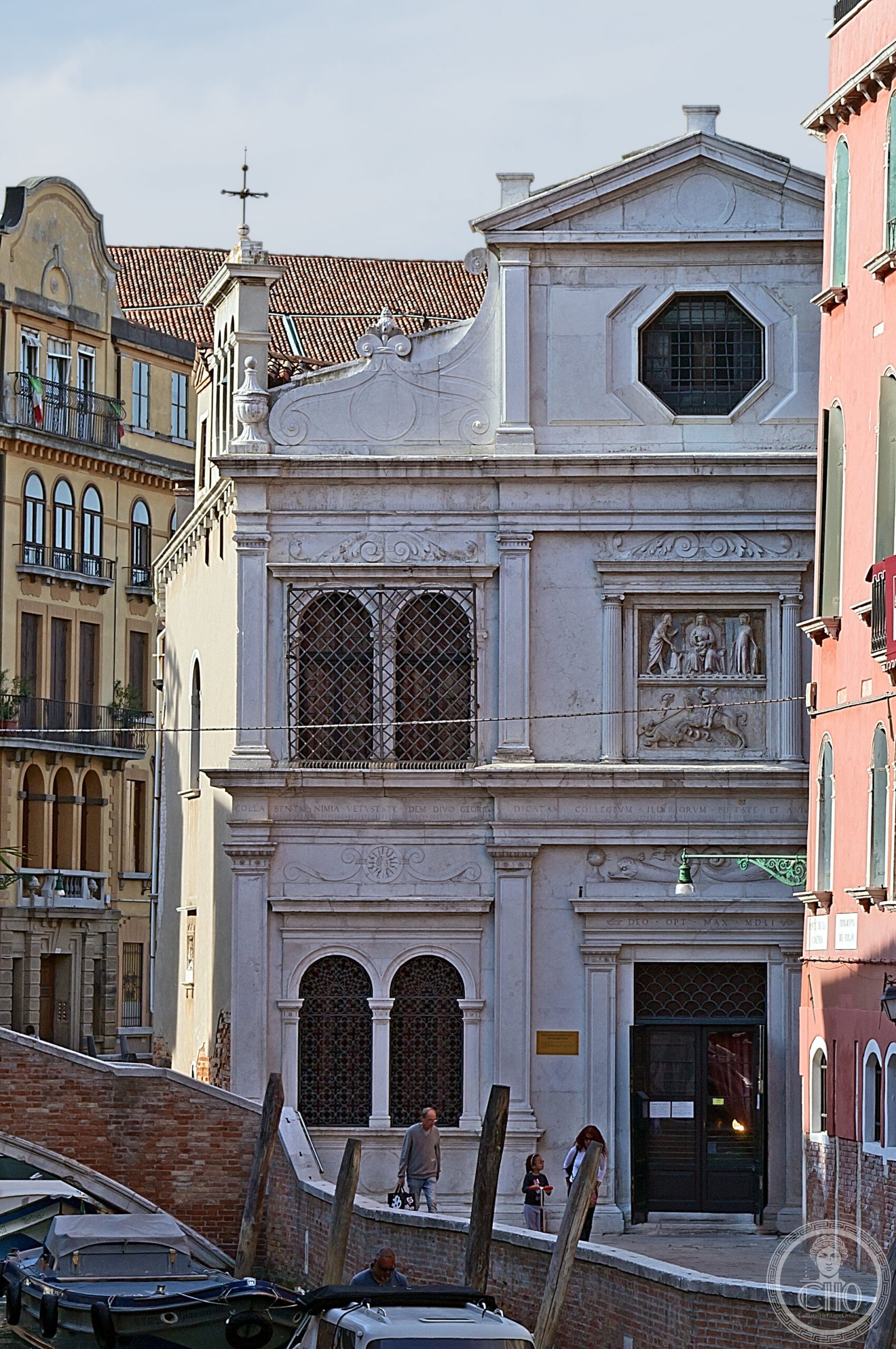
The Scuola di San Giorgio degli Schiavoni is one of Venice’s most intimate and perfectly preserved scuole piccole, the confraternal meeting houses of the city’s trade and immigrant communities. Founded by the Dalmatian (Slavic) community of Venice in the fifteenth century, its ground-floor hall contains one of the greatest cycles of narrative Renaissance painting in existence: nine canvases by Vittore Carpaccio depicting the lives of Saints George, Tryphon, and Jerome, executed between approximately 1502 and 1508.
At a glance
- Type
- Dalmatian confraternity building and Carpaccio painting cycle museum
- Period
- Confraternity founded 1451; present building 1551; Carpaccio cycle 1502–1508
- Style
- Venetian Renaissance
- Location
- Calle dei Furlani, Castello, Venice, Italy
- Coordinates
- 45.4362° N, 12.3438° E
Overview
The Scuola di San Giorgio degli Schiavoni in Venice, northern Italy, was one of the city’s confraternities — a scuola piccola located in the sestiere of Castello. Its building has been preserved in a near-intact state, making it exceptionally rare among Venice’s many historic institutions. The interior is celebrated above all for Carpaccio’s painting cycle, which remains in its original setting, allowing visitors to experience the works exactly as the Dalmatian brotherhood intended.
History
Dalmatian sailors and merchants had long formed one of Venice’s most important immigrant communities, given the Republic’s dominion over much of the eastern Adriatic coast. They were granted permission to establish their own confraternity, dedicated to Saints George, Tryphon, and Jerome — patron saints of their homeland — in 1451. The confraternity commissioned Vittore Carpaccio to paint a narrative cycle for the upper hall around 1502, and when the building was reconstructed in 1551 the paintings were moved to their present ground-floor position. The brotherhood survived the fall of the Republic of Venice in 1797 and continues to maintain the building today, now open as a museum.
What you see
The ground-floor hall is wrapped on three sides by Carpaccio’s nine large canvases, whose vivid narrative scenes — St George slaying the dragon on a field strewn with human remains, St Augustine interrupted at his desk by a divine vision, the Baptism of the Selenites — combine theological symbolism with extraordinary documentary detail about dress, animals, and architecture of the early sixteenth century. The warm light filtering through the hall’s small windows, the original dark wooden benches, and the smell of old timber create an atmosphere of extraordinary intimacy. Upstairs, a small sacristy contains additional paintings, reliquaries, and archival documents of the brotherhood.
Cultural significance
The Scuola di San Giorgio degli Schiavoni is unique in Venice for presenting a major artist’s painting cycle in its original, purpose-built setting, without any subsequent reorganisation. Carpaccio’s canvases here are widely regarded as the finest example of his mature narrative style, and the building is among the most completely preserved examples of a Venetian scuola piccola. For the Dalmatian diaspora, it also retains profound significance as a living symbol of the community’s historical presence in the Adriatic world.
Practical information
- Address
- Calle dei Furlani 3259/a, 30122 Castello, Venice, Italy
- Admission
- Small entrance fee; check official website for current rates
- Hours
- Check official website for current opening times; typically closed Mondays
Getting there
Take vaporetto line 1 or 2 to San Zaccaria; the scuola is approximately a ten-minute walk north through the Castello district via Campo San Provolo and Calle dei Furlani. Alternatively, line 4.1/4.2 stops at Arsenale, a five-minute walk to the south.
Sources & resources
See the place
Find it on the map
See this place and what’s around it →📷 Become a Cultural Heritage Online photographer
Share your photos of places: they stay published under your name as the author. The more they're seen, the more you get noticed — and soon a contest will reward the most appreciated photos.
Log in or sign up free to add a photoIs this page about you?
This page is read by travellers and heritage enthusiasts who find it on Google. Tell us how you are connected to this place and we will take it from there.