
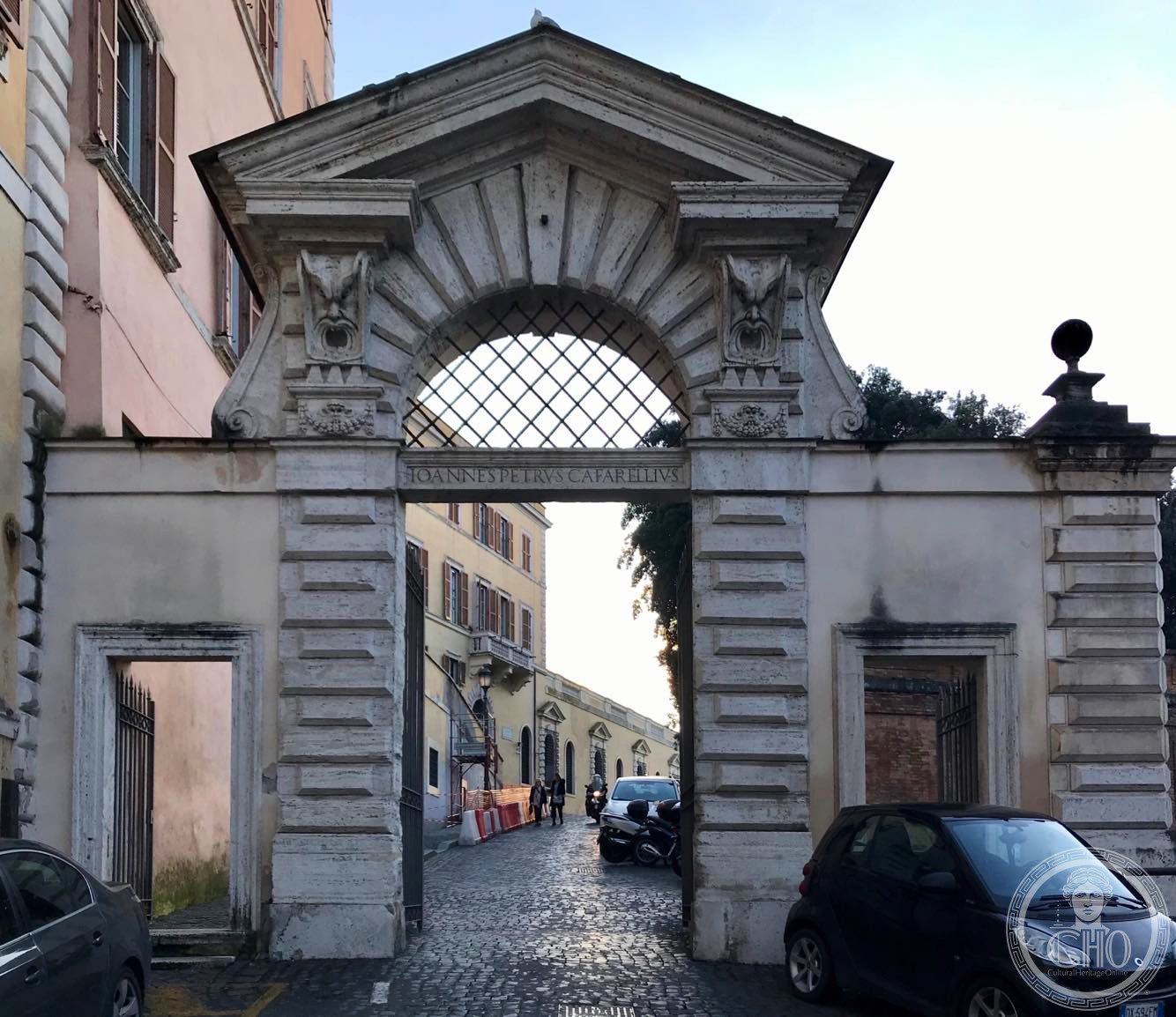
The Caffarelli Palace is a 16th-century noble residence built on the southern summit of the Capitoline Hill in Rome, on the site of the ancient Temple of Jupiter Optimus Maximus. Acquired by the German Empire in the 19th century as its Roman embassy, the palazzo was demolished in 1926 to allow the expansion of the Capitoline Museums and the construction of the Museo Nuovo Capitolino; only its tower survives as part of the museum complex.
At a glance
- Type
- Noble palace (partially demolished); integrated into museum complex
- Period
- Built c. 1550s for the Caffarelli family; demolished 1926
- Style
- Roman Renaissance; surviving tower incorporated into Capitoline Museums
- Location
- Campidoglio (Capitoline Hill), Rome, Italy
- Coordinates
- 41.8930° N, 12.4826° E
Overview
The Caffarelli Palace occupied the Arx, the southern of the two summits of the Capitoline Hill, directly above the ruins of the ancient Temple of Jupiter Optimus Maximus — the most sacred precinct of ancient Rome. The palace passed through several aristocratic and diplomatic hands over the centuries before becoming the German Embassy under the Kingdom of Italy. It stood in an uneasy relationship with the Capitoline Museums complex that flanked it, and its partial demolition in the 1920s allowed the museums to expand significantly.
History
The Caffarelli family, a powerful Roman noble clan, constructed the palace in the mid-16th century on land that had been in private hands since the medieval period, built directly over ancient foundations and spoil from the Temple of Jupiter excavations. In the 19th century the property was acquired by the Kingdom of Prussia and subsequently the German Empire, which used it as a consulate and then as the official German Embassy in Rome. The German archaeological polymath Johann Joachim Winckelmann had also spent time in Rome during the period when the area was subject to scholarly attention. After World War I and the end of German diplomatic tenure, the Italian state acquired the property, and in 1926 the main palace body was demolished to allow the Capitoline Museums to incorporate the site.
What you see
Today the Caffarelli tower — the medieval-Renaissance tower that formed part of the palace complex — survives as a distinctive element at the southern edge of the Capitoline Museums. From its terraces and from the adjoining museum rooms visitors enjoy panoramic views over the Roman Forum, the Circus Maximus, and the Palatine Hill. Beneath the site, archaeological excavations over the past century have progressively revealed the monumental podium of the Temple of Jupiter Optimus Maximus, fragments of which are on display in the Capitoline Museums.
Cultural significance
The site of the Caffarelli Palace sits at the convergence of Rome’s most sacred ancient precinct and a history of aristocratic, diplomatic, and imperial occupation that spans a millennium. The ongoing archaeological investigation of the Temple of Jupiter beneath the former palace grounds represents one of the most symbolically charged excavation projects in Rome. The surviving tower and its integration into the Capitoline Museums preserves a physical link to the layered history of the Campidoglio.
Practical information
- Address
- Piazza del Campidoglio 1, 00186 Rome, Italy (Capitoline Museums)
- Access
- Accessible as part of the Capitoline Museums complex; paid admission
Getting there
The Capitoline Hill is accessible from Piazza Venezia at the foot of the Vittoriano monument, a short walk up the cordonata ramp designed by Michelangelo. Bus lines 40, 44, 63, 64, 85, 117, and many others stop at Piazza Venezia. The nearest metro stations are Colosseo (line B, about 10 minutes on foot) and the area is well served by tram line 8 from Trastevere.
Sources & resources
See the place
Find it on the map
See this place and what’s around it →Historical events at this place (1)
📷 Become a Cultural Heritage Online photographer
Share your photos of places: they stay published under your name as the author. The more they're seen, the more you get noticed — and soon a contest will reward the most appreciated photos.
Log in or sign up free to add a photoIs this page about you?
This page is read by travellers and heritage enthusiasts who find it on Google. Tell us how you are connected to this place and we will take it from there.