

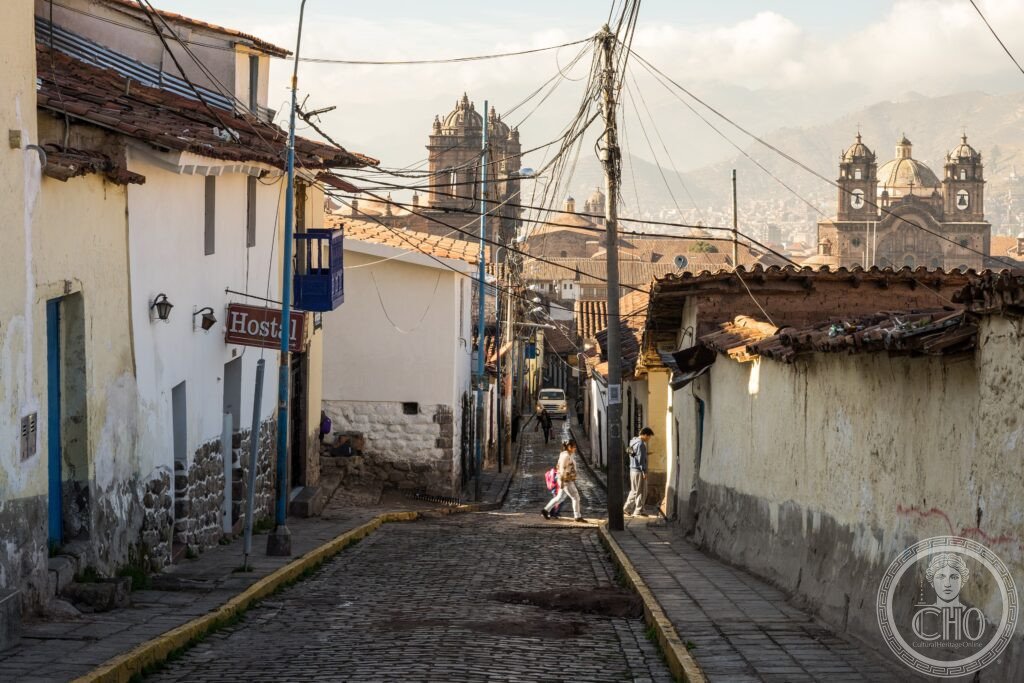
Cusco — Navel of the World
The capital of the most powerful empire in pre-Columbian America and the city where two civilisations collided so dramatically that their fusion is still visible in every street — Cusco, set at 3,400 metres in a valley of the Peruvian Andes, built the most extensive road network and the most precisely engineered stone architecture in the pre-Columbian world, and was then systematically overlaid by Spanish colonial architecture on top of Inca foundations that outlasted the buildings placed upon them.
At a glance
Cusco (Qosq’o in Quechua: “the navel of the world” — the most precisely cosmological single city name in the Americas; UNESCO WHS 1983 as the “City of Cusco”; the Inca Empire capital (the most road-networked single ancient empire in the Americas: the Inca road system covered 40,000 km — the most extensively road-networked single pre-modern empire in the Western Hemisphere; no wheeled vehicles and no draught animals — the most precisely human-and-llama-powered single imperial infrastructure in the Americas); the altitude (3,400 m above sea level — the most altitude-challenged UNESCO World Heritage city accessible by major airport in South America; altitude sickness is a real risk (described in Practical section)); the Inca stonework (the most precisely earthquake-resistant single construction technique in the Andes: the polygonal stone walls of Cusco (no mortar; the stones are fitted so precisely that a credit card cannot be inserted between them — the most precisely toleranced single ancient masonry in the Americas; the walls survived the 1650 Cusco earthquake that destroyed the Spanish colonial buildings built on top of them — the most precisely seismic-performance-demonstrating single heritage disaster in South American history)).
Key facts
- Sacsayhuamán: the most massive single pre-Columbian monument complex in South America — Sacsayhuamán (the most commonly mispronounced single UNESCO monument in the Americas: pronounced roughly “sexy woman” by English-speaking guides — the most consistently tourism-joked single Quechua place name; the scale (6 million tonnes of stone — the most precisely weighed single pre-Columbian monument complex in South America; the largest stones (the most precisely heavy single stone blocks in any pre-Columbian structure: some blocks weigh up to 360 tonnes and were transported 35 km from the quarry — the most precisely distance-hauled single ancient Peruvian stone without wheeled vehicles or draft animals; the most precisely hydraulic-ram-analogised single ancient construction method: archaeologists believe the stones were moved on roller-sledges pulled by thousands of workers)); the three zig-zag walls (the most precisely defensive-pattern single ancient Peruvian wall design: the three parallel zig-zag terraces rise 18 m above the Cusco valley floor — the most precisely terrace-height single pre-Columbian military structure in South America); the Inti Raymi festival (the most spectacular single Andean festival re-enactment: the Festival of the Sun, performed each year on 24 June at Sacsayhuamán — the most precisely equinox-adjacent single Andean festival; 200,000 spectators annually — the most attended single ancient-ritual re-enactment in South America))
- Qorikancha — the Temple of the Sun: the most gold-decorated single building in the history of the Americas — Qorikancha (the most precisely gold-stripped single Inca temple: the interior walls were originally covered with 700 solid gold panels, each weighing 2 kg (the most precisely gold-panel-counted single room in any ancient American temple; the Spaniards removed all the gold — the most precisely complete single looting event in the history of Andean heritage); the surviving Inca stonework (the most precisely coursed single Inca masonry in Cusco: the walls of Qorikancha show the highest quality Inca stonework in the entire city — the most consistently cited single example of Inca ashlar masonry by architectural historians); the Dominican conversion (the most dramatically overlaid single Inca building: the Church of Santo Domingo was built directly on Qorikancha’s foundations (1650 earthquake: the Spanish building collapsed; the Inca walls remained intact — the most precisely earthquake-vindication single moment in Andean heritage))
- The Hatun Rumiyoc 12-sided stone: the most precisely fitted single stone in the history of Andean architecture — the 12-sided stone (the most photographed single stone in any Inca wall: the stone in the wall of the former palace of Inca Roca on Hatunrumiyoc Street — the most precisely tourist-photographed single ancient stone face in South America; 12 angles, all fitting seamlessly with the surrounding stones (the most precisely multi-angled single ancient masonry joint in any Peruvian wall — the most consistently cited single example of Inca polygonal masonry in any archaeology textbook))
- Heritage: UNESCO World Heritage Site, City of Cusco, inscribed 1983
- GPS: -13.5170° S, -71.9780° W
History
The Inca founding (Manco Cápac is traditionally credited with founding Cusco around 1200 CE — the most precisely mythologically dated single Inca city foundation; the most precisely clan-origin-story-associated single Andean city: the myth of Manco Cápac and Mama Ocllo emerging from Lake Titicaca is the most consistently taught single Inca origin story in any Andean education system); the imperial expansion (Pachacuti Inca Yupanqui (1418–1471 CE) — the most personally empire-building single Inca emperor: he transformed Cusco from a small kingdom into an empire stretching 4,300 km from Colombia to Chile — the most precisely length-measured single pre-Columbian empire in the Americas; under Pachacuti, Cusco was redesigned in the shape of a puma (the most precisely zoomorphically planned single pre-Columbian capital city — the head of the puma was Sacsayhuamán, the body was the urban core)); the Spanish conquest (Francisco Pizarro entered Cusco in November 1533 — the most consequentially timed single Spanish conquest entry in South American history: he arrived just as the Inca civil war was ending; the most precisely executed single Inca emperor: Atahualpa was strangled in Cajamarca in 1533 despite paying the most precisely measured single ransom in the history of empire (a room filled with gold once plus silver twice — the most precisely spatially quantified single ransom demand in world history)); UNESCO WHS 1983.
What you see
The visit (the most architecturally layered single city walk in South America: every street in Cusco shows the Inca-Spanish overlay — the Inca stone foundations at street level, the colonial Spanish buildings above them; the most strongly recommended single Cusco walk: Hatunrumiyoc Street → Qorikancha → Plaza de Armas → Cathedral; the essential sequence: Plaza de Armas (the most atmospherically colonial single central square in the Americas: the Cathedral + La Compañía de Jesús + stone arcades; evening is the most dramatically lit single Andean heritage square — the floodlit Cathedral facade against the dark Andean sky)); Sacsayhuamán (4 km uphill from Plaza de Armas; taxi or 45-min walk; best at dawn — the most precisely light-angled single Inca monument at sunrise: the zig-zag walls cast the most dramatically shadow-striped single stonework at low morning light); Qorikancha (described in Key Facts; combined ticket with the on-site museum — the most precisely Inca-wall-to-Spanish-church single interior juxtaposition in the Americas)); the Sacred Valley (the most essential single Cusco day-trip: described in Practical section).
Practical information
- Getting there and altitude: Cusco Alejandro Velasco Astete Airport (CUZ; 5 km south of Plaza de Armas — the most altitude-challenging single commercial airport arrival in South America: at 3,429 m, many passengers feel altitude effects immediately upon landing; the most strongly medically recommended single heritage destination protocol: spend at least 2 days in Cusco acclimatising before visiting Machu Picchu (described in Nearby section); Diamox (acetazolamide) prevents altitude sickness if taken 2 days before arrival — the most precisely pharmaceutical single heritage visit preparation protocol in South America; coca tea (the most precisely traditional single altitude-remedy drink in any Andean city: available everywhere in Cusco; legal in Peru — the most consistently altitude-remedy single beverage in any UNESCO heritage city in the Andes))
- The Boleto Turístico: the most comprehensively Cusco-covering single heritage ticket — the Boleto Turístico de Cusco (the most consolidated single entry ticket in South American heritage tourism: one ticket covers 16 sites including Sacsayhuamán, Qenko, Puca Pucara, Tambomachay, and the outlying Inca sites of the Sacred Valley; validity: 1 day (partial, 8 sites) or 10 days (full); available at COSITUC offices or at major sites; does NOT include Machu Picchu (the most frequently confused single ticketing exclusion in South American heritage tourism))
- The Sacred Valley (Valle Sagrado del los Incas): the most Inca-saturated single day-trip in South America — the Sacred Valley (the most precisely Urubamba River-valley-defined single Inca heritage corridor: 75 km from Pisac to Ollantaytambo, 2,700–3,200 m altitude; the key sites: Pisac (the most impressively terraced single Inca agricultural complex still visible from a valley floor: the terraces of Pisac cover 40 km² of hillside — the most precisely farmed single Inca slope in the Sacred Valley; the Sunday market is the most colorful single Indigenous market in Peru (the most precisely artisan-textile single market in any Inca heritage town)); Ollantaytambo (the most perfectly intact single Inca town in the Americas: the street grid of Ollantaytambo is the same as it was in the 15th century — the most precisely unchanged single pre-Columbian urban grid in the Americas); the departure point for the Machu Picchu train (the most frequently photographed single heritage train departure in South America))
Getting there
Fly to Cusco Alejandro Velasco Astete Airport (CUZ; 5 km from Plaza de Armas; 1h from Lima). Acclimatise 2 days minimum. Buy the Boleto Turístico (16 sites, 10-day validity) at COSITUC offices. GPS: -13.5170, -71.9780.
Nearby
- Machu Picchu (UNESCO WHS 1983) — 112 km north-west (train from Ollantaytambo or Cusco Poroy: 1h 30min–3h 30min + bus 25min); the most iconic single pre-Columbian heritage site in the Americas — the most frequently photographed single Inca ruin; strict daily visitor limits (from 2023: max 4,044 visitors/day in 4 time slots of 2h each — the most precisely controlled single UNESCO site access in South America; book 3–6 months in advance in high season)
- The Sacred Valley (Valle Sagrado) — 15–75 km from Cusco (organised day-trip or hire car); Pisac terraces + market + Ollantaytambo intact Inca town — described in Practical section
- Lake Titicaca (Peru/Bolivia border) — 390 km south (5h bus from Cusco to Puno); the most altitude-high single navigable lake in the world (3,812 m — the most precisely altitude-measured single lake in South American heritage tourism); the Uros floating islands (the most precisely reed-constructed single inhabited islands in the Americas: the Uros people have lived on floating reed islands for over 500 years — the most continuously reed-inhabited single UNESCO-adjacent site in the Americas)
Sources
- Wikipedia, Cusco; Sacsayhuamán; Qorikancha; Inca Empire, accessed June 2026
- UNESCO, City of Cusco, WHS reference 273, inscribed 1983
- John Hemming, The Conquest of the Incas, Harcourt, 1970
Find it on the map
See this place and what’s around it →📷 Diventa un fotografo di Cultural Heritage Online
Condividi le tue foto dei luoghi: restano pubblicate con la tua firma come autore. Più vengono viste, più ti fai conoscere — e presto un concorso premierà le foto più apprezzate.
Accedi o registrati gratis per aggiungere una foto